Single-vendor vs multi-vendor BTL campaign management: 2026 decision framework
2 min read

Nothing about the ₹15,000 to 20,000 crore annual leak from unverified BTL execution required a single dishonest decision by anyone. It required only the gradual acceptance of small deviations, repea
"This is normal"
The three words at the centre of the largest invisible accountability gap in Indian marketing. The cultural reset starts with refusing to accept them.
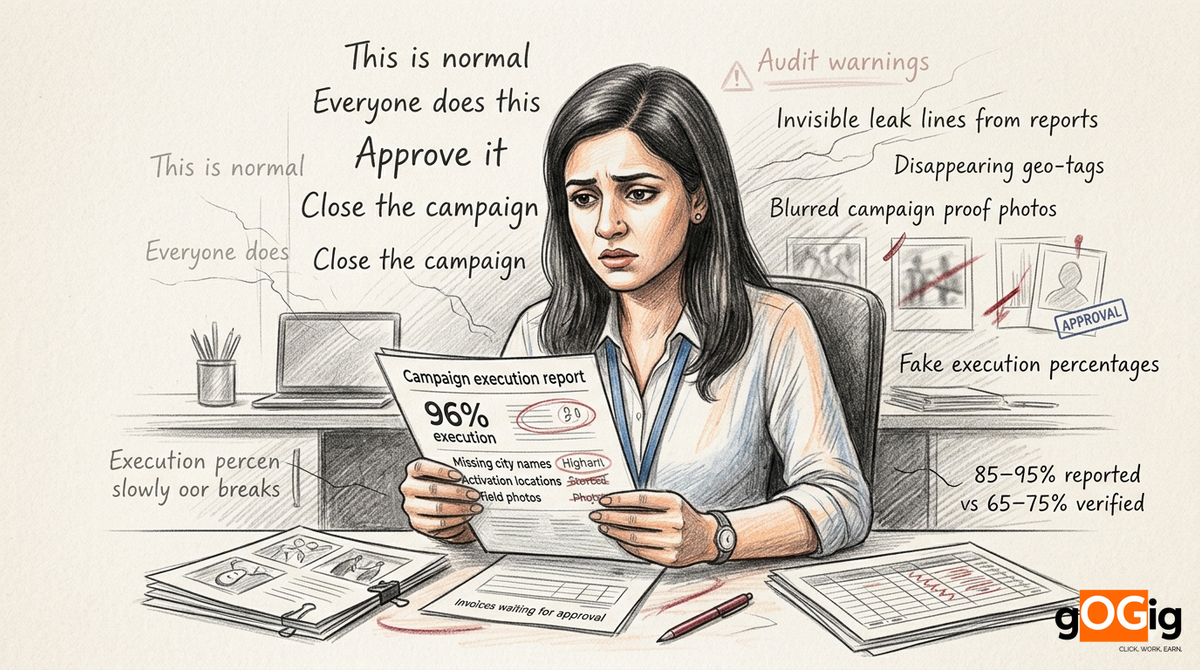
A new brand manager joins one of India's largest FMCG companies. In her second week, she notices that the agency report on a recently closed sampling campaign shows 96% execution, but the regional sales head mentions in passing that two of the listed cities never received the activation at all. She raises it. The senior manager beside her smiles and says, "Welcome to BTL. This is normal." Six months later, she stops raising it.
The sociologist Diane Vaughan studied the 1986 Challenger space shuttle disaster and produced one of the most cited concepts in organisational psychology. She called it the normalization of deviance. The term describes how, over time, groups inside organisations come to accept practices that would shock anyone outside the organisation, because the practice has happened repeatedly without an immediate visible consequence.
Her words apply directly to Indian BTL execution. Replace "space shuttle" with "wall painting campaign," replace "engineers" with "brand managers," replace "O-ring failure" with "ghost activation," and the framework fits.
Vaughan and the researchers who built on her work catalogued the four phrases people use to defend deviance once it has become normalised. Brand managers across India will recognise each one immediately.
"The rules are stupid and inefficient"
The rule that field execution should be independently verified gets dismissed as impractical. Workarounds become standard.
"Knowledge is imperfect"
People do not know what good verification looks like, so they cannot recognise when their workflow falls short of it. The deviation persists because the standard is invisible.
"I'm doing this for a good reason"
Procurement runs the legacy workflow because changing it would slow the next campaign. Marketing accepts the existing reports because escalating disputes would damage agency relationships. Each individual rationalisation is reasonable. The cumulative outcome is not.
"People are afraid to speak up"
Junior team members notice the gap. Senior team members have made peace with it. The reward for surfacing the problem is being labelled difficult. The reward for staying quiet is fitting in.
Every one of these four phrases shows up verbatim in Indian BTL teams. The "this is normal" problem is not unique to India. The scale at which it operates here is.
The clearest way to identify normalised deviance is to listen to the language people use. The phrases below appear in BTL agencies, brand teams, and procurement conversations across India every day. Each one is a fossil of the cultural drift that produced the gap.
What they mean: Everyone in the industry operates this way, so it cannot be wrong.
What it actually means: The industry has collectively agreed not to question a workflow that costs it ₹15,000 to 20,000 crore annually.
What they mean: Some shortfall is unavoidable in on-ground campaigns. Live with it.
What it actually means: The 20–30% of spend that disappears into unverified execution has been reclassified as "noise" so the brand does not have to take action on it.
What they mean: The proof is in.
What it actually means: The party that executed the work has self-certified the work. The brand has accepted the self-certification as evidence.
What they mean: Asking deeper verification questions is naive.
What it actually means: A senior person has decided that the existing workflow is permanent, and the junior asking the question should stop.
What they mean: It is not worth the effort to fix.
What it actually means: This was true until 2024. It is no longer true in 2026. The phrase persists because nobody updated the underlying assumption.
What they mean: Some execution is better than none.
What it actually means: The brand has accepted partial execution as a successful outcome to avoid the conflict of acknowledging the shortfall.
What they mean: Competitors face the same issues, so the playing field is even.
What it actually means: The category-wide acceptance of the gap is the precise reason the gap has persisted. Universal participation is not validation.
What they mean: The report says 92% execution, which is acceptable.
What it actually means: The numbers look fine because they were produced by the party with the incentive to produce numbers that look fine.
Refuse normal. See what verified looks like.
Run one campaign with full Field Execution Intelligence. See the specific gap between the agency report and the verified data. The first number you see ends the “this is normal” era for your brand.
Book a verification pilot →Normalisation does not arrive in a single day. It develops in stages, and each stage feels reasonable at the time. The progression below is what organisational psychology calls the "long incubation period" of deviance, applied to Indian BTL marketing.
The first deviation is noticed and excused
A campaign report shows 96% execution. A junior team member notices a clear gap between the report and the on-ground reality. The senior team member says, "We'll keep an eye on it this quarter."
The deviation produces no immediate consequence
The campaign closes. The invoice gets paid. No customer complains. No regulator audits. The brand manager who excused the gap learns that excusing it was the safe move. The lesson encodes.
The deviation is repeated and accumulated
More campaigns, more reports, more gaps. Each gap small enough that surfacing it feels disproportionate. The cumulative pattern is invisible to anyone in the chain because nobody is looking at the cumulative.
The deviation gets institutionalised
New brand managers join. Senior people teach them "how BTL works here." The deviant practice is now the curriculum. The standard has not just slipped, it has been overwritten.
The deviation becomes the brand's culture
Any new technology, vendor, or process that surfaces the gap is treated as an inconvenience, not a correction. The organisation now defends the deviance, because the deviance has become the operating model.
The unexpected becomes the expected, which becomes the accepted. The accepted then becomes the defended.
If you described the items below to a CFO or audit committee chair who was new to BTL, they would not believe the descriptions. Each one is treated as routine inside the industry. Each one is structurally absurd from outside it.
Photos accepted as proof without GPS or timestamp verification
If your finance team submitted invoices with no date and no destination, finance would reject them within an hour. BTL accepts the equivalent every day.
Reports written by the party being paid
In every other corporate function, the entity being audited cannot also be the auditor. BTL operates inside this conflict of interest as standard. Nobody flags it because everyone has stopped noticing it.
Vendor billing settled before execution is verified
If a logistics vendor invoiced your company for shipments you couldn't trace, the invoice would go through three escalation rounds before payment. BTL invoices go through procurement automation.
"Execution percentages" produced by the executor
No other channel in marketing accepts self-reported performance metrics. Digital has third-party analytics. TV has BARC. Print has ABC. BTL accepts the agency's self-report as the headline metric.
Discrepancies surfaced months after the fact
If your customer support response time was 8 weeks, the team would be restructured. BTL discrepancy resolution routinely takes 8 weeks and nobody blinks.
Multi-crore campaigns approved on PDF decks
If a CFO wanted to approve a ₹4 crore capex purchase based on a PowerPoint deck with no supporting evidence, the audit committee would intervene. ₹4 crore BTL spend is approved on PDF decks routinely.
WhatsApp groups as the audit trail of record
No serious enterprise function uses a messaging app as its evidence chain. BTL has used WhatsApp groups as the primary audit trail for a decade and accepts it as standard.
Trade scheme payouts on unverified distributor claims
If a salary system paid employees based on self-reported attendance with no verification, the system would not survive one audit cycle. Trade promotion schemes operate exactly this way at the FMCG distributor level, releasing crores annually.
The phrase "agency-reported execution" used in board decks
Boards reviewing marketing performance regularly see "85% execution" without anyone asking who calculated the 85%. The same boards would never accept "agency-reported revenue" or "agency-reported customer count."
The unspoken rule that surfacing the gap is career-limiting
Junior team members who flag discrepancies are not formally punished. They are informally discouraged. The discouragement is sufficient. After three quarters, they stop flagging.
Other markets have had marketing fraud, marketing waste, and marketing accountability gaps. India's normalisation runs deeper than most because of six specific structural conditions.
| Condition | How it accelerated normalisation |
|---|---|
| The physical economy is exceptionally large | ₹80,000 crore annual physical economy spend is bigger than most peer markets combined, providing more campaigns and more opportunities for the deviation to compound |
| The retail and trade structure is highly informal | 85% of FMCG flows through 13 million kirana stores. Verification at this scale was historically impossible, so the absence of verification became the accepted standard |
| The cost of verification exceeded the cost of the leak | For decades, third-party audits cost more than the inflation they would catch. Brands made the economically rational choice to live with the gap. Then the rational choice became the cultural default |
| Marketing accountability was siloed from finance | CFOs were not in the marketing accountability conversation. Without finance oversight, the gap stayed inside marketing's vocabulary of "execution noise" and never became a financial control issue |
| BTL agencies were rewarded for reporting, not for verifying | Agency contracts paid for execution, not for proof. The party with the most operational visibility had no incentive to surface gaps. The party with the most need for verification had the least operational visibility |
| The vocabulary itself was misleading | "Execution percentage," "campaign successful," "all locations covered" are phrases that sound like measurement but are actually claims. The language of BTL reporting borrowed the form of analytics without the substance |
Once a deviation becomes normal, its cost stops being calculated. It becomes part of the cost of doing business, which means it becomes invisible. The numbers below are what "normal" actually costs a typical Indian brand running BTL at scale.
| Cost dimension | Typical exposure | What it represents |
|---|---|---|
| Direct execution leak | 15–25% of BTL spend | Spend on activations that did not happen at the contracted scale |
| Scheme leakage on trade promotions | 12–18% of scheme budgets | Payouts against unverifiable distributor claims |
| Re-execution costs | 30–60% of original spend when fraud is detected late | The cost of redoing what should have been verified the first time |
| Decision contamination cost | Difficult to quantify, often larger than direct leak | Strategic decisions built on inflated execution data feeding incorrect budget allocation |
| Lost competitive advantage | Visibility shortfalls in tier-2 and tier-3 markets | Markets the brand believed it was active in but was not |
| Governance and assurance risk | Increasing under BRSR Core | Listed companies facing audit committee findings on marketing value chain accountability |
For a mid-size Indian brand, the cost of accepting "normal" runs to ₹3 to 8 crore annually. For a large enterprise brand, the cost runs to ₹50 to 200 crore. The cost is invisible because it has been classified as something other than cost.
Cultural resets do not happen through manifestos. They happen through specific decisions, made in specific meetings, by specific people, that visibly contradict the old normal. The five decisions below are how Indian brands have begun the reset.
Refuse to accept self-reported execution rates in board reviews
The simplest reset action. Boards stop reviewing "agency-reported execution percentages" and start asking for verified execution rates. The phrase change forces the data change.
Bring the CFO into the marketing accountability conversation
As long as marketing accountability sits inside marketing, the vocabulary of "execution noise" survives. When the CFO joins the conversation, the vocabulary shifts to financial control language and the gap becomes a measurable liability.
Add Proof Before Payment clauses to standard vendor contracts
The contractual change is the cultural change. Once payment is conditioned on independent verification, the deviance loses its commercial protection. Honest vendors welcome it. Vendors whose margins depended on the gap face compression.
Reward junior team members for surfacing discrepancies
The single highest-leverage intervention. The implicit incentive structure has rewarded silence. Reversing that incentive restructures the cultural drift that produced normalisation in the first place.
Adopt the new vocabulary deliberately
The phrase "verified execution rate" replaces "execution percentage." "Accountability gap" replaces "shortfall." "Ground Truth" replaces "the agency report." Language change is faster than process change and accelerates the rest.
A self-test for brand managers, agency leads, and finance teams. Each yes below indicates one stage of normalisation has occurred inside your organisation. Four or more yeses suggests the deviation has become institutionalised.
In the past 12 months, has anyone on your team said "this is normal" or "that's industry standard" when a BTL discrepancy was raised?
Are BTL execution rates reported to your board as agency-submitted numbers without independent verification?
Has a junior team member quietly stopped raising verification questions in the past two quarters?
Do you process BTL invoices based on PDF reports rather than verified execution data?
Does your procurement team treat verification capability as a "nice to have" rather than a contractual requirement?
Has the CFO not been involved in a BTL accountability conversation in the past quarter?
Does your marketing vocabulary still include "execution noise," "industry standard wastage," or "BTL is messy by nature"?
When agencies show 90%+ execution rates, does anyone ask who calculated the 90%?
Are trade scheme payouts released against distributor claims without independent verification?
Has your internal audit team flagged BTL spend in the past 12 months without anything systemic changing?
If you ticked four or more, the "this is normal" problem has institutionalised inside your brand. The reset is not impossible. It starts with a single campaign run differently.
Three forces have aligned in 2024–2026 to make the cultural reset commercially possible for the first time. Together, they remove the structural protections that allowed "this is normal" to persist.
The economics of verification have inverted
For decades, verification cost more than the leak. WhatsApp-native infrastructure, AI verification at submission, and the dropping cost of mobile inference have flipped the equation. Verification now costs a fraction of the leak it surfaces.
Regulatory pressure has reached marketing
SEBI's BRSR Core framework requires the top 1,000 listed Indian companies to disclose value chain accountability. Audit committees now flag unverified marketing spend as a governance weakness. The cost of "normal" now includes the cost of failed assurance.
Indian CMOs are not waiting for global precedent
For years, Indian buyers wanted global comparables before adopting new categories. That is no longer true. India's CMOs are increasingly comfortable being early adopters of categories that are largest in India.
The brands that have begun the reset describe specific changes in how they operate. The capability set below is what BTL accountability infrastructure looks like once "this is normal" has been retired.
Real-time visibility
Execution status visible as it happens, not at the end of the campaign. Gaps surface while the campaign window is still open.
Geo-verified proof
Every submission carries GPS coordinates validated at the moment of capture. Mock-location apps detected. Photo locations match contracted locations.
AI verification at scale
Duplicate detection, EXIF integrity checks, route reconstruction, and clustering analysis run automatically. Anomalies flagged before invoice approval.
Audit-grade evidence
Verification trails survive board reviews, internal audit, and BRSR Core assurance. Reports export as evidence with full chain of custody.
The opposite of "this is normal" is not "this is shocking." The opposite is "this is what verified execution looks like, and now it is the standard."
CFOs and audit committees stop receiving execution data they cannot substantiate
Procurement contracts include Proof Before Payment clauses as the new default
Brand managers spend 60–80% less time scrolling through campaign WhatsApp groups
Trade strategy stops running on inflated outlet databases
Sales forecasts calibrate against verified field coverage, not aspirational coverage
Junior team members feel safe surfacing discrepancies and are visibly rewarded for doing so
The phrase "this is normal" stops being used as a conversation-ender in internal meetings
Vendor competition shifts from rate cards to verification capability
Refuse normal. See what verified looks like.
Run one campaign with full Field Execution Intelligence. The number that comes back will not be the number your agency report shows. That gap is the cost of normal. It is also the start of the reset.
₹15,000–20,000 Cr
Annual leak from "normal"
40+
Years it has been accepted
30
Days to start the reset
Written by
gOGig Research
The gOGig Editorial team covers Field Execution Intelligence, BTL verification, and the future of India's physical marketing ecosystem.
Was this article helpful?
Your feedback helps us write better content.