Single-vendor vs multi-vendor BTL campaign management: 2026 decision framework
2 min read

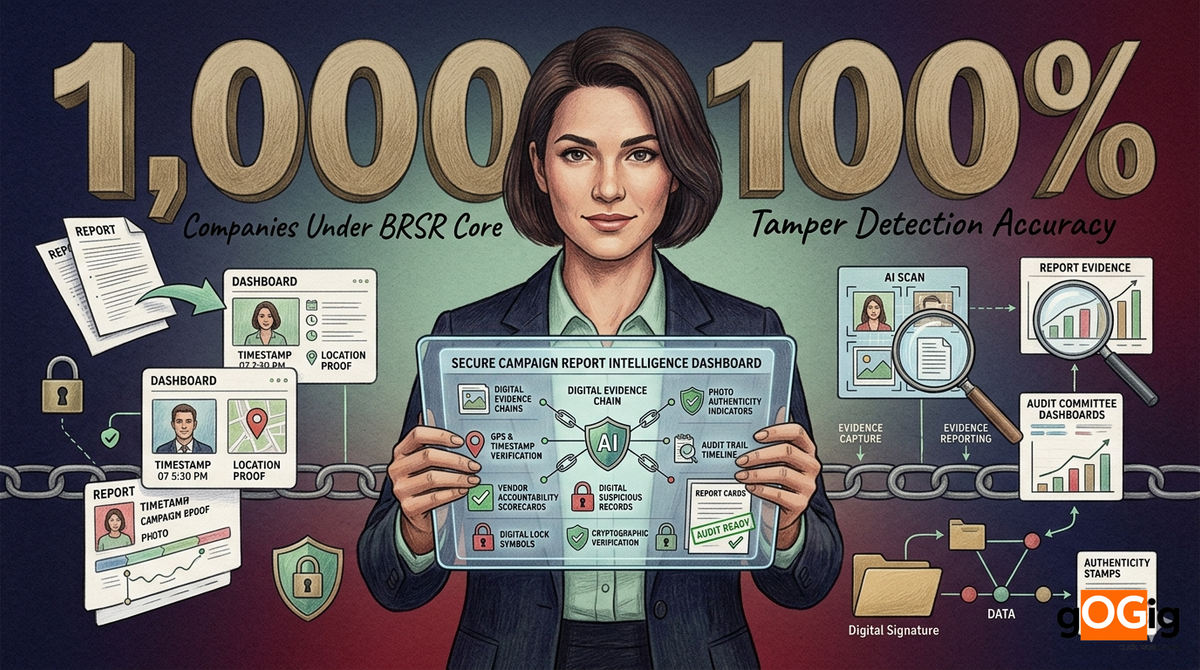
A practical 2026 audit-grade reporting playbook for trade marketing heads, BTL operations leads, brand managers, agency directors, and finance partners producing campaign reports for CMOs, audit committees, BRSR Core assurance, and CFO procurement reviews. Built around the 10-layer evidence architecture and the structured artifact replacing PPTs and PDFs with a verifiable, independently audit-able report.
15-20%
Higher investor engagement reported by Indian companies with robust ESG and audit-grade disclosures, per 2026 ESG research. The reporting frontier has shifted. CMOs no longer just present a PPT; they defend the evidence behind every number. A tamper-proof campaign report is no longer a design exercise. It is a board-grade artifact whose underlying data chain must survive third-party auditor scrutiny, BRSR Core assurance, and CFO procurement reconciliation.
A FMCG CMO has a Tuesday morning board review. Last quarter's marketing spend is on the agenda. ₹14 Cr across BTL, retail, OOH, and trade marketing. The audit committee chair asks a single question: "Can you walk us through the evidence behind these numbers?". The marketing director opens the closeout deck. 80 slides. Photos. City-wise summaries. Vendor sign-offs. The chair pushes further: "How do we know any of these photos were taken at the time and place the campaign was supposed to happen?". Silence. The deck shows installation. The chair is asking for authenticity. Six weeks later, the brand's third-party BRSR Core auditor sends a 12-page request: source data for marketing spend, evidence chain, timestamp authenticity, vendor accountability records. The deck cannot answer. This is the gap. The campaign happened. The report does not survive scrutiny. The CMO needs a tamper-proof report, not a beautiful one.
| Traditional report element | Why it is no longer enough |
|---|---|
| Vendor-submitted photo album | Photos can be from earlier campaigns, recycled, edited, or AI-generated |
| Excel campaign sheet | Data can be manually modified at any cell at any time; no audit trail |
| PPT closeout deck (80-slide) | Curated selection; not representative of execution reality |
| City-wise summary tables | Aggregated; per-asset evidence not traceable |
| Completion percentage | Self-reported; not independently verifiable |
| WhatsApp photo group archive | EXIF stripped (~89% on standard upload); timestamp ambiguous |
| Vendor invoice + delivery summary | Self-attestation; no proof of work underneath |
| Manager-signed approval form | Approval based on what was submitted, not what was verified |
| Sample audit selection (3-8%) | 92-97% of campaign not independently checked |
| End-of-campaign master spreadsheet | Built backwards from vendor reports; not forward from field |
Tamper-permissive (typical PPT/PDF)
Edited at any point by any person without trace. Photos selected by vendor or agency. Data entries can be manually altered. No timestamp authenticity. No identity verification of who submitted what when. Audit committee can ask questions; nobody can answer them with evidence. Survives boardroom but not auditor scrutiny.
Tamper-evident (2026 audit-grade)
Every data point links to a verifiable source event. Every photo carries SHA-256 + perceptual hash + edit-signature + EXIF. Every submission has server-side timestamp, 9-layer mock-location authenticity, face-matched identity. Every change is logged in audit trail. Modifications are detected automatically. Report can be reconstructed end-to-end from raw evidence. Survives BRSR Core reasonable assurance.
Geo-tagged evidence on every submission
Every asset photo carries GPS coordinates verified against the locked target location. Mock-location apps caught by 9-layer authentication.
Server-side timestamps on every event
Device clocks can be manipulated; server timestamps cannot. Every submission is anchored to authoritative time, independent of phone settings.
Live-capture photo enforcement
Gallery uploads disabled at app level. Photos must originate from camera at moment of capture. Eliminates the #1 source of fake evidence.
Cryptographic image fingerprinting
SHA-256 hash + perceptual hash + edit-signature detection. Catches exact duplicates, near-duplicates, Photoshopped images, AI-generated images.
Identity-verified field force
Face-match + Aadhaar identity check at field worker login. Catches substitute submission and buddy-punching at source.
Continuous audit trail
Every event (task assigned, submission created, GPS captured, AI verified, approval, modification) is logged with who/what/when in an immutable sequence.
Evidence chain of custody
Each piece of evidence carries provenance metadata from creation through transformation to report inclusion. Nothing arrives in the report without traceable origin.
AI fraud detection at scale
Manual review cannot scale beyond 5-8% of submissions. AI checks 100% for duplicates, anomalies, suspicious patterns, mock-location, edit signatures.
System-generated reports (no manual transcription)
Report PDFs, dashboards, and Excel exports generated directly from verified data without manual intervention. Eliminates manual modification risk.
7-year structured retention + auditor-grade access
Evidence stored in immutable structured retention for at least 7 years. BRSR Core, statutory auditor, CFO procurement can access source records on demand.
| Step | What happens |
|---|---|
| [1] Campaign task created | Brand HQ defines task: Wall painting at coordinates 12.9716°N, 77.5946°E, creative variant FMCG-2026-A |
| [2] Task assigned to vendor + painter | Painter ID + Aadhaar locked; assignment timestamped |
| [3] Field execution begins | Painter logs in via face-match + Aadhaar verification |
| [4] Geofenced capture | GPS coordinates within 25-50m of target; 9-layer mock-location verified |
| [5] Live photo captured | Camera-only (gallery disabled); EXIF preserved; server-side timestamp |
| [6] Cryptographic fingerprinting | SHA-256 + perceptual hash + edit-signature generated |
| [7] AI verification engine | 14 models: photogrammetry, creative match, duplicate detection, anomaly check |
| [8] Approval workflow | Supervisor or auto-approval (per rule); modification logged |
| [9] Aggregation into campaign data layer | Per-asset records flow into per-city, per-vendor, per-campaign rollups |
| [10] System-generated report | PDF / Excel / dashboard generated directly from verified data; no manual transcription |
| [11] 7-year retention | Audit-grade evidence pack stored in immutable structured retention; API-accessible for auditors |
| Per-asset submission field (example: 1 wall painting submission) | Value |
|---|---|
| Asset ID | WP-247 |
| Task ID | CAMP-Q2-WP-BLR-247 |
| Painter ID + Aadhaar | PNT-8492 / Face-match: PASS |
| Server timestamp | 2026-05-17 11:42:18.382 IST |
| Device timestamp | 2026-05-17 11:42:16 IST |
| Clock-skew check | PASS (within ±3 sec) |
| GPS coordinates | 12.97162°N, 77.59461°E |
| Target coordinates | 12.97168°N, 77.59459°E (8m away) |
| Geofence check | PASS (within 25m) |
| 9-layer mock-location | PASS (no spoofing detected) |
| Photo capture mode | CAMERA (gallery disabled) |
| EXIF metadata | PRESERVED |
| SHA-256 hash | a7f8b3e9c2d1...782f4a |
| Perceptual hash | d72a91f8...3b4e |
| Edit-signature | PASS (no manipulation) |
| Cross-asset duplicate | PASS (no match in DB) |
| Cross-campaign duplicate | PASS (no match in 12-month history) |
| AI photogrammetry area | 102.3 sq ft (claimed: 100 sq ft) |
| Creative match | PASS (matches FMCG-2026-A variant 96%) |
| Owner consent OTP | PASS (OTP verified to +91-9X-X-X-456) |
| Final verification status | VERIFIED |
| Audit-grade evidence pack | Retained until 2033-05-17 |
Coverage questions
What was completed across the campaign? · Where was it completed (per city, per zone, per pincode)? · Which planned assets remain pending or missed? · Is coverage balanced or concentrated?
Verification questions
Was each asset GPS-verified within geofence? · Was each photo captured live, not from gallery? · Was each submission timestamp-verified? · Was each field worker face-matched at submission?
Fraud questions
Were any duplicate submissions detected and removed? · Were any mock-location attempts caught? · Were any edited or AI-generated images flagged? · Were any cross-campaign photo re-uses identified?
Performance questions
Which city performed best per cost and per coverage? · Which vendor performed best / worst? · Where is visibility retention strongest? · Which zones underperformed and why?
Financial questions
What percentage of total billing is independently verified? · What is the unverified spend exposure? · What is the RoVE (Return on Verified Execution)? · Can this report defend procurement audit + BRSR Core assurance?
Audit committee questions
Is the evidence chain traceable end-to-end? · Are all underlying records retained for 7 years? · Has the report been independently verified? · Are anomalies flagged and reconciled?
Move from PPT reports to audit-grade verified evidence
Free 30-Day Verification Challenge on one live campaign. Per-asset evidence chain, 9-layer mock-location detection, AI image authentication, server-side timestamp, identity-verified field force, continuous audit trail, system-generated reports. Audit-grade evidence pack for CMO, audit committee, BRSR Core assurance, and CFO procurement review. 100% verification accuracy. 100% fraud detection rate.
Request a tamper-proof reporting pilot →| Report section | What it contains |
|---|---|
| Executive Summary | VER, VAR, VRS, RoVE per city + network composite |
| Campaign Health Score | Single composite (0-100) summarising all verification layers |
| Coverage Section | Verified asset count by city, zone, pincode; coverage heatmap; per-zone density |
| Verification Section | Per-asset breakdown of geofence + timestamp + identity + photo authenticity rates |
| Fraud Detection Section | Mock-location flags, duplicate detection, edit-signature catches, cross-campaign re-use |
| Per-vendor Scorecard Section | Tier A+ to D classification, per-vendor VER, drive-by rates, renewal recommendation |
| Lifecycle Section (for long campaigns) | Day 30 / 60 / 90 visibility retention audits |
| Financial Defensibility Section | Total invoice, verified billing %, unverified hold, RoVE calculation, PBP score |
| Audit Trail Appendix | End-to-end evidence chain per asset (server timestamps, hashes, identity records) |
| BRSR Core / ESG Disclosure Appendix | Auditor-ready evidence pack with API access |
| System-Generated Verification Certificate | "Verified by gOGig" stamp with cryptographic signature |
| Component layer | Score | Weight |
|---|---|---|
| Geo-verification rate | 97.7% | 15% |
| Photo authenticity rate | 99.4% | 15% |
| Identity verification rate | 98.6% | 10% |
| Verified Execution Rate (VER) | 93.9% | 15% |
| Verified Area Rate (VAR) | 93.7% | 10% |
| Visibility retention (Day 90) | 87.2% | 15% |
| Creative compliance rate | 96.0% | 10% |
| Audit pass rate (10% random sample) | 94.1% | 10% |
| Composite Campaign Health Score | 94.6 / 100 | — |
| BRSR Core / auditor expectation | How tamper-proof FEI report satisfies it |
|---|---|
| Data traceable to source records | Every report number links to per-asset audit trail |
| Independently verifiable using recognised standards | 9-layer mock-location + SHA-256 + perceptual hash + face-match are recognised technical standards |
| Measured consistently across periods | Same verification engine runs across all campaigns; methodology consistency |
| Clear data ownership across functions | Identity-verified submission + chain of custody documents ownership |
| Complete documentation | Per-asset 22-field evidence pack retained 7 years |
| Auditor-grade evidence chain | End-to-end from task creation through verified submission to system-generated report |
| Reasonable assurance support | API access for assurance providers (BSI, KPMG, EY, PwC, DNV) |
| Top 250 → top 1,000 readiness by FY 2026-27 | Designed for audit-grade marketing spend disclosure |
| Value chain ESG disclosure (FY 2025-26) | Per-vendor scorecard supports value chain partner reporting |
| 2-year minimum retention (often 7-year) | Default 7-year structured retention |
| Approach | What it guarantees | 2026 maturity in India BTL |
|---|---|---|
| Tamper-permissive (PPT, Excel) | None | Default in legacy operations |
| Tamper-resistant (locked PDF, signed reports) | Harder to edit; not impossible | Common; meets boardroom but not auditor bar |
| Tamper-evident (SHA-256 + perceptual hash + edit signature) | Modifications detected automatically; integrity verifiable | Best practice 2026; gOGig FEI standard |
| Tamper-proof (cryptographic chain + structured retention) | Modifications detected and provably attributed; audit-grade | Emerging in regulated sectors |
| Blockchain-anchored (distributed ledger) | External cryptographic proof of timestamp and integrity | Niche; used in supply chain provenance (Tech Mahindra + StaTwig vaccine ledger) |
| Annual marketing spend | Verification cost (gOGig) | Avg leakage prevented | Audit-grade benefit |
|---|---|---|---|
| ₹5 Cr (mid-size brand) | ₹6-12 L | ₹40-90 L | BRSR Core ready |
| ₹15 Cr | ₹15-28 L | ₹1.2-2.5 Cr | BRSR Core + CFO procurement ready |
| ₹50 Cr (large national) | ₹40-75 L | ₹4-8 Cr | BRSR Core + audit committee defensible |
| ₹150 Cr (national + regional) | ₹1.2-2.2 Cr | ₹10-22 Cr | BRSR Core + ESG disclosure + investor relations |
| ₹500 Cr+ (enterprise FMCG / paint / cement) | ₹4-8 Cr | ₹35-75 Cr | Top 250 BRSR Core mandatory readiness |
| Dimension | Manual PPT / PDF report | gOGig tamper-proof report |
|---|---|---|
| Evidence coverage | 3-8% sample | 100% of submissions |
| Modification detection | None | 100% (SHA-256 + audit trail) |
| Photo authenticity verification | ~3% manual review | 100% AI |
| Geo-verification | ~78% | 100% (9-layer) |
| Server-side timestamp authenticity | None | 100% |
| Identity-verified submission | ~5% | 100% (face-match + Aadhaar) |
| Cross-campaign duplicate detection | ~0% | 100% (12-month hash history) |
| Edit / AI-image detection | ~0% | 100% |
| End-to-end evidence chain | Manual reconstruction (weeks) | API-accessible (seconds) |
| Audit committee defensibility | Low | High |
| BRSR Core assurance readiness | Manual exercise | API-ready |
| Retention | Manual folders | 7-year structured immutable retention |
| Time to produce report | 2-6 weeks manual | Real-time, on-demand |
| Year-1 ROI | Baseline | 5-15x |
The most important question a CMO faces in 2026 is no longer "can you show me the report?". It is "can you prove that every number, image, location, and completion claim inside the report is authentic, traceable, and survives independent audit?". The PPT meets the meeting. The evidence chain meets the auditor.
Per-asset unique ID with locked task assignment
9-layer mock-location detection on every GPS
Server-side timestamp on every submission
Live-capture photo enforcement (gallery disabled at app level)
SHA-256 + perceptual hash on every photo
Edit-signature detection + AI-generated image detection
Face-match + Aadhaar identity at field worker login
EXIF metadata preservation across submission pipeline
Continuous audit trail with who/what/when on every event
Evidence chain of custody from creation to report inclusion
AI fraud detection on 100% of submissions
System-generated reports without manual transcription
Campaign Health Score with verification weights disclosed
Live dashboard reference URLs embedded in static report
7-year structured retention with API access for auditors
BRSR Core / ESG-ready evidence pack
Cross-campaign duplicate detection against 12-month hash history
Independent third-party assurance compatibility (KPMG, EY, PwC, DNV, BSI)
"Verified by gOGig" certification with cryptographic signature
gOGig's tamper-proof evidence chain applies across every offline execution format that must survive CMO, audit committee, and BRSR Core scrutiny.
gOGig's tamper-proof evidence chain is built for read-only API review by independent assurance and audit providers conducting BRSR Core and procurement assurance.
Move from PPT reports to audit-grade verified evidence
Free 30-Day Verification Challenge on one live campaign. Per-asset evidence chain, 9-layer mock-location detection, AI image authentication, server-side timestamp, identity-verified field force, continuous audit trail, system-generated reports. Audit-grade evidence pack for CMO, audit committee, BRSR Core assurance, and CFO procurement review. 100% verification accuracy. 100% fraud detection rate.
100%
AI accuracy
100%
Detection rate
5-15x
Year-1 ROI
Written by
gOGig Editorial Team
The gOGig Editorial team publishes research, frameworks, and field intelligence drawn from gOGig Labs' dataset of 10,000+ verified field submissions across FMCG, dairy, OOH, BTL, pharma, security, telecom, and BFSI sectors.
Was this article helpful?
Your feedback helps us write better content.