Single-vendor vs multi-vendor BTL campaign management: 2026 decision framework
2 min read

A practical 2026 measurement playbook for trade marketing heads, OOH planners, brand managers, and CFOs commissioning multi-city wall painting campaigns across India. Built around the 12 essential metrics (split across 7 dashboard categories), 90-day campaign-lifecycle tracking, and the proof-before-payment framework that separates installation success from sustained campaign visibility.
39%
Of marketing metrics are limited to campaign delivery and vanity rather than meaningful business outcomes, according to DMA research. In wall painting, this gap is widest. Brands measure walls painted on Day 1 and miss the question that actually matters: how many remained visible, compliant, and verifiable on Day 90. Installation is the start of the campaign. It is not the end of the measurement.
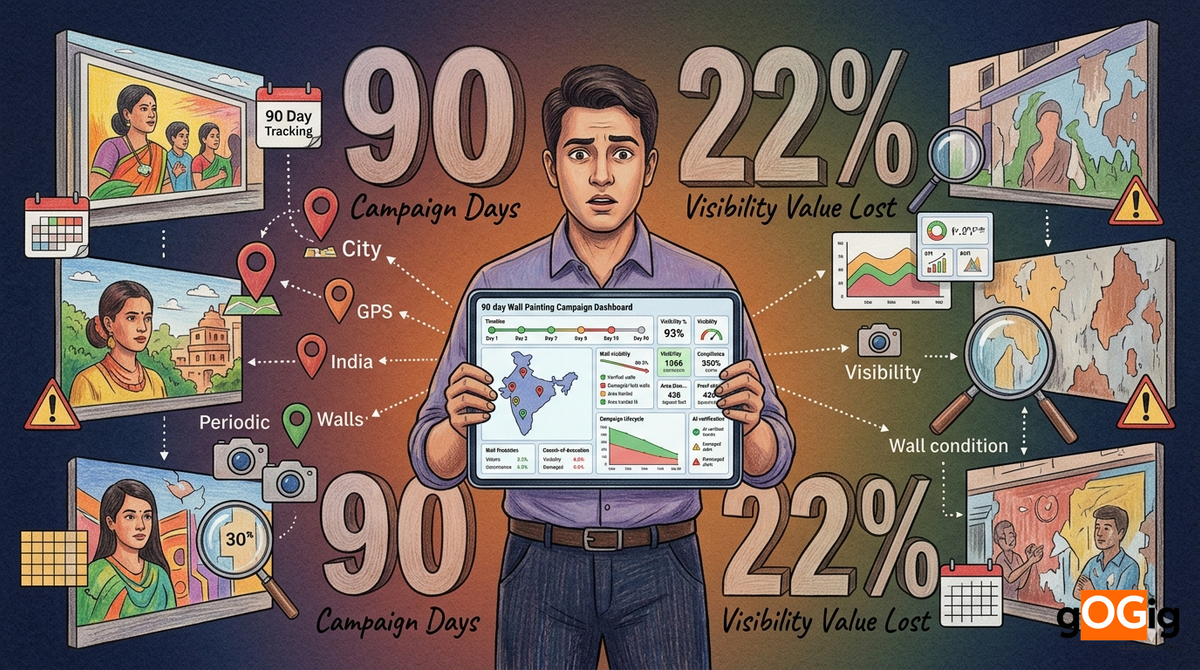
A consumer-durable brand commissions a 90-day wall painting campaign across Bangalore, Hyderabad, Pune, Indore, and Nagpur. 1,200 walls. 50,000 sq ft planned. ₹50 L budget. Day 14 closeout PPT: 1,180 walls reportedly painted; 98% completion. CFO asks one question at the quarterly review: "Of those 1,180 walls, how many are still visible today, on Day 76?". Silence in the room. The agency does not know. The trade marketing head does not know. Nobody has tracked visibility decay. Indore has its first monsoon week. 84 walls in low-quality plaster zones have peeled. 31 walls have been painted over by competitors. 17 walls were repurposed (someone repainted a different message on top). The brand had ₹50 L invoiced; what remains visible at Day 90 is approximately ₹38 L of effective campaign. The 22% gap is the cost of measuring installation instead of measuring lifecycle.
| Traditional KPI | What it misses |
|---|---|
| Number of walls painted | Whether the walls are real, unique, or duplicate submissions |
| Total square footage | Whether the claimed area matches actual measured area (8-14% typical inflation) |
| Campaign completion % | Whether walls are still visible at Day 30, 60, 90 |
| City coverage % | Whether coverage is balanced or concentrated in one zone |
| Photos submitted | Whether photos are authentic, live-captured, or recycled |
| Vendor invoice value | Whether invoiced work matches verified delivery |
| WhatsApp photo count | Whether photos came from inside geofenced wall coordinates |
| Sample audit pass rate | Whether 3-8% sample reflects the 92-97% un-sampled walls |
| Final report sign-off | Whether sign-off correlates with actual customer-facing visibility |
| Creative approval count | Whether installed creative matches approved variant on every wall |
| Dashboard category | Metrics included |
|---|---|
| Coverage Intelligence | Verified Wall Count, City Coverage %, Geo-Verification Rate |
| Quality Intelligence | Verified Square Footage, Creative Compliance Rate, Visibility Retention Score |
| Fraud Detection | Duplicate Submission Rate, GPS Anomalies, Mock-Location Flags |
| Vendor Performance | Vendor Compliance Score, Per-Vendor Tier A+ to D Ranking |
| Asset Health | Campaign Uptime, Damage Rate, 30 / 60 / 90 Day Audit Scores |
| Financial Defensibility | Proof-Before-Payment Score, Verified Billing %, RoVE (Return on Verified Execution) |
| Executive View | City Rankings, Coverage Heatmaps, Campaign Health Score |
Planned vs Verified Wall Count
Strips out fake submissions and missing executions. Verified walls matter more than reported walls.
Planned walls
1,200
Reported walls (vendor claim)
1,180
Verified walls (GPS + AI photo)
1,127
Verification gap
53 walls / 4.5%
Verified Square Footage (VAR — Verified Area Rate)
Walls counted is one number. Square feet actually painted is another. Inflation typically 8-14% on self-claimed area.
Planned area
50,000 sq ft
Reported area
49,200 sq ft
Verified area (AI photogrammetry)
46,850 sq ft
Inflation gap
2,350 sq ft / 4.8%
Geo-Verification Rate
% of walls with valid GPS coordinates, server-side timestamp, and 9-layer mock-location authentication.
Total submissions
1,180
GPS-verified (within 25m geofence)
1,153
Mock-location flagged
12
Outside-geofence
15
Geo-verification rate
97.7%
City-Level Coverage %
5-city campaigns hide weak performance in single-city reports. Always view city-by-city to surface gaps.
Bangalore
96%
Hyderabad
92%
Pune
88%
Indore
84%
Nagpur
79%
Vendor Compliance Score
Multi-vendor campaigns reveal vast variance. Tier A+ vendors get renewal; Tier C-D get intervention.
Vendor A (Bangalore, Hyd, Pune)
97% Tier A+
Vendor B (Indore)
91% Tier A
Vendor C (Nagpur)
78% Tier C (intervention)
Network avg
89%
Duplicate Submission Rate
Same wall, different angle, multiple submissions. AI image hashing catches it. Critical at 1,000+ wall scale.
Total photo submissions
3,600
SHA-256 exact duplicates
78
Perceptual hash near-duplicates
54
Cross-city duplicate flags
132 total / 3.7%
Visibility Retention Score (the lifecycle KPI)
Walls fade, get damaged, get painted over. The single most under-tracked metric in wall painting. The 90-day decay curve.
Month 1 (Day 30 audit)
96%
Month 2 (Day 60 audit)
91%
Month 3 (Day 90 audit)
84%
Avg lifecycle visibility
~90.3%
Creative Compliance Rate
Wrong creative version. Old logo. Wrong brand colors. Wrong messaging. AI creative-match scoring per wall.
Walls audited
1,200
Creative variant mismatch
22
Color / logo errors
18
Spelling / messaging errors
8
Compliance rate
96.0%
Campaign Uptime (Avg Wall Days Visible)
90-day campaign × walls = total days possible. Verified visible days = actual delivery. Industry-leading KPI.
Campaign days
90
Total wall-days possible (1,200 × 90)
108,000
Verified visible wall-days
99,576
Campaign uptime
92.2%
Avg wall visibility duration
83 days of 90
Coverage Heatmap Density
City coverage % alone hides distribution. 200 walls concentrated in one zone is not the same as 200 walls spread across 8 zones.
Bangalore (8 target zones)
5 zones high-density, 3 zones underserved
Hyderabad (6 target zones)
4 zones high-density, 2 zones empty
Per-zone min wall threshold
15 walls
Zones below threshold
9 zones across 5 cities
Audit Pass Rate (Random Sample Re-verification)
5-10% of walls re-audited by independent field auditor. Tests vendor consistency and AI verification accuracy.
Sample size
120 walls (10%)
Passed (verified per spec)
113
Failed (size, location, creative, visibility issue)
7
Pass rate
94.1%
Proof-Before-Payment Score (PBP)
The most important financial KPI. Tie invoice approval to verified per-wall execution, not vendor claim.
Total invoice value
₹50 L
Verified per wall
1,127 of 1,200 (93.9%)
Approved billing
₹46.95 L
Pending verification / hold
₹3.05 L
PBP score
93.9%
Day 0-15
Installation phase
Track planned vs verified wall count, geo-verification rate, vendor compliance score, duplicate submission rate. Early intervention on vendors with high error rates. Pre-paint baseline + post-paint photo pair captured for every wall.
Day 15-30
Completion + first audit
Full installation closeout. AI photogrammetry on verified area. Creative compliance rate calculation. First independent 10% sample audit. Coverage heatmap published per city. Invoice processing begins under Proof-Before-Payment workflow.
Day 30-60
Lifecycle monitoring phase 1
Random 10% sample re-audit. Visibility retention score calculated for first time. Damage rate flagged. Painted-over walls identified. Vendor accountability for repaint clauses triggered.
Day 60-90
Lifecycle monitoring phase 2
Second 10% sample audit. Final visibility retention calculation. Campaign uptime % computed. Per-city Day 90 effective coverage published. Final invoice reconciliation against PBP score.
Day 90+
Closeout + measurement-to-business-outcome correlation
Brand lift study tied to city coverage. QR scan correlation if QR-coded creative used. Sales lift attribution per pincode. Vendor renewal decision based on Tier scorecard. ROI calculation: RoVE (Return on Verified Execution).
| City | Verified wall coverage % (Day 30) | Verified walls |
|---|---|---|
| Bangalore | 96% | 240 walls |
| Hyderabad | 92% | 221 walls |
| Pune | 88% | 211 walls |
| Indore | 84% | 202 walls |
| Nagpur | 79% | 189 walls |
| Live dashboard metric | Value |
|---|---|
| Campaign | CD_BRAND_5CITY_Q2 |
| Day | Day 76 of 90 |
| Planned walls | 1,200 |
| Reported walls | 1,180 |
| Verified walls (install) | 1,127 |
| Verified walls (still visible Day 76) | 983 |
| Painted-over walls | 31 |
| Faded / damaged walls | 84 |
| Repurposed walls | 17 |
| Verified Area Rate (VAR) | 93.7% |
| Visibility retention (Day 76) | 87.2% |
| Creative compliance | 96.0% |
| Duplicate submission rate | 3.7% |
| Mock-location flags | 0 |
| Audit pass rate | 94.1% |
| Campaign uptime (so far) | 92.2% |
| Per-vendor Tier A+ | 2 of 3 vendors |
| Per-vendor Tier C (intervention) | 1 of 3 vendors |
| PBP-approved billing | ₹46.95 L of ₹50 L |
| Pending verification hold | ₹3.05 L |
Move from installation tracking to campaign lifecycle visibility
Free 30-Day Verification Challenge on one 5-city wall painting campaign. Per-wall asset master + 9-layer mock-location detection + AI photogrammetry for verified area + creative compliance scoring + Day 30 / 60 / 90 visibility retention audits + per-vendor scorecards + Proof-Before-Payment workflow. 100% verification accuracy. 100% fraud detection rate.
Request a 5-city wall painting pilot →| Benchmark | Industry average | Best-in-class (with FEI) |
|---|---|---|
| Verified install rate | 78-86% | 94-100% |
| Verified Area Rate (VAR) | 76-84% | 92-98% |
| Geo-verification rate | 72-84% | 96-100% |
| Creative compliance rate | 78-86% | 94-98% |
| Duplicate submission rate | 8-14% | <2% |
| Day 30 visibility retention | 88-92% | 94-98% |
| Day 60 visibility retention | 78-84% | 88-94% |
| Day 90 visibility retention | 68-78% | 82-92% |
| Audit pass rate | 78-86% | 92-98% |
| Campaign uptime (90-day avg) | 74-82% | 88-95% |
| PBP-approved billing rate | 74-82% | 92-98% |
| RoVE (Return on Verified Execution) | 1.4-2.2x | 2.6-4.5x |
| Cost dimension | Hidden invisible loss |
|---|---|
| Verified install vs reported install gap (4-8%) | ₹2-4 L |
| Area inflation (8-14% on self-claim) | ₹4-7 L |
| Duplicate submission overbilling | ₹2-4 L |
| Faded / painted-over / damaged walls (Day 90) | ₹4-8 L |
| Creative compliance failures (wrong message) | ₹2-4 L |
| Vendor underperformance in 1 of 5 cities | ₹3-6 L |
| Manual reconciliation labour | ₹0.5-1.2 L |
| Audit committee defensibility shortfall | Difficult to monetise |
| Total typical leakage on ₹50 L campaign | ₹17.5-34.2 L (35-68%) |
| Campaign size | Verification cost (gOGig) | Avg leakage prevented | Net ROI |
|---|---|---|---|
| 500-wall (₹20 L) | ₹50,000-90,000 | ₹4-8 L | 5-10x |
| 1,000-wall (₹40 L) | ₹90,000-1.7 L | ₹10-18 L | 5-12x |
| 1,500-wall (₹60 L) — typical 5-city × 90-day | ₹1.3-2.4 L | ₹16-28 L | 5-13x |
| 2,500-wall (₹1 Cr) | ₹2.2-4 L | ₹25-45 L | 6-14x |
| 5,000+ wall (₹2-3 Cr national) | ₹5-9 L | ₹55-110 L | 6-15x |
| Dimension | Manual WhatsApp + Excel + PPT | gOGig pipeline |
|---|---|---|
| Per-wall verification | Sample-based (5-10%) | 100% |
| Time per wall verified | 15-25 min manual | ~3 sec AI |
| Geo-verification | ~78% | 100% (9-layer) |
| Area accuracy | ±15-25% (vendor self-claim) | ±2-5% (AI photogrammetry) |
| Duplicate submission detection | 10-22% miss rate | 100% (SHA-256 + perceptual hash) |
| Day 30 / 60 / 90 visibility audit | Manual sample only | Random 10% sample + AI scoring |
| Creative compliance scoring | ~5% | 100% |
| Per-vendor scorecard refresh | End of campaign | Real-time |
| Coverage heatmap | Manual map plotting | Auto-rendered per city per zone |
| Proof-Before-Payment workflow | Manual reconciliation | Native |
| BRSR Core / audit-grade evidence | Manual collation | API-ready export |
| Year-1 ROI | Baseline | 5-15x |
In a 5-city, 3-month wall painting campaign, the campaign does not end on Day 14 when installation closes out. It ends on Day 90 when the last verified visible wall is audited. Brands that measure installation get installation outcomes. Brands that measure lifecycle get lifecycle outcomes. The metric is the strategy.
Per-wall unique ID (WP-NNN) with locked GPS coordinates and creative variant
Pre-paint baseline + post-paint completion photo pair
9-layer mock-location detection on every GPS submission
Live-capture photo validation (gallery uploads disabled)
AI photogrammetry for verified area on every wall
SHA-256 + perceptual hash on every photo (cross-wall, cross-city, cross-campaign)
Painter face-match + Aadhaar identity at every wall
Owner consent + OTP for every wall
Creative compliance scoring per wall (right variant, right color, right logo)
Day 30 / 60 / 90 visibility retention audit on random 10% sample
Damage / painted-over / repurposed flagging
Coverage heatmap per city per zone
Per-vendor Tier A+ to D scorecard refreshed real-time
Repaint / fix clauses tied to visibility retention score
Verified Execution Rate (VER) + Verified Area Rate (VAR) + Visibility Retention Score (VRS) as contractual KPIs
Proof-Before-Payment workflow for 3-way invoice matching
7-year audit-grade retention + BRSR Core-ready evidence pack
Verified by gOGig certification or equivalent independent verification standard
The same 12-metric, lifecycle-tracking framework applies to every multi-city offline execution format gOGig verifies.
gOGig's per-wall lifecycle verification runs across every major Indian metro and tier-1/tier-2 city used in multi-city wall painting campaigns.
Move from installation tracking to campaign lifecycle visibility
Free 30-Day Verification Challenge on one 5-city wall painting campaign. Per-wall asset master + 9-layer mock-location detection + AI photogrammetry for verified area + creative compliance scoring + Day 30 / 60 / 90 visibility retention audits + per-vendor scorecards + Proof-Before-Payment workflow. 100% verification accuracy. 100% fraud detection rate.
100%
AI accuracy
100%
Detection rate
5-15x
Year-1 ROI
Written by
gOGig Editorial Team
The gOGig Editorial team publishes research, frameworks, and field intelligence drawn from gOGig Labs' dataset of 10,000+ verified field submissions across FMCG, dairy, OOH, BTL, pharma, security, telecom, and BFSI sectors.
Was this article helpful?
Your feedback helps us write better content.