Single-vendor vs multi-vendor BTL campaign management: 2026 decision framework
2 min read

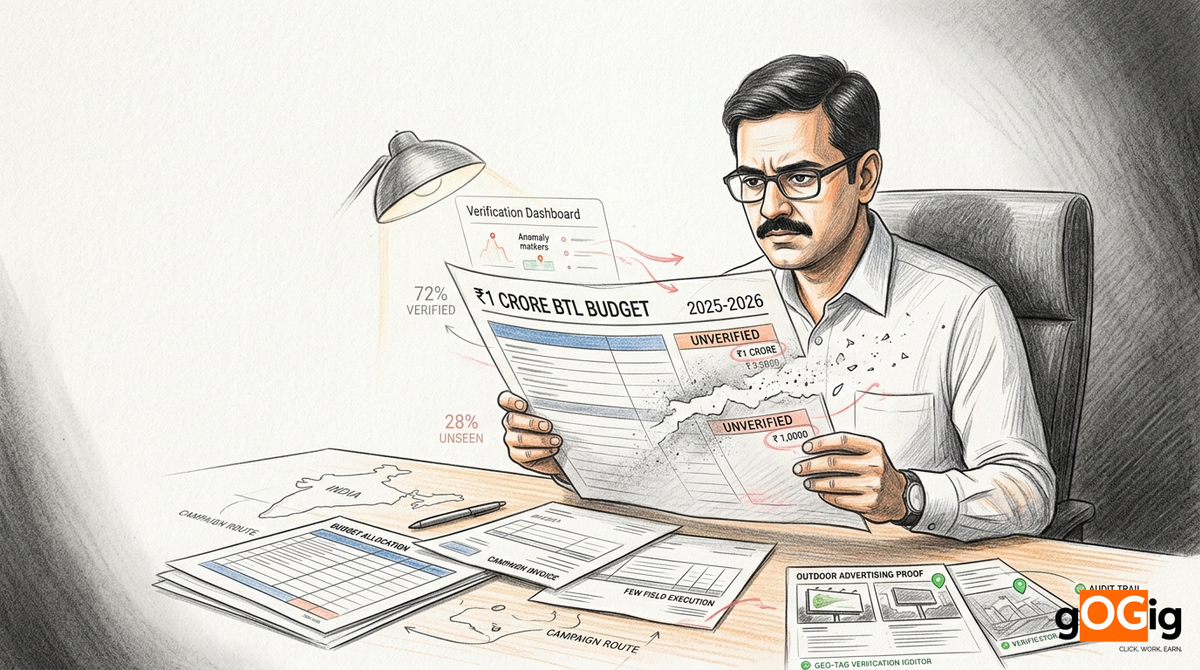
Most brand managers can describe what a ₹1 crore BTL plan looks like. Almost none can describe what verified ₹1 crore of execution looks like. The line-item walkthrough of where every rupee goes, what gets verified, and what disappears into the gap.
₹28 lakh
The portion of every ₹1 crore BTL budget that flows into unverified execution. Not stolen, not misallocated. Just unseen. The largest single hole in Indian marketing finance.
A CMO and a CFO sit in a quarterly review. The CMO presents a ₹1 crore BTL line on the marketing dashboard. The CFO asks one question: "How much of this is verified?" The CMO has the agency report. The agency report says 96%. The CFO asks the question again. There is no good answer. This blog is the answer.
| What the brand plans | What the brand pays | What the brand actually receives |
|---|---|---|
| 5,000 promoter hours | 5,000 promoter hours | 3,500–4,250 verified promoter hours |
| 20 cities of activation | 20 cities billed | 16–18 cities fully executed |
| 2,500 retail outlets touched | 2,500 outlets billed | 1,950–2,150 outlets verified |
| 500 hoarding installations | 500 hoardings billed | 460–480 verified installations |
| 120 sampling drives | 120 drives billed | 92–110 verified drives |
| 15 mall activations | 15 activations billed | 12–13 fully verified activations |
| 40 mobile van days | 40 days billed | 28–32 verified route-compliant days |
| 200 RWA / society events | 200 events billed | 148–168 verified events |
| Spend line | Allocation | What it typically buys |
|---|---|---|
| Retail visibility & merchandising | ₹22 lakh (22%) | 2,500 outlet touchpoints + POSM deployment |
| Promoter activations & mall events | ₹18 lakh (18%) | 5,000 promoter hours across 15 events |
| OOH hoardings & pole boards | ₹15 lakh (15%) | 500 installations across 20 cities |
| Sampling & product trial drives | ₹12 lakh (12%) | 120 drives, 60,000–80,000 trial samples |
| Mobile van & roadshow | ₹8 lakh (8%) | 40 days, 6–12 cities covered |
| Wall painting & rural BTL | ₹7 lakh (7%) | 30,000–50,000 sq ft across rural belt |
| Trade scheme support (POSM, displays) | ₹6 lakh (6%) | 1,500–2,000 displays / POSM elements |
| RWA / society activation | ₹5 lakh (5%) | 200 society events / lead capture activations |
| Auto / bus / cab branding | ₹4 lakh (4%) | 200–400 vehicles for 2–4 weeks |
| Agency fees & management | ₹3 lakh (3%) | Coordination, reporting, supervision |
| Total | ₹1,00,00,000 | - |
| Format | Typical unit price (India) | Reference |
|---|---|---|
| Retail visibility audit | ₹15–30 per outlet | Per-visit audit pricing |
| POSM material per outlet | ₹400–800 | Standard merchandising |
| Promoter day | ₹1,200–3,000 per day | Tier-1 vs tier-3 city wage band |
| Mall activation kiosk | ₹15,000–50,000 per day | Mall rental + setup |
| OOH hoarding (tier-1) | ₹50,000–3 lakh per month | Standard urban site |
| OOH hoarding (tier-2) | ₹20,000–1.5 lakh per month | Standard tier-2 site |
| Pole board / no-parking | ₹400–1,500 per board per month | Localised OOH |
| Sampling drive (per outlet) | ₹400–1,200 | Including sample distribution |
| Mobile van per day | ₹14,000–18,000 | Vehicle, fuel, manpower, materials |
| Wall painting | ₹9–20 per sq ft | Including paint, labour, transport |
| Auto rickshaw branding | ₹1,500–3,500 per auto per month | Standard tier-1 / tier-2 |
| Bus / cab branding | ₹4,000–12,000 per vehicle per month | Outdoor transit rate |
| Shop name board | ₹2,500–5,000 per shop | Branded shop signage |
| RWA / society activation | ₹15,000–45,000 per event | Setup + promoter + permissions |
| Trade scheme display | ₹1,800–4,500 per display | Branded shelf / end-cap |
| Invisibility driver | Mechanism |
|---|---|
| Self-reported execution rates | Agency reports 95–96% completion; gap never quantified |
| WhatsApp metadata stripping | GPS and EXIF removed by WhatsApp in standard mode |
| Excel cell editing without version control | "Execution %" updated without history |
| Manual audit sampling limits | 5–10% of sites physically audited; 90–95% unchecked |
| End-of-campaign reporting cadence | By the time anomalies surface, payment is released |
| Single source of truth = the vendor | Party being paid writes the report on the work |
| Re-execution cost discourages disputes | Brand absorbs gaps rather than pay 30–60% re-execution premium |
| No category vocabulary | Without "verified execution rate" as a KPI, gap is unmeasurable |
Try the BTL Leak Calculator
Enter your BTL budget, mix of formats, and geographic spread. The calculator estimates your unverified exposure and the rupee value at risk. Takes 60 seconds. No login required.
Open the BTL Leak Calculator →| Sub-component | Allocation | Unverified share |
|---|---|---|
| Outlet audit visits (2,500 outlets) | ₹6.25 L | 15–20% |
| POSM material (1,500 outlets) | ₹9.0 L | 10–18% |
| Planogram compliance checks | ₹3.5 L | 20–25% |
| Shelf branding installations | ₹3.25 L | 15–22% |
| Line total / Unverified estimate | ₹22 L | ₹3.5–4.5 L |
| Sub-component | Allocation | Unverified share |
|---|---|---|
| Promoter day cost (5,000 hrs approx 625 days) | ₹11.25 L | 18–25% |
| Mall rental (15 days x 4 venues) | ₹4.5 L | 5–8% |
| Setup & dismantling | ₹1.5 L | 10–15% |
| Materials & consumables | ₹0.75 L | 15–22% |
| Line total / Unverified estimate | ₹18 L | ₹3–4 L |
| Sub-component | Allocation | Unverified share |
|---|---|---|
| Hoarding rentals (500 sites x 1 month) | ₹11.0 L | 3–8% |
| Printing & flex installation | ₹2.5 L | 5–10% |
| Pole boards (200 units) | ₹1.0 L | 15–25% |
| Supervision & audit | ₹0.5 L | 10–15% |
| Line total / Unverified estimate | ₹15 L | ₹1.2–2.2 L |
| Sub-component | Allocation | Unverified share |
|---|---|---|
| Sample product cost (60K–80K samples) | ₹6.0 L | 10–15% |
| Distribution manpower (120 drives) | ₹3.6 L | 20–30% |
| Logistics & transport | ₹1.4 L | 8–12% |
| Tracking & reporting | ₹1.0 L | 15–20% |
| Line total / Unverified estimate | ₹12 L | ₹2–3 L |
| Sub-component | Allocation | Unverified share |
|---|---|---|
| Van rental (40 days x ₹14–18K) | ₹5.8 L | 20–30% |
| Manpower (driver + promoters) | ₹1.5 L | 15–25% |
| Fuel & route logistics | ₹0.5 L | 10–18% |
| Materials & demo collateral | ₹0.2 L | 10–15% |
| Line total / Unverified estimate | ₹8 L | ₹1.8–2.5 L |
| Sub-component | Allocation | Unverified share |
|---|---|---|
| Paint & surface preparation | ₹2.5 L | 10–15% |
| Manpower (painters & supervisors) | ₹2.8 L | 20–30% |
| Permissions & locale fees | ₹1.0 L | 15–25% |
| Quality audit & documentation | ₹0.7 L | 20–30% |
| Line total / Unverified estimate | ₹7 L | ₹1.5–2 L |
| Sub-component | Allocation | Unverified share |
|---|---|---|
| POSM displays (1,500–2,000 units) | ₹3.5 L | 15–25% |
| Trade scheme payouts | ₹1.8 L | 12–18% |
| Distributor incentives | ₹0.5 L | 10–15% |
| Compliance audits | ₹0.2 L | 15–20% |
| Line total / Unverified estimate | ₹6 L | ₹1–1.5 L |
| Sub-component | Allocation | Unverified share |
|---|---|---|
| Event setup (200 events) | ₹3.0 L | 15–22% |
| Promoter / coordinator costs | ₹1.5 L | 20–28% |
| Permissions & RWA fees | ₹0.4 L | 10–15% |
| Documentation & reporting | ₹0.1 L | 15–20% |
| Line total / Unverified estimate | ₹5 L | ₹1–1.4 L |
| Sub-component | Allocation | Unverified share |
|---|---|---|
| Vehicle rental (200–400 vehicles x 2–4 weeks) | ₹2.5 L | 15–25% |
| Printing & vinyl installation | ₹1.0 L | 8–12% |
| Monitoring & audit | ₹0.5 L | 15–20% |
| Line total / Unverified estimate | ₹4 L | ₹0.7–1 L |
| Sub-component | Allocation | Unverified share |
|---|---|---|
| Project management fee | ₹2.0 L | 0–5% |
| Reporting & coordination | ₹0.8 L | 5–10% |
| Quality assurance | ₹0.2 L | 0–5% |
| Line total / Unverified estimate | ₹3 L | ₹0.1–0.3 L |
₹19–28 lakh of every ₹1 crore. The 19% baseline assumes well-supervised metro campaigns. The 28% scenario assumes typical tier-2/tier-3 + rural mix. Most Indian brands sit closer to 28% than 19%.
| Line item | Plan (₹lakh) | Unverified (₹lakh) | Unverified % |
|---|---|---|---|
| Retail visibility & merchandising | 22.0 | 4.0 | 18% |
| Promoter activations & mall events | 18.0 | 3.5 | 19% |
| OOH hoardings & pole boards | 15.0 | 1.7 | 11% |
| Sampling & product trials | 12.0 | 2.5 | 21% |
| Mobile van & roadshow | 8.0 | 2.1 | 26% |
| Wall painting & rural BTL | 7.0 | 1.8 | 26% |
| Trade scheme support | 6.0 | 1.2 | 20% |
| RWA / society activation | 5.0 | 1.2 | 24% |
| Auto / bus / cab branding | 4.0 | 0.85 | 21% |
| Agency fees & management | 3.0 | 0.2 | 7% |
| Total | 100.0 | ~19.05 L | 19% baseline |
| Fraud type | Share of ₹28 lakh loss | Detection difficulty |
|---|---|---|
| Ghost retail coverage | ₹6 L | High (requires outlet-level verification) |
| Duplicate retailer onboarding | ₹3.5 L | Medium (de-duplication logic) |
| Proof-of-performance fraud (recycled photos, GPS spoof) | ₹6.5 L | Medium (AI image verification) |
| Field force productivity leakage | ₹6 L | High (requires real-time visibility) |
| Manual reporting manipulation | ₹3 L | Low (platform-based capture) |
| Trade scheme leakage | ₹3 L | Medium (verified payouts) |
| Total invisible to brand | ₹28 L | - |
| Industry | Typical unverified % | Loss per ₹1 Cr |
|---|---|---|
| BFSI | 13–16% | ₹13–16 lakh |
| FMCG modern trade focus | 16–19% | ₹16–19 lakh |
| Telecom & consumer durables | 17–21% | ₹17–21 lakh |
| Pharma | 18–22% | ₹18–22 lakh |
| Auto & 2-wheeler | 20–24% | ₹20–24 lakh |
| QSR & multi-outlet retail | 21–25% | ₹21–25 lakh |
| FMCG general trade focus | 24–29% | ₹24–29 lakh |
| Edtech | 25–30% | ₹25–30 lakh |
| Real estate & construction | 27–32% | ₹27–32 lakh |
| Cement, paint & building | 30–35% | ₹30–35 lakh |
| D2C brands | 32–38% | ₹32–38 lakh |
| Geographic mix | Unverified % | Loss per ₹1 Cr |
|---|---|---|
| 100% tier-1 metros | 13–15% | ₹13–15 lakh |
| 70% tier-1 + 30% tier-2 | 16–19% | ₹16–19 lakh |
| 50% tier-1 + 30% tier-2 + 20% tier-3 | 20–24% | ₹20–24 lakh |
| 30% tier-1 + 30% tier-2 + 30% tier-3 + 10% rural | 24–28% | ₹24–28 lakh |
| 20% tier-1 + 30% tier-2 + 30% tier-3 + 20% rural | 27–32% | ₹27–32 lakh |
| 30% rural-heavy mix (FMCG/cement/auto) | 30–36% | ₹30–36 lakh |
| Format dominance in mix | Anomaly rate | Loss factor on ₹1 Cr |
|---|---|---|
| Field sales heavy (40%+ of mix) | 34% | ₹25–30 lakh |
| Lead generation heavy (30%+) | 37% | ₹28–34 lakh |
| Promoter heavy (40%+) | 28% | ₹22–26 lakh |
| Mobile van heavy (30%+) | 26% | ₹20–25 lakh |
| Sampling heavy (35%+) | 24% | ₹19–23 lakh |
| OOH heavy (40%+) | 20% | ₹14–18 lakh |
| Visual merchandising heavy (40%+) | 16% | ₹12–15 lakh |
| Shop boards heavy (40%+) | 15% | ₹11–14 lakh |
| Question | Legacy answer | FEI answer |
|---|---|---|
| How much of this ₹1 Cr executed? | ~96% (agency PDF) | 72–85% verified |
| How many cities actually got covered? | "All 20" (verbal) | 16–18 fully, 2–4 partial |
| How many promoter-days are real? | "5,000" (Excel) | 3,500–4,250 verified |
| How many outlets were actually touched? | "2,500" (DMS) | 1,950–2,150 verified |
| Where did the ₹28 lakh go? | Unknown | Itemised across 6–10 fraud types |
| Can we substantiate for BRSR Core? | No | Yes, 7-year audit trail |
| Audit committee comfort level | Recurring concern | Closed within 1 audit cycle |
| Time to detect issues | Quarter-end or never | Real-time / 3 seconds |
Sample calculation for a ₹1 Cr BTL campaign
Annual BTL budget: ₹1,00,00,000
Industry: Consumer durables. Loss factor: 19–22%
Geographic mix: 50% tier-1, 30% tier-2, 20% tier-3. Additional loss: +2–4%
Format mix: 30% promoter, 25% retail, 20% OOH, 25% other. Additional loss: +1–3%
Adjusted leakage estimate: 23–28%
Estimated annual loss exposure: ₹23–28 L
Same ₹1 Cr after 12 months of FEI:
Annual BTL budget (unchanged): ₹1,00,00,000
Adjusted leakage after FEI: 5–8%
Loss exposure remaining: ₹5–8 L
Savings recovered annually: ₹15–23 L
Platform cost annual: ~₹2.5–4 L
Net annual ROI: ~4–6x
Legacy ₹1 Cr
₹72 L verified execution. ₹28 L invisible loss. Agency-reported 96% completion. No substantiation for BRSR. 3-week post-campaign disputes. 20 cities billed, 16–18 actually delivered. ₹0 of the lost ₹28 L recovered. Quarter-end review reveals nothing.
FEI ₹1 Cr (after 12 months)
₹92–95 L verified execution. ₹5–8 L residual loss (vs ₹28 L). Verified execution rate measurable per format, per vendor, per city. Full BRSR audit trail. 3-second anomaly detection. ₹15–23 L recovered annually. CFO can substantiate every rupee.
| Financial metric | Pre-FEI | Year 1 with FEI | Year 3 steady state |
|---|---|---|---|
| Verified execution value | ₹72 L (unknown) | ₹85 L | ₹93 L |
| Invisible loss | ₹28 L | ₹12 L | ₹5 L |
| Recovered savings | ₹0 | ₹16 L | ₹23 L |
| Platform cost | ₹0 | ₹3 L | ₹3 L |
| Net financial improvement | - | ₹13 L | ₹20 L |
Marketing line stops being a black box
₹1 crore goes from "trust the deck" to a line-item P&L with verified execution rate per line.
3-way matching applied to BTL
The procurement standard already used for IT, logistics, and capex extends to BTL. PO + invoice + verification report.
BRSR Core assurance becomes substantiable
The 7-year audit trail satisfies value chain disclosure requirements that listed companies face under FY 2025-26.
Re-execution costs drop sharply
Mid-campaign correction within the 60-day window prevents the 30–60% re-execution cost premium.
Vendor selection shifts from rate cards to performance
Verified execution rate becomes a contracted KPI, not a marketing preference.
Audit committee findings close
BTL ceases to be a recurring marketing controls concern at quarterly audit reviews.
| Year of FEI adoption | Verified execution | Loss residual | Cumulative savings |
|---|---|---|---|
| Pre-baseline | ~72% | ~28% | - |
| Year 1 | 85% | 15% | ₹13 L |
| Year 2 | 91% | 9% | ₹19 L |
| Year 3 | 95% | 5% | ₹23 L |
| Year 4–5 steady state | 96–97% | 3–4% | ₹24–25 L annually |
| BTL budget size | Typical loss | FEI year-1 recovery | FEI year-3 recovery |
|---|---|---|---|
| ₹1 Cr | ₹28 L | ₹16 L | ₹23 L |
| ₹10 Cr | ₹2.8 Cr | ₹1.6 Cr | ₹2.3 Cr |
| ₹50 Cr | ₹14 Cr | ₹8 Cr | ₹11.5 Cr |
| ₹100 Cr | ₹28 Cr | ₹16 Cr | ₹23 Cr |
| ₹500 Cr | ₹140 Cr | ₹80 Cr | ₹115 Cr |
| ₹2,000 Cr (top MNC) | ₹560 Cr | ₹320 Cr | ₹460 Cr |
| Brand size signal | Implication |
|---|---|
| Loss scales linearly with budget | ₹100 Cr = ₹28 Cr exposure vs ₹1 Cr = ₹28 L |
| Vendor count scales | More vendors = more cracks in the verification chain |
| Geographic breadth scales | More tier-3 / rural exposure = higher loss factor |
| Format mix complexity scales | More formats = more fraud sub-types to detect |
| Procurement governance lag | Larger procurement teams take longer to adopt new standards |
| BRSR Core regulatory exposure rises | Top 250 listed companies face limited assurance first |
| CFO scrutiny rises with budget | ₹100 Cr is a board-level number that demands board-level evidence |
The ₹28 lakh you'll never know you lost is the ₹28 lakh that defines the next decade of Indian marketing accountability. Once measured, it cannot be unmeasured.
The CMO has a new metric to report
"Verified execution rate" replaces "campaign completion percentage." First time the BTL line on the dashboard becomes substantiable.
The CFO has a new question to ask
"What was the verified execution rate this quarter?" The marketing team needs a real number, not a deck slide.
Procurement has a new clause to add
Proof Before Payment becomes default in next vendor MSA. 3-way matching extends to BTL invoices.
Internal audit has a new report to issue
BTL ceases to be the recurring controls weakness. New audit report can substantiate spend.
The board has a new line to expect
Quarterly board pack includes "Verified BTL spend" as a permanent fixture, alongside ROAS.
BTL and OOH formats with the highest unverified spend exposure in a Rs 1 crore budget.
Indian cities where BTL unverified spend exposure is highest due to supervision density and tier mix.
Try the BTL Leak Calculator
Enter your BTL budget, industry, geographic mix, and format mix. The calculator estimates your unverified exposure in rupees and recommends the next move. Takes 60 seconds. No login required.
₹19–28 L
₹1 Cr loss exposure
₹13–16 L
Year-1 recovery with FEI
₹23–25 L
Steady-state recovery
Written by
Accountability Research Team
The gOGig Editorial team publishes original research, annual indices, and data-driven analysis on field execution intelligence, BTL accountability, and India's physical economy.
Was this article helpful?
Your feedback helps us write better content.