Single-vendor vs multi-vendor BTL campaign management: 2026 decision framework
2 min read

Indian brands invest crores into on-ground activations every quarter. A measurable share of that spend disappears into a category of loss that has never been quantified at scale. This is the long-form case for putting a number on it, with the math, the patterns, the industries, and the path out.
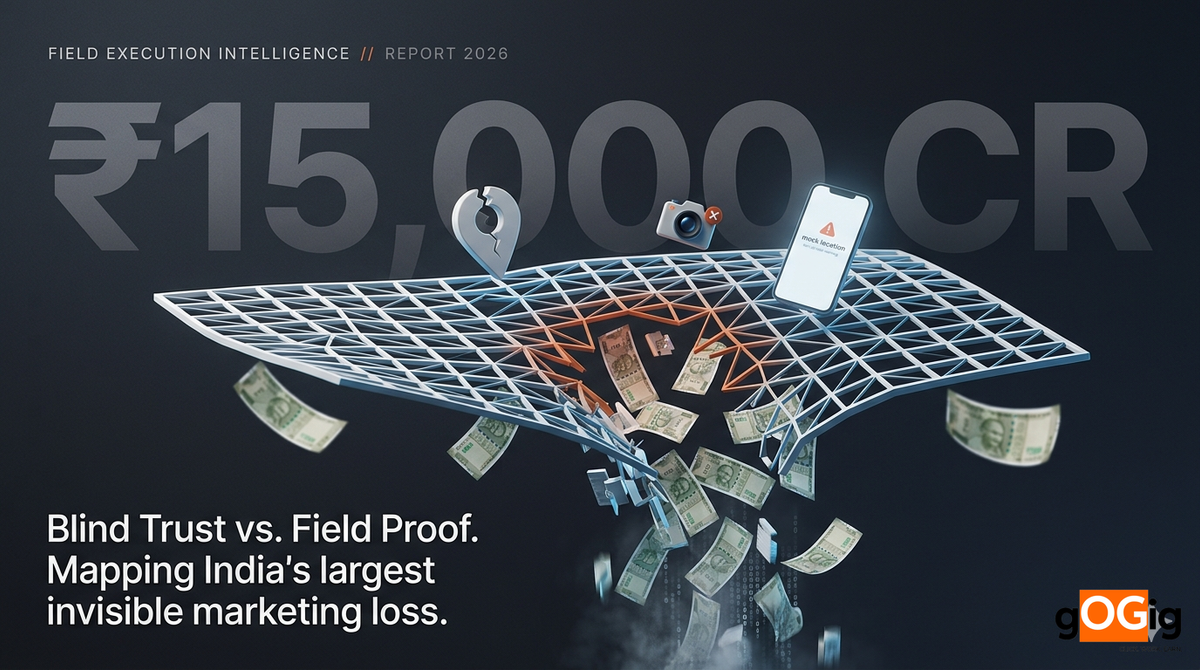
₹15,000 Cr
Estimated annual leak from unverified on-ground execution across India's BTL, OOH, and trade activation ecosystem in 2026
The number is a derived estimate, not a published industry figure. Each input is sourced. The math is transparent so the number can be debated, refined, and ultimately owned by the industry it describes.
| Input | Value | Source |
|---|---|---|
| India total ad spend 2026 (projected) | ₹1,15,460 Cr | dentsu e4m 2026 report |
| Live events & experiential market 2025 | ₹17,000 Cr | EY-Parthenon 2025 |
| OOH market 2024 | ₹5,920 Cr | EY-FICCI 2024 |
| BTL + trade activation share of total ad spend | 45–55% | Industry estimates, multiple sources |
| Unverified share of on-ground execution | 20–30% | KPMG India consumer markets, 2024 |
| Trade promotion share of FMCG revenue | 15–20% | KPMG India 2024 |
| Scheme leakage within trade promotions | 12–18% | KPMG India 2024 |
The number is published here for the industry to debate, refine, and react to. A problem without a number is a problem that never gets fixed.
Understanding the leak requires understanding the volume of work it sits inside. Indian brands operate at a scale that few global markets match.
| Activity | Typical scale | Verification rate today |
|---|---|---|
| FMCG sampling campaign | 20,000 outlets, 15 states, 1 quarter | Photo-only, no GPS, no timestamp lock |
| Pole board program (one metro) | 5,000 installations across 2 months | End-of-campaign photo deck |
| Pharma field force | 80,000 doctors per quarter via 12,000 reps | Self-declared daily call reports |
| QSR visual merchandising audit | 800 outlets monthly, 35 cities | Periodic regional checks |
| Real estate launch (no-parking boards) | 2,000 boards in 2 nights, one city | Photo proof, no unit identifier |
| Consumer durables dealer branding | 18,000 dealer outlets nationally | Quarterly visit cycles |
| Telecom door-to-door | 1.2 million household visits per month | Sales-team self-reported |
| Wall painting (rural) | 15,000–50,000 sq ft per campaign | End-of-project completion photos |
| Format | Typical cost | Unit basis |
|---|---|---|
| Wall painting (rural) | ₹9–20 per sq ft | Per square foot painted |
| Mobile van advertising | ₹14,500 per day | Per van per day |
| BTL promoter activation | ₹1,200–3,000 per day | Per promoter per day |
| In-shop branding | ₹1,000 per day | Per outlet per day |
| Road show advertisement | ₹80,000 per month | Per campaign per month |
| Mall activation kiosk | ₹15,000–35,000 per day | Per kiosk per day |
| Auto rickshaw branding | ₹600–1,200 per auto per month | Per unit per month |
| No-parking board printing | ₹40–90 per unit | Per board printed |
A ₹40 lakh activation, inflated by 12%, hides ₹4.8 lakh in a single campaign. Ten such campaigns a year per brand. Multiply across the industry and the headline number assembles itself.
Calculate your exposure to the leak
Enter your monthly BTL, trade activation, and field spend. The BTL Leak Calculator shows your conservative, mid, and aggressive exposure in 90 seconds.
Open the BTL Leak Calculator →Blind Trust is the default arrangement where the vendor or agency executes the work, reports on its own execution, and the brand pays based on that self-report. It is not a moral failure. It is the natural result of a payment system that has had no alternative for forty years.
Digital marketing
Every impression measured by a third party. Every click logged. Every conversion attributed. Verification is the platform itself. Audit trail by default.
Field execution
Photos compiled at the end. GPS optional. Timestamps editable. The executor is also the reporter. Audit trail is whatever the agency chooses to share.
BTL is the only major marketing channel in India where the executor and the reporter are the same party. That asymmetry is the structural origin of the ₹15,000 crore leak.
| Channel | Third-party verification | Verification mechanism |
|---|---|---|
| Television | Yes | BARC audited ratings |
| Yes | ABC audited circulation | |
| Radio | Yes | RAM audited listenership |
| Digital | Yes | Platform analytics, third-party MMP |
| OOH | Partial | Site audit only, no proof of view |
| BTL & trade activation | No | Agency self-report |
| Field force operations | No | Self-declared daily call reports |
Misaligned incentives across the value chain
The executor is the reporter. The agency is paid based on what it reports. The vendor is paid based on what the agency accepts. The brand manager is evaluated on whether the campaign was "executed," a binary that the agency's own report satisfies. Nobody in the chain is rewarded for catching the gap.
Verification cost historically exceeded leak cost
Until 2024, sending a third-party audit team to 200 villages to check whether 500 wall paintings actually exist cost more than the inflation it would catch. Brands rationalized the loss as the unavoidable cost of operating in India.
Many small failures, not one big one
A 12% inflation on a ₹40 lakh activation does not break anybody's quarter. But ₹40 lakh activations happen tens of thousands of times a year across India. The 12% compounds quietly into the headline number that no one individual is responsible for surfacing.
The ₹15,000 crore is not evenly distributed. Some industries carry disproportionate exposure because of how their on-ground operations are structured. Below is an exposure snapshot by sector, ranked from highest to lowest concentration of unverified spend.
FMCG & consumer goods
Highest exposure. Trade promotions consume 15–20% of revenue. Sampling, retail visibility, and merchandiser activity all run through self-reporting chains. KPMG documented this category for its specific scheme leakage forensic tool.
25–30%
Pharma field force
12,000 to 15,000 medical reps per major company visiting doctors and chemists. Daily call reports are self-declared. Detection happens through internal audits months later, when the territory has already shifted.
20–25%
Real estate & construction
No-parking boards, hoardings, society activations, pole boards during launch windows. Night installations at scale make duplicate-board fraud easy. Builder margins absorb the leak silently.
20–25%
Cement, paint & building materials
Dealer branding, wall painting, rural BTL across thousands of villages. Geographic distribution makes physical audits nearly impossible at scale. Verification cost has historically exceeded campaign value.
18–22%
Telecom & consumer durables
Door-to-door sales, dealer point branding, mall activations. Lead generation campaigns where the lead itself can be fabricated. CRM systems show high lead volume, low first-call connect.
15–20%
Auto & two-wheeler
Showroom visibility, dealer board compliance, test ride events, roadshows. Verification typically run by regional teams with limited central visibility. Compliance scores look healthy until they are sampled.
15–18%
BFSI (banks, NBFCs, insurance)
Field sales for credit cards, loans, insurance. Branch visibility checks. Lead generation activations. Regulatory pressure is finally forcing verification investment from compliance teams, not marketing teams.
12–15%
QSR & multi-outlet retail
Visual merchandising audits across hundreds of outlets monthly. Compliance fraud detected weeks after the fact. First vertical to demand systematic verification because the cost of incorrect POSM at outlet level is immediate revenue loss.
10–15%
The ₹15,000 crore is not a single failure mode. It is the sum of ten well-known patterns that the industry has lived with for decades. Each is small in isolation. Together, they account for the headline number.
Fictitious secondary sales
Distributors claim sales that did not occur to trigger scheme payouts. KPMG India has built a dedicated forensic tool specifically to detect this category at scale, signalling its prevalence across the consumer markets sector.
Ghost manpower billing
The agency bills 8 promoters for a mall activation when 5 were deployed. The brand has no independent attendance record. Ghost manpower is the most invoiced line item in BTL fraud and the hardest to detect retrospectively.
Sampling stock diversion
A 5,000-unit sampling campaign distributes 2,800 units to genuine consumers. The remaining 2,200 enter the grey market or are dumped. Sales lift underperforms expectations, but no one connects the underperformance to missing units.
Duplicate or recycled proof
The same shop branding photographed at five angles becomes five installations in the report. The same mall canopy serves three brands across one weekend, each billed in full as if the canopy was theirs alone.
Location and timestamp manipulation
Mock-location apps spoof GPS coordinates. Photos taken days in advance are submitted on the wrong dates. Route maps for mobile vans are reconstructed in PowerPoint at the end of the day instead of tracked live during the day.
Phantom outlet visits
A field sales executive logs 15 retailer visits from one GPS coordinate. A merchandiser marks 8 store audits without entering the store. Daily call reports become fiction the moment incentives are tied to volume rather than outcomes.
Inflated execution scale
A multi-city campaign reports execution in 15 cities when 11 received the work. A retail visibility audit claims 800 stores when 540 were visited. The shortfall hides across regions because no single regional head sees the whole picture.
Material quantity inflation
POSM material is invoiced at quantities that exceed the actual installation footprint. Posters billed at 10,000 units physically deploy 6,200. The difference is absorbed as standard wastage when in fact it never left the warehouse.
Fake lead generation
Promoters at activations submit fabricated lead lists. Numbers are recycled from old databases. Names are invented to hit incentive targets. The sales team finds out only when 60% of leads fail at first contact.
Setup-and-dismantle billing inflation
Setup and dismantling charges are billed for setups that ran a fraction of the contracted duration. The four-hour activation is billed as a full eight-hour deployment because the agency tells the brand the team waited on standby.
Different formats produce different fraud vectors and different leak intensities. The table below shows the dominant fraud type and the typical leak range for each major BTL format.
| Format | Dominant fraud vector | Leak intensity |
|---|---|---|
| Wall painting | Inflated coverage area, clustered locations reported as spread | 15–25% |
| Pole boards | Same board photographed at multiple poles | 20–30% |
| No-parking boards | Duplicate boards, night-time installation fraud | 25–35% |
| Auto rickshaw branding | Branding removed after photo, billed as full month | 20–30% |
| Cab branding | Duplicate vehicle, zone substitution | 15–25% |
| Mobile van | Route deviation, location/timestamp manipulation | 20–30% |
| Mall activation | Ghost promoters, reduced duration | 10–20% |
| Sampling drives | Stock diversion, fake distribution counts | 20–35% |
| Visual merchandising audit | Skipped outlets, fabricated compliance scores | 15–25% |
| Field sales visits | Geo-spoofing, phantom visits, DCR fraud | 20–30% |
| Lead generation activation | Fabricated leads, recycled databases | 30–50% |
| Shop name boards | Survey skipped, before-after gaps unrecorded | 10–20% |
The leak is not geographically uniform. It widens systematically as campaigns move from metros to tier-2 cities and again from tier-2 to rural India. The pattern is driven by supervisor proximity and audit feasibility.
| Geography | Supervisor density | Audit feasibility | Typical leak range |
|---|---|---|---|
| Tier-1 metros | High (1 supervisor per 8–12 sites) | Manageable via random checks | 10–15% |
| Tier-2 cities | Medium (1 per 20–30 sites) | Limited, regional only | 15–25% |
| Tier-3 cities | Low (1 per 50+ sites) | Sporadic and incomplete | 20–30% |
| Rural BTL belt | Minimal (1 per 100+ sites) | Effectively absent | 25–40% |
The very markets where brands need accountability most, tier-2 and tier-3 cities and rural belts where supervision is hardest, are the markets where the leak runs widest. The gap between metro and rural verification rates is itself one of the most actionable insights brands can act on.
The gap between agency-reported execution and platform-verified execution is the operational definition of the BTL Leak. Below is what it looks like at line-item level for a typical brand.
| What the brand sees | What the brand bought | The hidden gap |
|---|---|---|
| 92% execution reported by agency | 92% activations actually delivered | 10–18% routinely overstated per KPMG-equivalent leakage estimates |
| Photo proof in shared folders | Geo-tagged, timestamped proof per unit | EXIF data missing, timestamps editable, duplicates undetected |
| City-wise execution counts | Outlet-level coverage map | Tier-2 and tier-3 shortfalls dissolved into national averages |
| Vendor invoice with line items | Verified manpower and material deployment | Ghost promoters and inflated material at line-item level |
| End-of-campaign summary deck | Daily execution visibility | Course correction impossible after the window closes |
| 'All activations successful' | Activation duration, footfall, lead capture | Quality metrics absent, only binary completion reported |
| Lead lists from activations | Verified leads with OTP-confirmed contact | 30–50% of leads in some categories fail first contact |
Brands lose more than they spend on the next campaign trying to fix yesterday's gap. The financial geometry of unverified BTL has three components.
| Cost type | Typical value | What it captures |
|---|---|---|
| Direct leak from billed-but-not-delivered work | 10–18% of campaign value | Pure cash loss from inflated invoices |
| Re-execution cost when fraud is detected late | 20–40% of original spend | Cost of redoing campaigns in shortfall regions |
| Internal audit and forensic investigation | 5–8% of annual marketing spend | Cost of running BTL audits across financial year |
| Lost sales attributable to skipped coverage | 1–3% of campaign-linked revenue | Revenue that would have been generated if execution matched plan |
For decades, the BTL Leak was a known problem with no commercially viable solution. Three structural shifts converged in 2024 and 2025. By 2026, the cost of running unverified campaigns now exceeds the cost of putting verification in place.
This is the category gOGig is building. We call it Field Execution Intelligence. The premise is that on-ground work should produce online proof in real time, not at campaign end, not on a deck, and not on the agency's terms. The capability layer breaks down as follows.
Geo-tagged capture
Every photo carries verified GPS coordinates locked at the moment of submission. Mock-location spoofing is detected and flagged.
Time-locked submission
Submissions carry server-side timestamps that cannot be backdated. Photos taken in advance get caught at the upload window.
AI duplicate detection
The same image submitted twice across two locations gets flagged automatically. The same board photographed at five angles is collapsed into one unit.
EXIF integrity check
Image metadata is cross-verified against submission context. GPS coordinates that do not match the EXIF data get questioned at source.
Route reconstruction
Mobile van movements get plotted from submission points, not from PowerPoint claims. Geo-fencing flags excursions outside contracted zones.
WhatsApp-native submission
Field teams submit through the WhatsApp interface they already use. Zero new-app installation. Adoption friction eliminated at source.
Real-time dashboard
Brand managers see execution status as it happens, not after the campaign ends. Course correction becomes possible while the window is open.
Audit-ready reports
Verification trails survive regulatory scrutiny, internal audit, and CFO-level demand for proof. Reports export as evidence, not as opinion.
Reports tell you what the agency said happened. Proof tells you what actually happened. ₹15,000 crore is the gap between those two sentences.
As long as the BTL Leak was an abstract unease, no defensible action was possible. Once the number exists, every conversation in the buying cycle shifts.
CFOs allocate verification budget against a measured loss, not a vague concern
Procurement teams add Proof Before Payment clauses to vendor contracts
Brand managers ask agencies for verifiable execution rates, not self-reported ones
Agencies with verification infrastructure win business at a premium
Internal audit teams flag unverified BTL spend as a governance issue, not just a marketing issue
Board-level reviews of marketing spend include execution accountability, not just ROAS
The market starts rewarding transparency because transparency now has a number attached to it
Categories form when a problem is named so clearly that the absence of a solution becomes intolerable. The BTL Leak is that problem. Field Execution Intelligence is the category that closes it.
Most brands cannot rebuild their entire verification stack in one quarter. They do not need to. The following sequence has worked for the brands that have moved earliest.
| Metric | What it tells you |
|---|---|
| Agency-reported execution rate | The baseline self-report |
| Platform-verified execution rate | The actual delivered rate |
| Gap (difference between the two) | The brand's specific leak number |
| Format-wise leak distribution | Where the gap concentrates by activation type |
| Region-wise leak distribution | Where the gap concentrates by geography |
| Time-to-detection improvement | How much faster issues surface with real-time verification |
| Course-correction savings | Value recovered by fixing issues mid-campaign |
Put a number on your own BTL leak
The BTL Leak Calculator takes your monthly BTL, OOH, and field activation spend and shows what is currently unverified. Two minutes. No commitment. Free to use.
₹1,15,460 Cr
India ad spend 2026
₹15,000 Cr
Estimated annual leak
12–18%
Scheme leakage range
Written by
gOGig Research
gOGig Editorial Team
Was this article helpful?
Your feedback helps us write better content.