Single-vendor vs multi-vendor BTL campaign management: 2026 decision framework
2 min read

This is not a tech founder story. It is the story of an engineer who walked into a brand manager's office, watched one question hang in the air with no honest answer, and decided to spend the next decade building that answer.
I did not set out to build a tech company. I set out to find a problem worth solving, and a problem found me.
In 2022, I was a year out of Samsung R&D, talking to founders, brand managers, and operators across multiple industries. I was looking for a structural problem in the Indian economy that was large enough, unsolved enough, and ignored enough to commit a decade to. That afternoon in Bangalore, in a senior brand manager's office, I found it.
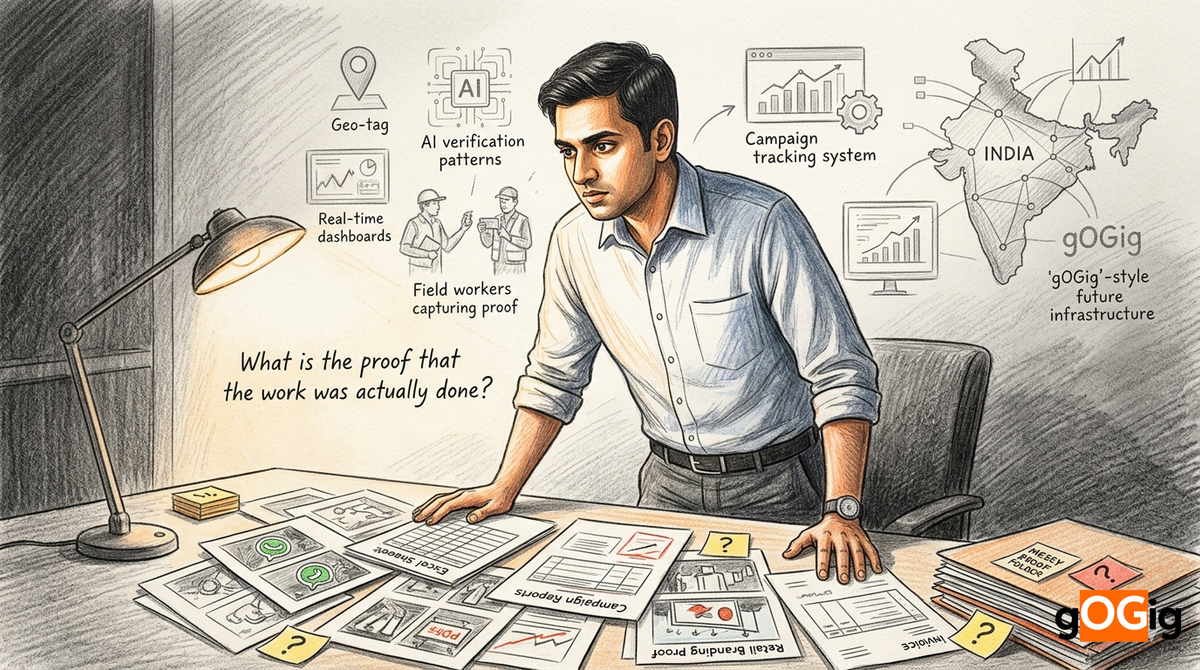
"What is the proof that the work was actually done?"
It was the brand manager's own question, asked half to the room and half to himself. On his desk were photographs. WhatsApp forwards. Excel sheets. PDFs. The proof he had asked for. He flipped through them with the expression of someone who had stopped expecting the proof to mean anything.
I sat in similar rooms over the next several months. Different brands. Different categories. Different cities. Same scene. The same question. The same folder of photographs. The same resigned acceptance from people whose job it was to verify execution they had no infrastructure to verify.
Every CMO and brand manager in India was approving crores in on-ground spend and then receiving a WhatsApp folder as the only proof. Not because they wanted to. Because no other system existed.
It was not malice. It was structure. Nobody had verified proof. Everyone was operating on trust. And trust, at scale, across hundreds of campaigns and thousands of field executors, breaks. Not in dramatic ways. In small, repeated ways that compound into the difference between what brands pay for and what they actually receive.
That afternoon, walking out of that office in Bangalore, the engineer in me kept circling back to one question. The same question that has shaped every line of code we have written since.
Why isn't there a system for this?
To understand why I could not let the question go, you have to understand the path that led me to it.
The early years
NIT Allahabad, Electronics & Communication Engineering
One of India's premier engineering institutions. The place where I learned to look at problems as systems before looking at them as inconveniences. The engineering mindset never left.
2014 to 2021
Samsung R&D Bangalore. Seven years as Technical Lead.
Building mobile technology at global scale. Two patents filed in mobile technology during this time. Learned how serious engineering teams ship serious products. Also learned how rare it is for that level of engineering to be applied to the unglamorous problems that actually move the Indian economy.
2021 to 2022
A year of searching for the right problem
Left Samsung to find a problem big enough, structural enough, and unsolved enough to commit the next decade to. Spent the year talking to founders, brand managers, agency heads, and operators across multiple industries. Watched how Indian businesses actually run versus how they are reported to run.
2022
The brand manager's office in Bangalore
The afternoon that turned the search into a decision. The question that nobody in the room could honestly answer. The realisation that the same question had no honest answer anywhere in the industry.
2023
First version of gOGig built
Started with WhatsApp-based capture, geo-tagging, and a simple dashboard. The hypothesis was that field teams would adopt it if it lived inside the app they already used. The hypothesis turned out to be right.
2024 onwards
First enterprise brands sign on. Then more. Then a category.
What started as one engineer trying to answer one question became the proof-of-work layer for India's physical economy. The category has a name now: Field Execution Intelligence.
Run your first campaign on gOGig, free
No contract. No commitment. Just real verified data on what is actually happening on the ground. The first number you get back is yours.
Book a demo →Samsung was not the obvious path to building a BTL verification platform. But the seven years there shaped how I approached the problem in ways I could not have planned.
India's BTL industry was full of heroic operators who held things together through sheer force of will. None of them scaled. Samsung taught me that the answer to a heroic problem is not a more heroic operator. It is a better system.
Mobile technology, the part you actually use, is mostly invisible engineering decisions stacked on top of each other for years. The same is true of accountability infrastructure. Nobody sees the verification engine. Everybody benefits from it.
In 2022, 'field execution intelligence' was not a phrase anyone used. There was no category, no analyst report, no venture pitch deck. The absence of the term was the opportunity. If everyone had been talking about it, someone else would already have built it.
The mobile teams I worked with shipped products to hundreds of millions of users. The technology mattered less than the friction at the first touch. That lesson translated directly to gOGig. We built on WhatsApp because field teams already used WhatsApp. Friction at adoption is the silent killer of every accountability platform.
Devleena
Co-founder & life partner
When your co-founder is also your life partner, everything becomes both harder and easier at the same time. Harder because the startup never really switches off. Easier because we are always on the same page. gOGig exists because two people decided to commit fully to one problem. Neither of us could have built this alone. Every conversation about gOGig at home is a conversation about gOGig at work. Every decision is two perspectives in the same room. The pressure compounds in both directions, and so does the resolution. People ask whether it is hard. The honest answer is yes. The more honest answer is that we would not change it.
Three years after that afternoon in Bangalore, the question that bothered me has produced an answer that more than two dozen Indian enterprise brands now rely on every day.
WhatsApp-native capture
Field teams submit through the app they already use. Zero new app installation. Zero training friction. The adoption barrier that killed every previous attempt removed at the source.
Geo-locked and time-locked proof
Every submission carries verified GPS coordinates and server-side timestamps that cannot be backdated or spoofed. The proof becomes evidence the moment it is created.
AI verification at submission
Duplicate detection, EXIF integrity, route reconstruction, and clustering anomalies flagged automatically. Catches at scale what no human reviewer could check.
Real-time accountability dashboard
Brand managers see execution as it happens, not weeks after. Course correction becomes possible while the campaign window is still open.
India's first Field Execution Intelligence platform. A single dashboard to verify, track, and analyse every physical task executed by a vendor ecosystem, in real time, without anyone going to the ground.
There is a specific type of moment that founders wait for without knowing they are waiting for it. The moment when the customer's relationship to the product moves from convenient to necessary. It happened for me on a phone call earlier this year.
A client called and said something I will never forget.
That sentence carries more in it than any growth metric we could put on a slide. The client was not telling us they wanted to stop using gOGig. They were telling us they wanted to use it deeply enough that they needed time to absorb what it was showing them. That is the moment a product crosses from useful to indispensable. It is also the moment a founder knows the years were worth it.
It is bigger than media inflation, bigger than agency margins, bigger than any single line item on a CMO's spreadsheet. It is invisible because everyone in the chain is structurally incentivised to keep it invisible. Naming it was the precondition to ending it.
Existing software categories (retail execution, field service management, field sales software) all touch parts of the problem. None of them was designed for India's specific structural realities. We had to name a new category. We called it Field Execution Intelligence.
Anybody can build geo-tagging. Anybody can train an image fingerprint model. The hard part is getting hundreds of thousands of field executors to actually submit through your platform every day. WhatsApp-native architecture is the unfair advantage that compounds over time.
For two years, we sold gOGig to marketing teams. The shift happened when finance teams started reviewing marketing accountability under BRSR and audit committee oversight. Now most enterprise deals have at least one CFO or finance head in the room. The product hasn't changed. The buying conversation has.
India has the largest informal physical economy of any major market. India has the WhatsApp penetration. India has the regulatory framework now pushing accountability. India has the agency density and the verification depth. The category will be defined in India and exported from India. That is the bet we are running.
Every founder thinks the first sale is the breakthrough. The truth is that the second sale, made without the founder energy of the first one, is the real proof that the product works.
Trying to convince an industry to adopt verification is a slow death. Finding the specific CMO at the specific brand who is ready to lead the change is a different problem entirely, and that one has answers.
Every time the platform catches a discrepancy that saves the client money, the client tells two other people. We have not spent on demand-generation marketing in any serious way. Verified outcomes do the marketing for us.
When the CFO joins the buying conversation, the deal stops being a marketing efficiency tool and starts being a financial control. The contract values follow accordingly.
For years, Indian buyers wanted to see a global comparable before adopting a category. That has changed. Indian CMOs are now comfortable being early adopters of categories that are larger in India than they are anywhere else.
If you are a brand running offline campaigns and relying on vendor reports, I want to show you what your ground reality actually looks like.
Your first campaign on gOGig is completely free. No contract. No commitment. Just real verified data from one campaign you would have run anyway. The number that comes back will become the most useful piece of brand intelligence you receive this quarter.
What is the proof that the work was actually done? In 2022, the brand managers I met did not have a good answer. In 2026, neither does anyone running BTL on Blind Trust. The difference is that now there is an alternative.
If you are a founder thinking about building in this category, I am happy to share what we have learned. If you are an investor curious about how the category will develop over the next five years, the conversation is open. If you are running BTL, OOH, field force, or trade activation at scale and you are tired of WhatsApp groups going silent and reports arriving too late, talk to us.
DM me on LinkedIn or book a demo on gogig.in. The question that started gOGig is the same question I want to help you answer for your own brand.
Your first campaign on gOGig is free
No contract. No commitment. One campaign, fully verified, with the data shown back to you in real time. If the number that comes back is useful, we talk. If it is not, no obligation.
29
Enterprise brands
241
Live campaigns
₹84L+
Billing caught
Written by
gOGig Research
gOGig Editorial Team
Was this article helpful?
Your feedback helps us write better content.