Single-vendor vs multi-vendor BTL campaign management: 2026 decision framework
2 min read

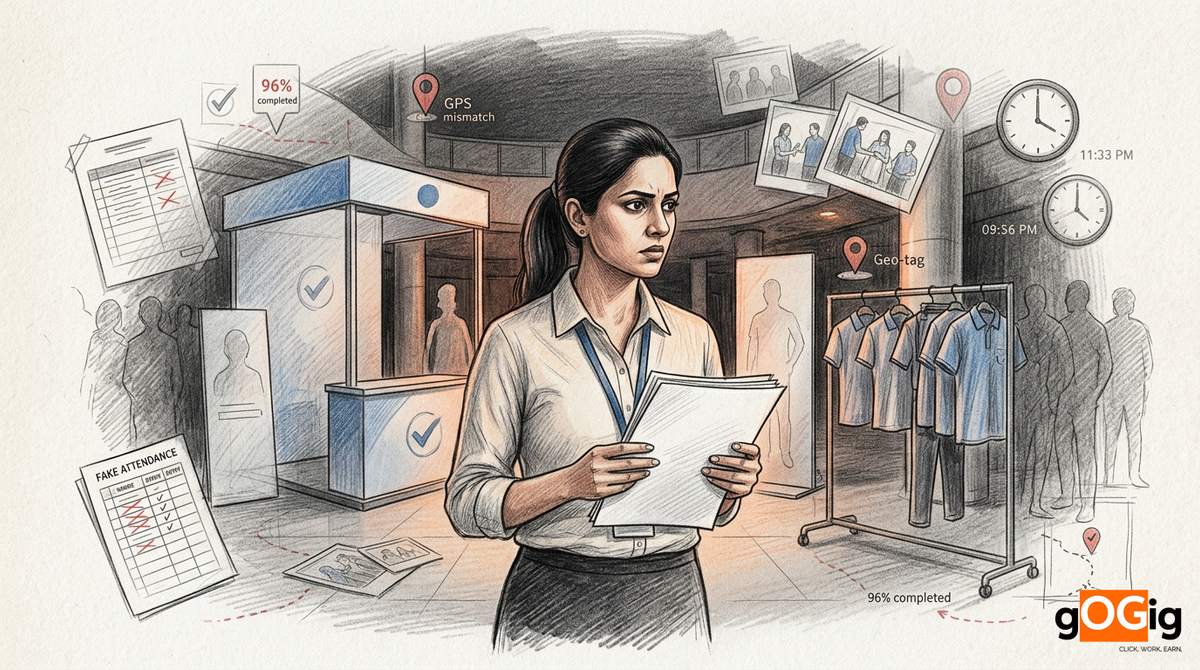
A mall activation that never happened. A 12-promoter team that was actually 4 people. A campaign reported at 96% completion that ran for 41 minutes. The single most common BTL fraud pattern in India, broken down into its mechanics, signals, and detection.
10–25%
Share of BTL activations in India that are partial, hollow, or completely ghosted. The most common single fraud pattern affecting brand managers running on-ground campaigns.
At 11:47 AM, the brand manager opens the campaign WhatsApp group. A photo just arrived. A mall activation in Indore with 12 promoters in branded T-shirts, a kiosk, and a queue of customers. The metadata is gone, stripped by WhatsApp. The brand manager taps "thumbs up". 6 hours later, the campaign report will say "executed successfully." Except none of it happened that way. This is what a ghost activation looks like.
| Definition layer | What it means |
|---|---|
| Total ghost | Activation reported as executed but did not happen at all |
| Partial ghost | Activation happened but at smaller scale than billed |
| Hollow ghost | Activation happened but for shorter duration than billed |
| Location ghost | Activation happened, but at a different (cheaper) location |
| Manpower ghost | Activation had fewer promoters than billed |
| Setup ghost | Activation happened but branded setup was incomplete or missing |
Type 1: Total ghost (most expensive, least common)
The activation never happened. No team showed up. No setup occurred. Photos were fabricated or recycled from prior campaigns. Found in 2–5% of activation submissions.
Type 2: Partial ghost (most common, hardest to spot)
Activation happened at half the contracted scale. 12 promoters billed, 6–8 actually deployed. The remaining promoter names are fabricated. Found in 12–18% of activation submissions.
Type 3: Hollow ghost (duration manipulation)
Activation contracted for 8 hours. Actually ran for 3–4 hours. Setup photos taken at start, then team packed up. Found in 18–25% of mall and promoter activations.
Type 4: Location ghost (geographic substitution)
Activation contracted at Premium Mall A. Actually executed at smaller Mall B nearby (lower rental, lower visibility). Footfall data falsified. Found in 5–10% of mall activations.
Type 5: Manpower ghost (specific to attendance fraud)
Promoters listed on attendance sheets who were never deployed. Names borrowed from previous campaigns. Found in 15–22% of multi-promoter deployments.
Type 6: Setup ghost (branding incompleteness)
Activation happened but full branded setup was not installed. Banners missing, kiosks half-assembled, POSM not deployed. Found in 8–15% of activations.
₹45,000 RWA activation contracted at a premium gated community in Hyderabad. Saturday morning slot. 6 promoters. 4 hours. Sampling, lead capture, branded setup. Here is what was contracted vs what happened.
| Element | Contracted | What actually happened |
|---|---|---|
| Location | Premium gated community, 800 households | Smaller mid-tier society, 220 households |
| Duration | 4 hours (9 AM-1 PM) | 1 hour 47 minutes |
| Promoter count | 6 | 3 |
| Promoter wages billed | ₹12,000 (6 x ₹2,000) | ₹4,500 (3 x ₹1,500) |
| Setup | Full kiosk + 4 banners + POSM | 1 banner + folding table |
| Sample distribution | 500 samples planned | 187 distributed |
| Leads captured | 120 expected | 34 actual, 50 fabricated |
| Photos submitted | 15 expected | 4 fresh + 6 recycled |
| GPS coordinates | Premium society zone | 3.2 km away from contracted location |
| Timestamps | 9 AM-1 PM range | 11:13 AM-12:58 PM only |
| Billed value | ₹45,000 | Should have been ₹14,200 |
| Hidden loss | - | ₹30,800 (68% ghost) |
Friday 8:42 PM
Activation team gets the brief. Agency forwards the SOW to the regional vendor. Saturday morning slot. ₹45,000 budget. 6 promoters, 4 hours, premium society.
Friday 11:30 PM
Vendor realises cost overrun. Calling 6 promoters at short notice will cost ₹2,000 each. Premium society permission requires extra ₹3,000. Margin compressed. Vendor decides to optimise.
Saturday 10:54 AM
Team arrives at substitute location. 3 promoters instead of 6. Mid-tier society instead of premium. Setup begins quickly with reduced infrastructure.
Saturday 11:13 AM
First "real" photo taken. Team has setup ready. Photo captured at substitute location. Vendor immediately starts WhatsApp uploads to make the timeline look longer.
Saturday 11:24 AM
Photo "from 9:30 AM" submitted. Photo from a previous campaign with similar setup, forwarded into the campaign group. WhatsApp strips the original timestamp. Brand manager sees fresh-looking photo.
Saturday 12:58 PM
Team begins packing up. 1 hour 47 minutes since real start. Team has captured enough photos. Distribution is still incomplete (187 of 500 samples).
Saturday 1:15 PM
Final "wrap-up" photo submitted. Photo timestamped to look like 1 PM. Brand manager sees a complete-looking activation timeline.
Saturday 6:30 PM
Excel attendance sheet shared. 6 promoter names listed. 3 names borrowed from previous campaigns. Brand manager accepts; no identity verification.
Saturday 8:42 PM
Lead list shared. 84 leads submitted (34 real + 50 fabricated names and phone numbers). Brand manager queues for first-call follow-up next week.
Monday
Invoice raised at ₹45,000. Standard PO match. Procurement approves. ₹30,800 of ghost activation enters the brand's books as legitimate spend.
Following Wednesday
First-call follow-up fails. Marketing team tries to call 50 of the 84 leads. 38 numbers are wrong or invalid. Brand manager notes it as "lead quality issue" -- not "ghost activation."
The contracted location
Assumed to be
Photos of "the activation venue"
Actually is
Activation occurred 3.2 km away at a smaller society with lower permission cost.
The 6 promoters billed
Assumed to be
Attendance sheet listing 6 names
Actually is
3 promoters deployed. 3 names borrowed from previous campaign attendance sheets.
The 4-hour duration
Assumed to be
Photos timestamped across 9 AM-1 PM
Actually is
Team active from 11:13 AM to 12:58 PM. Earlier photos recycled from previous campaign.
The full branded setup
Assumed to be
"Setup complete" message in WhatsApp
Actually is
1 banner + folding table. No kiosk, no POSM, no full branding.
The 500 sample distribution
Assumed to be
"Samples distributed" in agency report
Actually is
187 distributed. Remaining stock returned to vendor warehouse.
The 120 leads captured
Assumed to be
84 leads on the lead list
Actually is
34 real leads. 50 fabricated phone numbers.
The "high-footfall" venue
Assumed to be
Premium gated community claim
Actually is
Mid-tier society with 220 households (vs 800 contracted).
The supervisor sign-off
Assumed to be
WhatsApp voice note "all done sir"
Actually is
Voice note from vendor coordinator, not on-site supervisor.
Signal 1: GPS coordinates 1–5 km off contracted location
If EXIF GPS doesn't match the contracted venue, the activation likely happened elsewhere. WhatsApp standard mode strips this -- so a brand never sees it without verification platform.
Signal 2: Photo timestamp 1–3 hours earlier or later than expected
Photos arriving in 30-minute bursts at start and end of contracted window, with no activity in between, suggests setup-and-leave pattern.
Signal 3: Lead list with high call-failure rate
If more than 25–30% of submitted leads have invalid phone numbers or never answer, those leads are likely fabricated.
Signal 4: Photo metadata stripped (WhatsApp standard mode)
All photos lacking GPS, capture timestamp, and device data means the verification chain is broken before review even begins.
Signal 5: Same backdrop appearing across multiple activation photos
If 3 of your activations across different cities show the same wall, same banner pattern, or same lighting, image fingerprinting will flag duplicate proofs.
Signal 6: Attendance sheet names that don't match payroll records
If "Sunil Kumar" appears on the attendance sheet but does not exist in vendor payroll, the name is borrowed from a prior campaign.
Signal 7: Sample stock not returning to warehouse
If 500 samples were issued and 187 distributed, the remaining 313 should return. If they don't, samples may be diverted, suggesting partial-execution ghost.
Signal 8: "All done sir" voice notes without identity verification
Voice notes purporting to be from supervisors without callable phone numbers or on-site coordinates are unverifiable signals.
Signal 9: End-of-day photo dumps
If all activation photos arrive after 6 PM despite a morning slot, the photos are likely consolidated end-of-day uploads, not real-time captures.
Signal 10: Footfall claims that don't match society / venue size
If a 220-household society generates "800 footfall," the math doesn't work. Venue capacity needs to be validated against claims.
| Industry | Ghost rate in BTL activations | Most common ghost type |
|---|---|---|
| FMCG (sampling drives, society activation) | 20–28% | Partial ghost (manpower) |
| Consumer durables (mall activations) | 15–22% | Hollow ghost (duration) |
| Pharma (doctor / chemist visits) | 22–30% | Manpower ghost |
| BFSI (lead generation events) | 25–35% | Lead fabrication ghost |
| Telecom (dealer activation, mall events) | 18–25% | Setup ghost |
| Auto & 2-wheeler (RWA, showroom events) | 15–22% | Location ghost |
| Real estate (society activations) | 22–32% | Hollow ghost |
| Edtech (school/college campaigns) | 30–40% | Lead fabrication ghost |
| D2C brands (multi-venue activations) | 28–38% | Total ghost (sample diversion) |
| QSR (mall and retail activations) | 15–22% | Partial ghost |
| Format | Ghost rate | Typical ghost mechanism |
|---|---|---|
| Mall activations | 18–25% | Hollow + manpower (duration + headcount) |
| RWA / society activations | 22–32% | Location + duration + manpower |
| Sampling drives at outlets | 20–28% | Sample diversion + skipped outlets |
| Promoter deployment in retail | 15–22% | Idle time + early departure |
| Roadshow stops | 18–25% | Skipped stops + truncated duration |
| College / campus activations | 25–35% | Lead fabrication + duration |
| Lead generation events | 30–40% | Phone number fabrication |
| Dealer / channel partner events | 15–22% | Attendance fraud + setup |
| Trade fair activations | 10–15% | Footfall claim inflation |
| Activation type | Typical cost per activation | Typical ghost loss |
|---|---|---|
| Mall activation (small kiosk) | ₹35,000–60,000 | ₹8,000–18,000 |
| Mall activation (premium) | ₹80,000–2.5 lakh | ₹20,000–75,000 |
| RWA / society activation | ₹25,000–65,000 | ₹8,000–30,000 |
| Sampling drive (per day per city) | ₹40,000–1.2 lakh | ₹12,000–35,000 |
| Roadshow stop | ₹50,000–1.5 lakh | ₹15,000–45,000 |
| Promoter deployment (8-hour, 4 promoters) | ₹15,000–25,000 | ₹4,000–9,000 |
| Lead generation event | ₹40,000–1.5 lakh | ₹12,000–50,000 |
| Dealer event | ₹80,000–3 lakh | ₹20,000–90,000 |
| Annual portfolio size | Number of activations | Ghost loss (20% rate) | Ghost loss (30% rate) |
|---|---|---|---|
| ₹1 Cr annual BTL | ~80–120 activations | ₹16–22 lakh | ₹24–32 lakh |
| ₹5 Cr annual BTL | ~400–600 activations | ₹80 lakh–1.1 Cr | ₹1.2–1.6 Cr |
| ₹25 Cr annual BTL | ~2,000–3,000 activations | ₹4–5 Cr | ₹6–8 Cr |
| ₹100 Cr annual BTL | ~8,000–12,000 activations | ₹16–22 Cr | ₹24–32 Cr |
Detect ghost activations on your next campaign.
Run one upcoming BTL activation through gOGig's verification engine. See real-time GPS, EXIF, and AI-verified evidence. Free first audit, no commitment.
Detect ghost activations now →| Invisibility driver | Mechanism |
|---|---|
| WhatsApp metadata stripping | GPS, capture time, EXIF removed in standard photo mode |
| Recycled photo undetectability | Without image hash fingerprinting, the same photo can pass through 5+ campaigns |
| Self-reported attendance | Names on Excel sheet not cross-referenced against payroll |
| End-of-day batch reporting | Photos arrive in bulk; brand manager cannot reconstruct true timeline |
| Footfall numbers self-declared | Society / venue capacity never validated |
| Voice note as supervisor verification | "All done sir" treated as proof; no identity check |
| Manual audit infeasibility | 5–10% of activations physically audited; rest invisible |
| Re-execution cost premium | Brand absorbs gap rather than re-execute at 30–60% premium |
| Method | What it catches | Reliability |
|---|---|---|
| Geo-fenced check-in (mandatory) | Location ghost | 92–96% |
| EXIF + GPS cross-match | Photo-source spoofing | 88–94% |
| Server-side timestamp validation | Hollow ghost (duration) | 95–99% |
| Image hash fingerprinting | Recycled photo / total ghost | 95–98% |
| Mock-location detection | GPS spoofing | 85–92% |
| Face recognition + selfie verification | Manpower ghost | 90–95% |
| OTP-verified lead capture | Lead fabrication ghost | 95–99% |
| Accelerometer cross-check | Static device claiming activity | 88–93% |
| Cross-campaign clustering | Multi-brand ghost detection | 85–92% |
| Real-time dashboard visibility | Live anomaly surfacing | Real-time |
Without verification
₹45,000 invoice approved. ₹30,800 ghost loss absorbed. 6 promoters billed (only 3 deployed). 4-hour activation reported (1h 47m actual). 84 leads received (50 fabricated). Brand manager has no visibility into the gap.
With FEI verification
GPS flagged: 3.2 km off. Timestamp gaps surfaced in real time. Image hash detected 6 recycled photos. Lead OTP failure rate 60%. Variance window opened. Invoice adjusted to ₹14,200. ₹30,800 protected.
| Growth driver | Mechanism |
|---|---|
| Compressed festive cycles | 35% of annual BTL in 60-day festive window leaves no margin for execution control |
| Fragmented vendor pools | 14+ regional vendors per campaign = more verification gaps |
| Rising minimum activation costs | ₹2,000+ per promoter / day vs ₹600 a decade ago creates vendor margin pressure |
| Tier-2 / tier-3 expansion | Lower supervision density = higher ghost rate (28–34% in rural) |
| WhatsApp as default workflow | Metadata stripping makes ghost photos undetectable |
| Mock-location app accessibility | Free Play Store apps spoof GPS at scale |
| Lead-based incentive models | Performance-pay structures incentivise lead fabrication |
| Quick-commerce promoter scarcity | Real promoters in short supply during peak slots; vendors borrow attendance |
Day 1: Pick one recent activation campaign
Choose a campaign closed within the last 30 days. Export the full submission and reporting dataset.
Day 2: Cross-match attendance against payroll
List every promoter name billed. Cross-check against vendor's payroll record. Flag any names that don't match.
Day 3: Geo-validate photo locations
Pull GPS coordinates from photos (if available). Compare with contracted venue addresses. Flag anything 1+ km off contract.
Day 4: Run image hash fingerprinting
Compare submitted photos across the last 3 campaigns. Flag any duplicates or near-duplicates.
Day 5: Call 10% of the leads submitted
Random sample of phone numbers from lead capture. If more than 20% are wrong or never answer, lead list is partially fabricated.
Day 6: Validate footfall vs venue capacity
Match claimed footfall against the venue's known maximum capacity. Flag any claims exceeding venue size.
Day 7: Build the ghost exposure report
Aggregate flags into a single document. Calculate total exposure in rupees. This is your ghost activation baseline.
| Change | Mechanism |
|---|---|
| Vendor behaviour recalibrates within 14 days | Vendors who realise verification is active stop ghosting |
| Genuine vendors see payment cycles shorten | Clean execution accelerates Net 30 -> Net 12–15 |
| Ghost vendors face contract review | Repeated variance triggers Clause 7 termination risk |
| Brand manager spends less time scrolling WhatsApp | Real-time dashboard replaces 320 hrs/quarter manual reconciliation |
| CFO can finally answer the audit committee | "This is how much we verify, this is how much we don't" |
| BRSR Core readiness improves | Value chain disclosures become substantiable |
| Year of FEI | Ghost rate (industry typical) | Ghost rate (FEI active) |
|---|---|---|
| Year 0 (baseline) | 20–28% | 20–28% |
| Year 1 | 20–28% | 8–12% |
| Year 2 | 20–28% | 5–8% |
| Year 3 | 20–28% | 3–5% |
| Year 4–5 (steady) | 20–28% | 2–3% |
| Signal | If present, ghost likelihood |
|---|---|
| All photos arrive after 6 PM for a morning activation | High |
| Attendance sheet uses repeated names across 3+ campaigns | High |
| Lead list has 25%+ invalid phone numbers | Very High |
| Footfall claim exceeds venue capacity | Very High |
| Photos missing all EXIF metadata | Medium-High |
| Photos show same backdrop across cities | High |
| Supervisor voice notes never with on-site coordinates | Medium |
| Sample stock not reconciling with distribution claims | High |
| Vendor consistently reports 95%+ execution | Medium |
| Photo timestamps cluster at start and end, gaps in middle | High |
| No video evidence requested or available | Medium |
| Activation runs at vendor-chosen "convenient" location | High |
| Capability | Detection latency | Action triggered |
|---|---|---|
| Geo-fence violation | At submission (3s) | Auto-flag, hold from verified count |
| Timestamp pre-dating | At submission (3s) | Auto-reject submission |
| Mock-location app active | At submission (3s) | Auto-reject + vendor escalation |
| Image hash duplicate | At submission (3s) | Auto-reject + pattern flag |
| Lead OTP failure | Within 24 hours | Lead disqualified from billing |
| Footfall vs capacity mismatch | At submission | Manual review flag |
| Attendance vs payroll cross-check | End of day | Discrepancy report to brand |
| Cross-campaign clustering | Within minutes | Investigation queue |
Pick the next BTL activation campaign in your calendar
Choose a mid-size activation in the next 7–14 days. ₹15–50 lakh range is ideal for a first audit.
Activate verification at submission
Move that campaign onto a Field Execution Intelligence platform. Vendors continue using WhatsApp; verification runs in the background.
Set the 7-day check-in cadence
Review the verification dashboard daily for the first 7 days. Most ghost patterns surface within the first week.
Compare verified vs reported
At day 7, compare the agency-reported execution rate against the verified rate. The gap is your first ghost measurement.
Bring the CFO into the next review
The first verified data point converts the BTL conversation from marketing efficiency to financial control.
Document the case for organisation-wide rollout
One verified campaign becomes the foundation for adding PBP clauses to all BTL MSAs.
BTL and field execution formats with the highest rates of ghost activations in India.
Indian cities where ghost activations are most prevalent based on gOGig FEI data.
Detect ghost activations on your next campaign
Run one upcoming activation through gOGig's verification engine. See real-time GPS, EXIF, AI image verification, and lead OTP validation. First audit is free.
20–28%
Typical ghost rate
8–12%
After 1 year of FEI
2–3%
Steady state
Written by
Fraud Intelligence Team
The gOGig Editorial team publishes original research on field execution fraud patterns, BTL accountability, and detection methodologies for India's physical economy.
Was this article helpful?
Your feedback helps us write better content.