Single-vendor vs multi-vendor BTL campaign management: 2026 decision framework
2 min read

India has spent twenty years optimising what brands say. It has barely begun measuring what brands do. Field Execution Intelligence is the category that closes that gap. This is the long-form case for the term, the discipline, and the operating standard.
₹80,000 Cr
India's annual physical economy spend across BTL, OOH, field force, trade activation, and on-ground vendor work. The category Field Execution Intelligence was built to measure.
A senior CMO at one of India's largest FMCG brands looks at her quarterly review deck. Twelve campaigns. ₹47 crore deployed across BTL, OOH, sampling, and retail visibility. Every campaign marked green. Every execution report self-certified by the agency. She asks her team one question. "Show me one campaign where we have independent proof of what actually happened." Silence. That silence is the reason this category needs to exist.
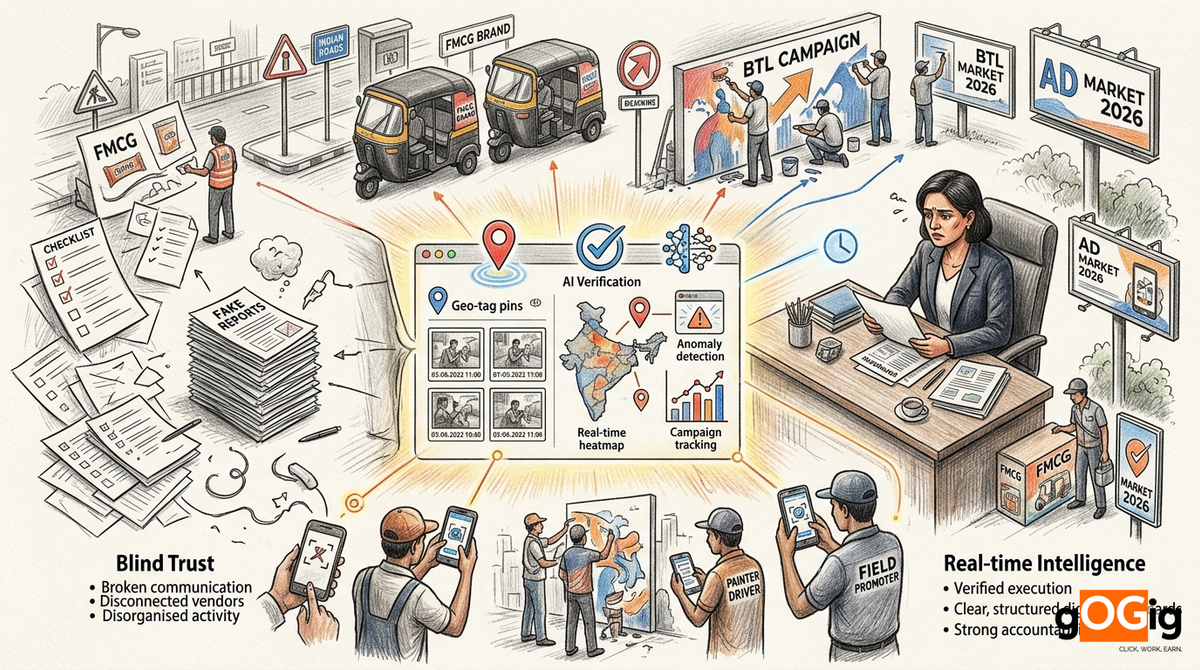
Field Execution Intelligence is the category of platforms that turn offline, on-ground work into structured, verified, real-time digital proof. It combines geo-tagged capture, AI image and pattern verification, time-locked submission, and unified accountability dashboards into one infrastructure layer that sits above older categories like field force tracking, retail audit, or trade promotion management.
| Word | What it means | What it rejects |
|---|---|---|
| Field | Physical, on-ground work. The world outside the dashboard. Vendors, promoters, technicians, salespeople, painters, drivers, surveyors. | Office-bound or virtual-only work. Anything that does not require a human at a specific place at a specific time. |
| Execution | What actually happens, not what was planned. The verified delivery, not the brief. The footprint, not the proposal. | Strategy, plan, intent, or report. Documents that describe execution are not execution. |
| Intelligence | Actionable insight from verified data, surfaced in time to change outcomes. AI-driven anomaly detection. Pattern recognition. Not just a log file. | Passive tracking. Tools that record events but never act on them. Dashboards that document failure without enabling correction. |
Field Execution Intelligence is the proof-of-work layer for the physical economy. It is what analytics is to digital marketing, what BARC is to television, and what ABC is to print. Until 2026, this layer did not exist for India's on-ground work.
Category creation is one of the highest-leverage moves in B2B software. Companies that define and own a category capture disproportionate value. The most successful examples in the last decade prove the pattern.
Gong
Created Revenue Intelligence. Took sales call recording and reframed it as a strategic discipline that connects every customer conversation to revenue outcomes.
$7.25B
Valuation
HubSpot
Coined Inbound Marketing. Renamed the practice of attracting customers with content into a movement, then built the platform that became its default infrastructure.
$30B+
Market cap
Slack
Did not call itself a chat tool. Created the collaboration hub category, repositioning email and meetings as the legacy alternative.
$27.7B
Acquisition
SafetyCulture (iAuditor)
Created Frontline Operations Platform. Took inspection checklists and reframed them as the operating system for everyone doing real work outside an office.
$2.7B AUD
Valuation
Salesforce
Defined SaaS itself as a category. Reframed enterprise software from one-time license sales to recurring revenue infrastructure.
$300B+
Market cap
Gainsight
Established Customer Success as a discipline, then created the software category that powers it. Launched a function inside enterprise organisations that did not exist before.
$1.1B
Valuation
Three adjacent categories exist globally that touch parts of what FEI covers. None of them solve the full Indian problem. Below is how FEI sits relative to each.
| Adjacent category | Global market size | What it covers | What it misses for India |
|---|---|---|---|
| Retail Execution Software | $304M (2025) | In-store audits, planogram compliance, POS data, merchandising | Built for organised retail. Misses 85% of Indian retail that runs through kirana, dealers, and rural outlets. Does not cover OOH, BTL, or field force. |
| Field Service Management | $5.49B (2025) | Technician scheduling, dispatch, work orders, asset tracking | Built for service technicians (telecom, HVAC, utilities). Does not cover marketing execution, BTL, OOH, or trade promotion. |
| Field Sales Software | $2.8B (2023) | Sales rep route planning, CRM sync, daily call reports | Self-reporting by design. The same person executes and reports. Does not include independent verification, which is the entire point of FEI. |
| EHS / Audit Platforms | $3.1B (2024) | Compliance inspections, safety audits, frontline checklists | Built for safety and compliance, not marketing accountability. Generic forms not tuned to Indian BTL fraud patterns. |
No existing category fits because no existing category was built for the structural realities of India's physical economy: 13 million kirana stores, 7.5 million security guards, 12,000+ pharma reps per major brand, 20,000-outlet sampling campaigns, and 50,000 sq ft wall painting programs across 200 villages. FEI is built for that scale.
FEI is not a single feature. It is a discipline composed of five interlocking capabilities. A platform that delivers fewer than four of these is doing field force tracking or retail audit, not Field Execution Intelligence.
Geo-locked capture
Every execution event tagged with verified GPS coordinates at the moment of submission. Mock-location spoofing detected and flagged. EXIF data cross-verified against submission metadata.
Time-locked submission
Server-side timestamps that cannot be backdated. Photos taken in advance get caught at the upload window. The temporal claim is enforced as part of the data structure.
AI verification at submission
Duplicate image detection, EXIF integrity checks, route reconstruction, and clustering anomalies flagged automatically. Catches at scale what no human reviewer could check manually.
Multi-format unification
Wall painting, mobile vans, pole boards, retail audits, sales visits, technician installs, and security patrols measured in one consistent data model. One dashboard. One source of truth.
Real-time accountability dashboard
Brand managers see execution status as it happens, not weeks after the campaign ends. Gaps surface while the campaign window is still open. Course correction becomes possible.
Audit-grade reporting
Verification trails survive regulatory scrutiny, internal audit, and CFO-level demand for proof. Reports export as evidence with full chain-of-custody, not as opinion.
Read the Field Execution Intelligence Manifesto
The full doctrine of what the category stands for, why it had to be created, and what changes when an industry adopts it. Twelve pages. Free download.
Download the FEI Manifesto →FEI is not a horizontal SaaS category that applies to everyone in marketing. It is purpose-built for a specific set of buyers who operate at the intersection of large physical spend and weak verification infrastructure.
CMOs and senior marketers
Responsible for marketing accountability at board level. Need to answer "where did the BTL spend actually go?" with evidence, not estimates. FEI is the answer infrastructure.
Primary
BUYER
Heads of trade marketing & field operations
Run the day-to-day deployment of activations across hundreds or thousands of locations. Need real-time visibility into what is happening on the ground while the campaign is running.
Primary
USER
CFOs and finance leadership
Increasingly responsible for marketing spend governance. Want audit trails that survive board reviews and external auditors. FEI is their controls layer for the physical economy.
Strategic
BUYER
BTL and activation agencies
Forward-looking agencies use FEI as a competitive differentiator. Verification capability becomes a premium service tier that wins business away from competitors.
Partner
CHANNEL
OOH media companies
Need to prove client-facing execution at scale across thousands of sites. FEI is the verification layer that converts photo proof into audit-grade evidence.
Vertical
BUYER
Internal audit and procurement
New stakeholder for marketing accountability. FEI provides the evidence base for Proof Before Payment contract clauses and quarterly governance reviews.
Influencer
STAKEHOLDER
FEI does not replace agencies or vendors. It replaces the operating standard those agencies and vendors have worked within for forty years. Blind Trust is what FEI displaces. The transition has measurable phases.
The Blind Trust era
Vendor reports execution. Brand pays based on report. WhatsApp groups serve as proof system. Audit, if any, runs months later. Course correction impossible. ₹15,000 crore leak unmeasured and unaddressed.
The Field Execution Intelligence era
Every execution event captured with geo-lock and time-lock. AI flags anomalies at submission. Real-time dashboards surface gaps mid-campaign. CFOs receive audit-grade evidence. Course correction becomes routine.
Level 1 - Self-reported: Agency-submitted execution reports. Photos in WhatsApp groups. No GPS, no timestamp lock, no third-party verification. The default state for most Indian brands until 2024.
Level 2 - Photo-tagged: Photos with manual location tags. Brand asks for 'GPS-tagged photos' but accepts whatever the agency submits. No verification of whether the tags are authentic. Slightly better, still self-reported.
Level 3 - Geo-verified: Real GPS lock at the moment of capture. Some duplicate detection. Server-side timestamps. The minimum bar for credible field verification. Where most early-stage adopters land.
Level 4 - AI-verified: Image fingerprinting. EXIF cross-checks. Route reconstruction. Anomaly detection across thousands of submissions. The level at which fraud patterns can be detected before invoicing.
Level 5 - Field Execution Intelligence: Multi-format unification, real-time dashboards, audit-grade reports, CFO-ready evidence trails. Verification embedded in the campaign workflow rather than added afterwards. The new operating standard.
Field Execution Intelligence could not have existed five years ago. Three structural shifts converged in 2024 and 2025 to make the category not just viable but inevitable.
WhatsApp-native architecture
India has 500 million-plus WhatsApp users. Field teams already live inside it. Verification platforms built as WhatsApp workflows eliminate the adoption friction that killed every previous attempt at field tracking. No new app to install. No new behaviour to learn.
AI at the inference edge
Image fingerprinting, EXIF anomaly detection, GPS validation, and clustering analysis are now possible at submission cost of fractions of a rupee per image. The marginal cost of verifying one more execution event has dropped near zero. AI made verification economically viable at scale.
CFO entry into marketing accountability
Indian CFOs and audit committees now treat unverified BTL spend as a controls weakness, not a marketing inefficiency. Quarter-end finance reviews flag campaign execution audit trails as a governance requirement. The cost of running unverified now exceeds the cost of verification.
The data moat advantage for the first mover
Whoever builds first gets the largest proprietary dataset of Indian field execution patterns. That dataset becomes the platform's fraud detection engine and the basis for every benchmark, report, and industry insight the category ever publishes. A moat that compounds with every submission.
The ESG and governance overlay
Listed Indian brands now face ESG reporting requirements that extend to marketing supply chains. Unverified field execution is increasingly flagged in governance reviews. FEI is the infrastructure that produces the disclosures these frameworks require.
Category adoption changes the buying cycle, the contracts, the agency mix, and the metrics that get reported to the board. The shift is measurable at each level.
CMOs can answer "where did the spend go?" with verified data, not estimates
Course correction becomes possible while campaigns are still running
Re-execution costs drop by 30–60% because issues are caught at week 1, not week 8
CFOs receive audit-grade evidence quarterly, not anecdotal photos
Marketing accountability becomes a board-level metric alongside ROAS
Verification capability becomes a competitive differentiator in pitches
Billing disputes drop sharply because execution is documented at the moment it happens
Payment cycles shorten because Proof Before Payment turns into Proof Equals Payment
Agency margins improve through reduced rework and faster collections
Forward-looking agencies adopt a "Verified by gOGig" badge in their pitch decks
Procurement teams add Proof Before Payment clauses to standard vendor contracts
Internal audit teams flag unverified BTL spend as a governance weakness
The market starts rewarding transparency because transparency has a measurable number
Industry benchmarks emerge for execution accountability rates by sector and city
Regulators and ESG frameworks reference FEI standards in disclosure requirements
Marketing has had analytics for a decade. The physical economy has waited a generation. Field Execution Intelligence is what it has been waiting for.
Every category creates its own vocabulary. The terms below are the operating language of Field Execution Intelligence. Adopting the category means adopting the words.
| Term | Definition | Replaces |
|---|---|---|
| Ground Truth | What actually happened on the ground, verified independently | 'The agency report' |
| Blind Trust | Paying for work before verifying it happened | 'How things are done' |
| Proof Before Payment | Contractual standard requiring verified execution prior to invoice approval | 'Net 30 on report' |
| Geo-lock | GPS coordinate captured and validated at the moment of submission | 'Photo with location tag' |
| Time-lock | Server-side timestamp that cannot be backdated or manipulated | 'Photo timestamp' |
| Verification rate | The percentage of reported execution that can be independently confirmed | 'Execution percentage' |
| Accountability gap | The difference between agency-reported execution and platform-verified execution | 'The shortfall' |
| Audit trail | Chain of custody documentation surviving regulatory and board-level scrutiny | 'The folder of photos' |
Brands do not need to rebuild their full marketing stack overnight. The sequence that has worked for the earliest adopters is staged, measurable, and reversible at each step.
CMO has named FEI as the operating standard in a leadership briefing
CFO has approved verification as a budget line, not a project expense
Procurement has added Proof Before Payment to standard vendor contracts
Internal audit has signed off on the verification platform as audit-grade evidence
Agencies have been briefed on the new verification requirement
First quarter of measured accountability gap has been presented to the board
Category vocabulary (Ground Truth, Proof Before Payment, Verification Rate) is used in internal meetings
A category in its first 24 months looks different from one at the 5-year mark. Below is the trajectory we expect for FEI in India, based on how comparable categories matured in their home markets.
| Stage | Timeline | Indicator |
|---|---|---|
| Category named and defined | 2025–2026 | The term enters trade publications, analyst briefings, and CMO vocabulary. Where FEI is now. |
| Industry adoption begins | 2026–2027 | First 100 Indian brands adopt FEI as a contractual standard. Proof Before Payment clauses enter procurement playbooks. |
| Analyst recognition | 2027–2028 | Gartner, Forrester, or IDC publishes their first FEI category report. Independent benchmarks emerge. |
| Regulatory referencing | 2028–2030 | SEBI, MCA, or ESG frameworks reference FEI standards in disclosure requirements for listed brands. |
| Global expansion | 2028–2032 | The category, proven in India, expands to Middle East, Southeast Asia, and other emerging markets with similar structural fits. |
| Default operating standard | By 2030 | Field Execution Intelligence becomes the assumed default for Indian on-ground marketing, the way digital analytics became the default in 2010. |
Define the new operating standard for your brand
Field Execution Intelligence is the discipline. gOGig is the platform that brought it to India first. Run a pilot on your next BTL campaign. See your accountability gap in 30 days.
₹80,000 Cr
India physical economy
₹15,000 Cr
Estimated annual leak
20–30%
Typical unverified share
Written by
gOGig Research
gOGig Editorial Team
Was this article helpful?
Your feedback helps us write better content.