Single-vendor vs multi-vendor BTL campaign management: 2026 decision framework
2 min read

For forty years, Indian brands have paid for on-ground work based on the executor's own word. The cost of that arrangement has finally been audited. This is the evidence, the case, and the verdict.
₹20,000 Cr
Upper-bound annual accountability gap from unverified on-ground marketing execution in India. This blog presents the evidence, brand by brand, audit by audit, regulation by regulation.
A finance director at a top-100 Indian listed company opens the latest BRSR Core assurance report. The auditor has flagged the marketing supply chain as a "controls weakness." Three quarters of activation spend, ₹62 crore last year, was approved on the basis of agency self-reports with no third-party verification. The finance director asks the CMO a single question. "If SEBI asks us to prove this spend in our value chain disclosure, what evidence do we present?" The room goes quiet. The cost of Blind Trust just became a regulatory exposure.
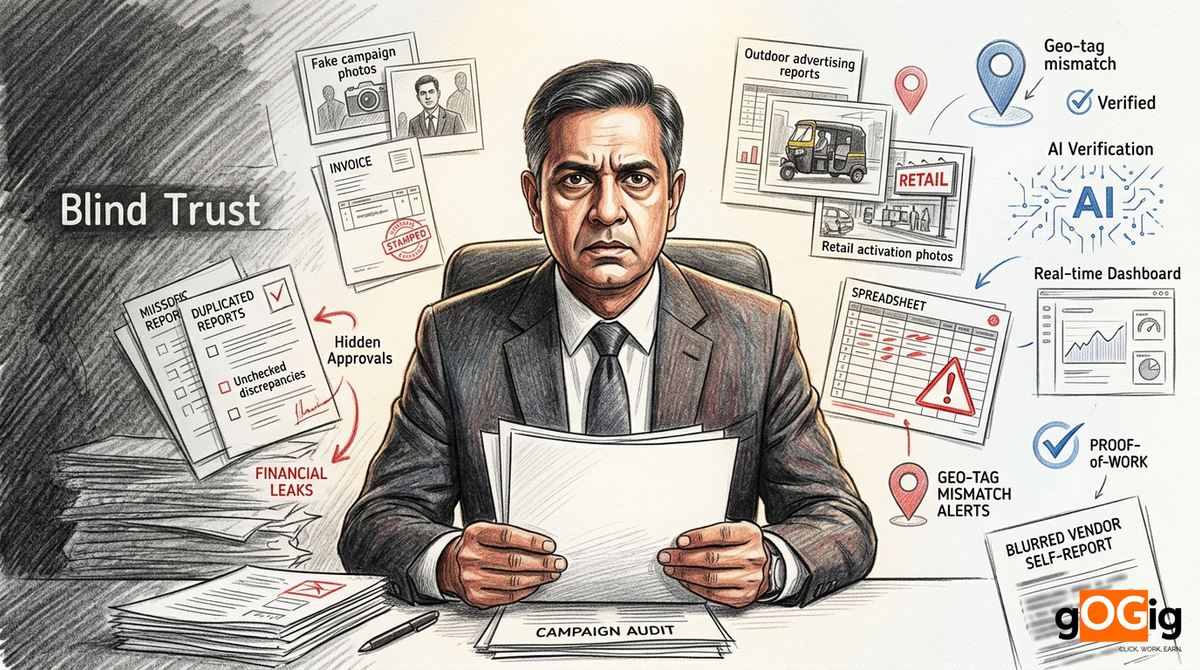
Blind Trust is the default operating standard in India's physical economy. It is the arrangement where a vendor executes the work, reports on its own execution, and the brand pays based on that self-report. The brand has no independent way to verify what actually happened. Blind Trust is not malice. It is the inheritance of forty years of marketing operations that had no alternative.
| Feature | How it operates | What it produces |
|---|---|---|
| Executor equals reporter | The agency or vendor doing the work is the same party producing the proof of work | Structural conflict of interest. Self-report becomes the only source of truth. |
| Verification post-facto | Audit, if it happens, runs weeks or months after the campaign ends | By the time discrepancies surface, the campaign is closed and remediation is impossible. |
| Proof is voluntary | The vendor decides what photos, dates, locations, and reports to share | Brand sees what the vendor wants to show, not what the vendor would prefer to hide. |
Blind Trust is not 'trust' in the human sense. It is the absence of verification masquerading as trust. The enemy gOGig was built to replace.
This blog presents four charges. Each carries supporting evidence. The cumulative case is the most defensible reason to end the Blind Trust era of Indian marketing.
CHARGE 1
Blind Trust costs Indian brands between ₹15,000 and ₹20,000 crore every year
A measurable share of India's annual marketing spend disappears into unverified execution. Derived from published industry numbers. Defensible to the rupee.
CHARGE 2
Blind Trust corrupts brand decision-making at every level
When the data feeding board reviews is structurally unreliable, the strategic decisions built on that data are unreliable too. The compounding cost exceeds the direct leak.
CHARGE 3
Blind Trust has become a governance risk under Indian regulatory frameworks
SEBI's BRSR Core framework now requires the top 1,000 listed companies to disclose value chain accountability. Unverified marketing spend is increasingly being flagged as a controls weakness.
CHARGE 4
Blind Trust is no longer the cheapest option, even before counting the losses
The cost of verification has dropped below the cost of the leak. Continuing with Blind Trust is now an active choice, not an inherited constraint.
See what your own audit gap looks like
The BTL Leak Calculator takes your monthly BTL and field activation spend and shows conservative, mid, and aggressive exposure ranges. Two minutes. No commitment.
Open the BTL Leak Calculator →The ₹15,000–20,000 crore range is the conservative midpoint of a calculation built from published industry inputs. Below is the math, exhibit by exhibit, so the number can be debated by anyone who chooses to.
| Input | Value | Source |
|---|---|---|
| India total ad spend FY26 (projected) | ₹1,15,460 Cr | dentsu e4m 2026 |
| India physical economy spend (BTL + OOH + field force + vendor work) | ₹80,000 Cr | gOGig estimate, multiple industry sources |
| Live events & experiential market 2025 | ₹17,000 Cr | EY-Parthenon 2025 |
| Unverified share of on-ground execution | 20–30% | KPMG India consumer markets 2024 |
| Trade promotion share of FMCG revenue | 15–20% | KPMG India 2024 |
| Scheme leakage in trade promotions | 12–18% | KPMG India 2024 |
| Fraud share occurring in sales & distribution | 30% | KPMG India 2024 |
| Organisations seeing no fraud reduction despite reforms | 79% | KPMG India 2024 |
Identify the addressable spend
India's physical economy spend across BTL, OOH, field force, trade activation, and vendor work sits at approximately ₹80,000 crore annually
Apply the unverified share
KPMG India and similar audits place the unverified component at 20–30% of this spend, ranging from ₹16,000 crore to ₹24,000 crore
Take the conservative range
Midpoint of this band falls between ₹15,000 crore and ₹20,000 crore, with ₹20,000 crore as the upper-bound estimate for the worst-affected year
Sense-check against industry audits
Documented enterprise audits routinely uncover 15–25% leak rates on individual campaigns, consistent with the macro estimate
The number is published here so the industry can debate, refine, and ultimately own it. A problem without a number is a problem that never gets fixed. ₹20,000 crore is the upper bound. ₹15,000 crore is the conservative anchor.
The case against Blind Trust does not rest on macro estimates alone. Below are documented patterns from enterprise verification programmes that show what happens when an unverified execution layer finally gets audited.
FMCG retail universe expansion through verification
An FMCG verification audit was run across an unverified retailer database to identify duplicates, ghost outlets, and unverifiable claims. The pre-audit retail universe was approximately 1.6 million outlets, considered reliable by the brand.
What the audit found
Post-verification, the genuine outlet universe expanded to 2.6 million through identification and elimination of fake and duplicate records, with 98%+ verification accuracy. The brand had been running trade strategy on a database that was simultaneously incomplete and inflated.
OOH hoarding verification at scale
A 1,200-hoarding audit across 180 Indian cities was conducted to verify installation, location accuracy, and execution compliance against the vendor's reports.
What the audit found
The audit identified recycled photo proofs, incorrect installations, and non-compliant sites. ₹18.6 lakh in media rental payments were protected from release on a single campaign cycle. Extrapolated across the OOH sector, the implications run into hundreds of crores.
Trade scheme leakage detection
KPMG India built and deployed a dedicated forensic tool specifically to detect fictitious secondary sales used to trigger trade scheme payouts. The fact that this tool exists is itself evidence of how systemic the problem is across the consumer markets sector.
What the audit found
Scheme leakage in FMCG trade promotions estimated at 12–18% of scheme budgets. For a brand spending ₹100 crore annually on trade schemes, this implies ₹12–18 crore disappearing into unverifiable claims every year.
CMO measurement crisis
The IBM CMO Study 2025 surveyed Indian marketing leaders on their ability to quantitatively demonstrate the impact of their campaigns on revenue and business outcomes.
What the audit found
Only 35% of Indian marketers can quantitatively demonstrate campaign impact on revenue. The remaining 65% are operating in measurement environments where Blind Trust on execution compounds with weak attribution on outcomes.
Persistence of fraud despite reforms
KPMG India's 2024 survey of Indian consumer markets organisations asked whether regulatory reforms over the previous five years had measurably reduced fraud incidence in their operations.
What the audit found
79% of organisations reported no measurable reduction. Reforms changed compliance paperwork. They did not change what actually happens on the ground. Blind Trust is what survives regulatory change without being addressed.
The direct financial leak is only one dimension of the cost of Blind Trust. The corrupted data feeding board reviews, strategic planning, and trade decisions produces a compounding cost that often exceeds the original leak.
Distribution and trade strategy
When the verified outlet universe is 60% larger or smaller than the brand believes, every distribution decision built on that database is structurally wrong. Trade investments flow to outlets that do not exist. Coverage gaps remain invisible because they hide inside inflated numbers.
Campaign budget allocation
When agency-reported execution shows 92% completion but actual delivery is 74%, the next quarter's budget gets allocated on the false premise that the previous quarter's coverage was achieved. The leak compounds quarter over quarter.
Geographic expansion decisions
When tier-2 and tier-3 shortfalls dissolve into national averages, expansion strategy gets calibrated against visibility that was never created in the regional markets where the brand needs it most.
Agency and vendor evaluations
Agencies are renewed based on self-reported performance. The agencies whose margin depends on the gap are structurally selected for, because honest agencies that report shortfalls look like underperformers next to dishonest agencies that report 100%.
Sales forecast accuracy
Sales forecasts that assume the contracted level of trade visibility, sampling reach, and promoter engagement consistently overestimate because the real execution rate is structurally below the reported rate.
Investor and board reporting
Boards reviewing marketing performance see execution percentages reported by agencies. The data feeding board oversight is the data the agency chose to submit. Governance reviews built on this data are reviews of the report, not reviews of reality.
Until 2022, unverified marketing spend was a marketing problem. From FY 2022-23, it became a corporate governance problem for India's top 1,000 listed companies. From FY 2024-25, it became a value chain disclosure problem for the top 250.
| Year | Regulatory step | Companies affected |
|---|---|---|
| FY 2022-23 | BRSR mandatory disclosure introduced by SEBI | Top 1,000 listed companies |
| FY 2023-24 | BRSR Core sub-framework launched with 49 key performance indicators | Top 150 listed by market capitalisation |
| FY 2024-25 | Value chain disclosure introduced for upstream and downstream partners | Top 250 listed (comply-or-explain) |
| FY 2025-26 | Limited assurance required on value chain disclosures | Top 250 listed (mandatory) |
| FY 2026-27 | BRSR Core assurance phased in across all top 1,000 listed companies | Top 1,000 listed |
| By 2027 | BRSR proposed to extend to all listed companies | All listed entities |
For listed Indian brands, Blind Trust is no longer a marketing inefficiency. It is a governance liability that surfaces in the annual report, the assurance opinion, and the board audit committee. The CFO has become a primary stakeholder in marketing execution accountability.
The historical defence of Blind Trust was that the cost of verification exceeded the cost of the leak. Sending audit teams to 200 villages cost more than the inflation they would catch. That equation has reversed in 2024–2026 because of three converging shifts.
Pre-2024 economics
Third-party audit teams ₹3–5 crore annually for nationwide coverage. Per-unit verification cost ₹40–80 per execution event. Time to detect issues 4–8 weeks. Audit fees often exceeded the inflation they caught.
2026 economics
WhatsApp-native verification ₹40–60 lakh annually for similar coverage. Per-unit verification cost ₹5–15 per submission. Time to detect issues less than 24 hours. Verification cost is a fraction of the leak it surfaces.
WhatsApp-native infrastructure
Field teams already use WhatsApp daily. Building verification into the existing workflow eliminates the adoption friction that previously killed every attempt at field tracking. No new app to install. Zero training overhead.
AI image and pattern analysis at submission
Duplicate detection, EXIF integrity checks, GPS validation, and clustering analysis now run at fractions of a rupee per image. AI made verification economically viable across millions of submissions.
CFO and audit committee engagement
Marketing accountability is now reviewed at board level under BRSR. The cost of running unverified now includes the cost of failed assurance, governance flags, and the explanation owed to the audit committee.
Different industries carry different cost profiles from Blind Trust. Below is an estimate of annual exposure by sector, based on category-specific spend levels and typical leak intensities.
FMCG & consumer goods
Trade promotion at 15–20% of revenue. Scheme leakage at 12–18% of scheme budgets. Largest absolute exposure to Blind Trust by industry.
₹4,500–6,000 Cr
Pharma field force
12,000–15,000 medical reps per top company. Daily call reports self-declared. Verification rate the lowest of any major Indian industry vertical.
₹2,500–3,500 Cr
Cement, paint & building materials
Rural BTL across thousands of villages. Wall painting, dealer branding, and tertiary trade activation. Geographic distribution defeats traditional audit.
₹1,800–2,500 Cr
Telecom & consumer durables
Door-to-door sales, dealer point branding, mall activations, and lead generation campaigns where the lead itself can be fabricated.
₹1,500–2,200 Cr
Real estate & construction
No-parking boards, hoardings, society activations, and pole boards during launch windows. Night installations make duplicate-board fraud easy.
₹1,200–1,800 Cr
Auto & two-wheeler
Showroom visibility, dealer board compliance, test ride events, roadshows. Regional verification standards inconsistent across markets.
₹900–1,400 Cr
BFSI (banks, NBFCs, insurance)
Field sales for credit cards, loans, insurance. Branch visibility. Lead generation activations. Regulatory pressure already pushing reform.
₹800–1,200 Cr
QSR & multi-outlet retail
Visual merchandising audits across hundreds of outlets monthly. First vertical to demand systematic verification because shelf execution directly affects daily sales.
₹500–800 Cr
For decades, the operating norm of Blind Trust had defensible explanations. Each one has been rebutted by the structural shifts of 2024–2026. Below is the full rebuttal.
| The historical defence | Why it no longer holds |
|---|---|
| 'Verification costs more than the leak' | WhatsApp-native verification now runs at ₹5–15 per submission, fractions of the leak it surfaces. The math has inverted. |
| 'Field teams won't adopt new tools' | WhatsApp-native architecture eliminates adoption friction. Field teams continue using the app they already use. Zero new app installation. |
| 'AI verification isn't reliable in Indian conditions' | AI image fingerprinting, EXIF validation, and clustering anomaly detection now run at 98%+ accuracy in production India deployments. |
| 'Agencies will resist verification' | Honest agencies welcome verification as a competitive differentiator. The agencies that resist are the ones whose margin depends on the gap. |
| 'It's just standard wastage in every industry' | Digital marketing has analytics. TV has BARC. Print has ABC. BTL is the only major channel where the executor is also the reporter. The asymmetry is structural, not industry-standard. |
| 'This is how BTL has always worked' | BRSR Core, assurance requirements, and audit committee oversight are new. The operating standard that worked for forty years is the operating standard that now produces governance findings. |
Replacing Blind Trust does not require replacing agencies, rebuilding teams, or rewriting contracts overnight. The transition is staged, measurable, and reversible at each step.
Days 1–30: Audit one campaign
Pick a mid-sized campaign already in the pipeline. Run it under verified execution standards. Compare the agency-reported execution rate to the platform-verified rate. The gap is the brand's specific Blind Trust cost.
Days 31–60: Build the internal case
Present the documented gap to the CFO, procurement, and internal audit. Move verification from project expense to budget line. Lock in CFO support before scaling.
Days 61–90: Update vendor contracts
Add Proof Before Payment clauses to standard vendor agreements. Brief existing agencies. Onboard format by format, starting with the highest accountability gap from the pilot.
Days 91–180: Embed in operating standard
Make verification the default for every new campaign. Update procurement, finance, and audit playbooks. Report verified execution rates alongside ROAS in board reviews.
One full pilot campaign run under verified execution standards
Documented accountability gap presented to CFO and procurement
Proof Before Payment added to standard vendor contracts
Internal audit has signed off on the verification platform as audit-grade evidence
CFO has approved verification as a recurring budget line, not a one-off expense
Board reporting now includes verified execution rates alongside ROAS
BRSR disclosure team has integrated value chain verification data into the annual report
Blind Trust survived for forty years because nobody had the data to indict it. The audits are now in. The regulations have caught up. The economics have inverted. The defence has collapsed.
The case against Blind Trust does not require a unanimous jury. It requires only one realisation, made by enough CMOs, CFOs, and procurement heads in enough boardrooms in 2026 and 2027.
The cost of Blind Trust is measurable at ₹15,000–20,000 crore annually across India
The corrupted data flowing from Blind Trust corrupts decisions at every level of the brand
SEBI's BRSR Core and BRSR Core assurance have turned Blind Trust into a governance exposure
The economic defence of Blind Trust has collapsed as verification costs have dropped by 70–90%
Continuing with Blind Trust in 2026 is no longer an inherited constraint. It is an active choice with documented costs.
The era of Blind Trust ends when enough brands stop accepting it as the price of doing business in India. The infrastructure to end it now exists. The financial case has been made. The regulatory framework has caught up. What remains is the decision.
End Blind Trust on your next campaign
Run one campaign with full verification. See the accountability gap in 30 days. The first number is yours. Every conversation after that becomes easier.
₹80,000 Cr
India physical economy
₹15,000–20,000 Cr
Annual Blind Trust cost
20–30%
Typical unverified share
Written by
gOGig Research
gOGig Editorial Team
Was this article helpful?
Your feedback helps us write better content.