Single-vendor vs multi-vendor BTL campaign management: 2026 decision framework
2 min read

India's most expensive marketing budgets are being audited by the world's most convenient messaging app and the world's most flexible spreadsheet. Neither was designed for verification. Both make fraud invisible by design. This is the case for replacing the habit, not the tools.
85%
Of Indian brands running BTL, OOH, and field campaigns still use WhatsApp groups and Excel sheets as their primary proof-of-execution system in 2026.
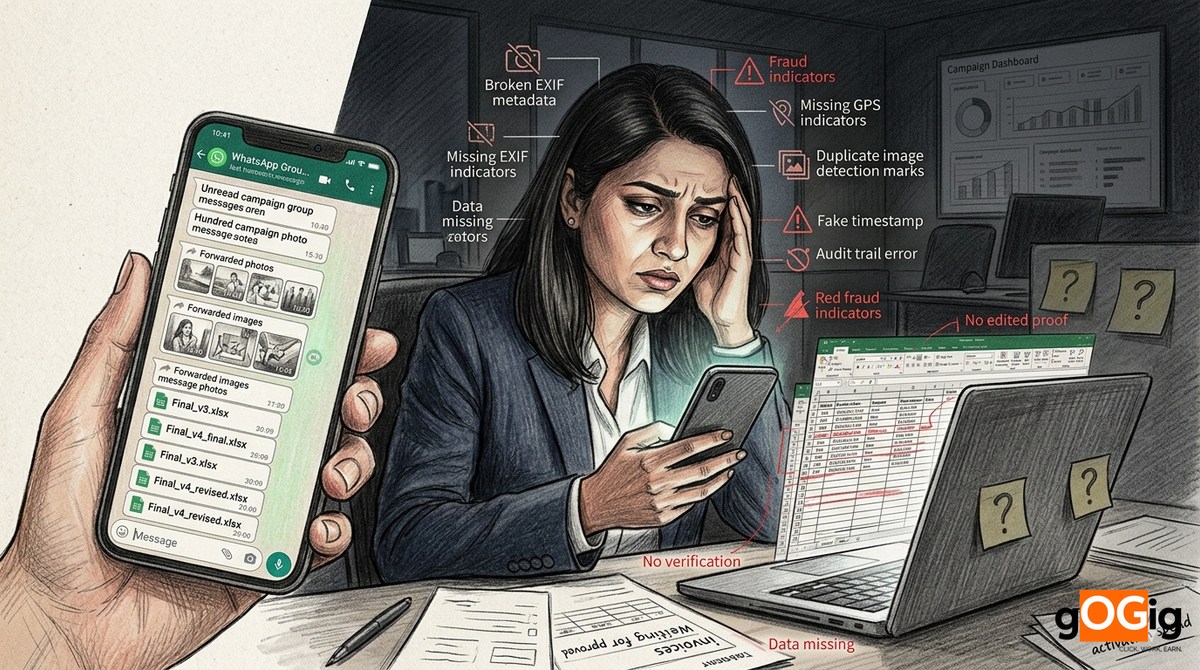
A senior brand manager at a top consumer brand opens her WhatsApp at 9:47 PM on a Friday. 312 unread messages in the campaign group. Photos. Voice notes. Forwarded images. Three Excel attachments labelled 'Final_v3,' 'Final_v4,' and 'Final_v4_revised.' Somewhere inside those 312 messages is the proof that ₹62 lakh of activation spend was executed. She scrolls for eleven minutes. Closes the app. Approves the invoice on Monday based on the summary deck the agency sends. This is the system that runs India's ₹80,000 crore physical economy.
WhatsApp was built for personal communication. Excel was built for financial modelling. Neither was designed to be a verification system for billions of rupees of physical campaign execution. The reason the workflow fails is not that brands picked the wrong tools. The reason is that this category of work was never tools' responsibility in the first place.
| Tool | What it was built for | What brands use it for |
|---|---|---|
| Encrypted personal messaging with friends and family | Proof of execution for crores of rupees of BTL spend | |
| Excel | Financial modelling and analytical spreadsheets | Master verification log for vendor billing approval |
| Email forwards | Asynchronous text communication | Compliance documentation chain |
| Shared drives | File storage with no verification logic | The brand's 'audit trail' |
A messaging app and a spreadsheet stacked together do not become a verification platform. They become a habit that brands have stopped questioning. The habit is the competitor.
When a field worker takes a photograph and sends it through WhatsApp in standard photo mode, WhatsApp does more than transmit the image. It systematically destroys most of the metadata that would let you verify when, where, and on what device the photograph was actually taken.
| Metadata field | In the original photo | After WhatsApp standard mode |
|---|---|---|
| GPS coordinates | Latitude and longitude embedded | Removed |
| Photo capture timestamp | Exact date and time captured | Removed, replaced with download time |
| Camera make and model | Device identifier present | Removed |
| Aperture and ISO settings | Camera state at capture | Removed |
| Image dimensions | 3456 x 4608 (12 MP) | 1599 x 1200 (compressed) |
| File size | 4 to 8 MB typical | ~73% smaller after compression |
| EXIF metadata block | Full block intact | Block essentially emptied |
By the time a WhatsApp photo reaches the brand manager's phone, the technical evidence that could prove the photograph was taken at a specific location, on a specific date, on a specific device, has already been deleted by WhatsApp itself. The photograph is intact. The proof embedded in the photograph is gone.
WhatsApp standard mode photo
Compressed file. No GPS. No real timestamp. No camera information. The photograph the brand receives is essentially a forensically empty image. Nothing in it can prove or disprove its origin.
Field Execution Intelligence submission
Server-side timestamp. Verified GPS coordinates. EXIF metadata cross-checked. Mock-location apps detected. The submission carries its own proof of authenticity at upload.
See what verified execution actually looks like
Run one campaign with full Field Execution Intelligence. Compare the proof you receive to the WhatsApp folder you have today. The difference is the gap between communication and verification.
Book a demo →A typical BTL campaign WhatsApp group has six recurring elements. Each one is structurally designed to fail at verification. Below is what each element actually delivers compared to what brands assume it delivers.
The campaign group itself
Assumed to be
A real-time accountability stream of execution updates.
Actually is
A scroll of compressed photos with no chronological integrity, no verification, and no searchability.
Photo updates from field teams
Assumed to be
Geo-tagged, time-stamped proof of execution.
Actually is
Standard-mode WhatsApp photos with GPS and timestamps already stripped by the platform before delivery.
Voice notes from supervisors
Assumed to be
On-ground verification by a trusted human.
Actually is
Unverifiable audio that disappears into a chat history, never indexed, never queried.
'Done' emoji confirmations
Assumed to be
Activation completion sign-off.
Actually is
An emoji. Often sent before the work began. No accountability weight.
Excel sheets shared as attachments
Assumed to be
The master execution log.
Actually is
A spreadsheet whose data is entered by the same party submitting the work. Cells can be edited at any time without trace.
Forwarded messages
Assumed to be
Verified updates from another team or partner.
Actually is
Messages that have already lost their context, attribution, and timing. 'Forwarded many times' is the only audit trail.
Each technique below is something a determined field worker, vendor, or agency can do in minutes using freely available tools on any standard Android phone. The ease of execution is the reason WhatsApp + Excel does not work as a verification system.
Spoof the GPS coordinates of a photo
Install a free mock-location app from the Play Store. Drop a pin at the contracted location. Take the photo. WhatsApp strips the EXIF anyway, but the chat narrative says 'here at the location.'
3 min
To execute
Backdate the photo capture
Change the device system date. Take the photo. Send it via WhatsApp. The recipient sees only the WhatsApp send timestamp, which feels recent. The original capture date is already gone.
2 min
To execute
Submit the same photo across multiple campaigns
A wall painting photographed once. The same image submitted to three brand campaigns simultaneously. WhatsApp compression means image fingerprinting cannot reliably detect the duplication after transmission.
1 min
To execute
Forward photos from a previous campaign
Old campaign photos forwarded into the new campaign group. The 'forwarded many times' label often does not appear on first forwards. The brand manager sees the photo as fresh execution proof.
30 sec
To execute
Edit the Excel 'execution percentage' cell
The agency-maintained Excel sheet says 87% completion this week. Next week, it says 91%. No version control. No audit log. No way to know what the number was last week without manually comparing files.
10 sec
To execute
Stage a photo at one location, claim execution at another
Take the photograph somewhere convenient. Caption it with the contracted address. WhatsApp strips the actual GPS. The brand has no way to verify the address claim is true.
5 min
To execute
Copy and paste the previous month's vendor log
Last month's Excel sheet duplicated. Names changed. Dates updated. Submitted as this month's execution record. The brand sees a complete-looking log. The reality is identical work claimed twice.
15 min
To execute
Add a fake supervisor 'all done' voice note
A 12-second voice note in the campaign group from someone who claims to be the supervisor. Voice note tone of authority. Brand managers accept it because it sounds reasonable. No identity verification.
1 min
To execute
If WhatsApp destroys the technical proof, Excel destroys the analytical detection layer. The spreadsheet your team treats as the master log was never built to identify fraud patterns. It was built to add numbers in columns.
Duplicate retailer entries
An Excel sheet listing 1,000 retailers can contain 100 duplicate entries with slightly different spellings (Shree Krishna Store vs Shri Krishna Stores). Manual review of 1,000 rows never catches it. Specialised verification programs catch it routinely.
Ghost promoters in attendance
A promoter named 'Suresh Kumar' appears on the attendance sheet 22 days a month. Cross-checked against payroll, 'Suresh Kumar' was never onboarded. Excel does not flag this. Excel has no concept of identity verification.
Route deviation in mobile campaigns
A mobile van log in Excel shows 'covered tier-2 city X, tier-3 town Y, tier-3 town Z' on consecutive days. Excel cannot detect that the geographic sequence is physically impossible to execute in the time claimed.
Inflated billing across vendors
Three vendor invoices listing the same activation across overlapping date ranges. Excel sums them dutifully. No cross-vendor deduplication. No pattern recognition. The brand pays three times for one execution.
Fake attendance for promoter-day billing
An attendance log claims 8 promoters on a mall activation day. Three of the names are fabricated. Excel has no way to verify that the listed names correspond to real, deployed humans.
Out-of-window submission
An activation contracted for 11 AM to 8 PM is logged as 'executed.' Excel does not show that all the supporting photos were timestamped between 1 PM and 3 PM. The contract specified hours; the proof shows a fraction.
Below is a realistic timeline of how a single fraudulent execution flows through the WhatsApp + Excel workflow without ever being caught. Each timestamp is a moment where the workflow could have detected the fraud and didn't.
Day 1, 8:42 AM
Field team supposed to deploy 12 promoters at a mall activation. Only 7 actually arrive on site. The team coordinator decides to bill all 12.
Day 1, 12:14 PM
Photos taken of the 7 promoters at work. One promoter is photographed three times from different angles to appear as three different deployments.
Day 1, 2:30 PM
Photos uploaded to the campaign WhatsApp group in standard mode. EXIF and GPS stripped by WhatsApp. Brand manager sees photos and assumes everything is in order.
Day 1, 5:48 PM
Activation supposed to run until 8 PM. Team packs up at 5:30. No further photos sent. Brand manager does not notice the absence.
Day 1, 9:11 PM
Excel attendance sheet shared in the group. All 12 promoter names listed. Three names are fabricated. Two are real people who were not at the venue.
Day 1, 9:12 PM
Supervisor sends a voice note: 'All done sir, 12 promoters deployed full day.' Brand manager hears confidence and moves on.
Day 3, 11:30 AM
Agency submits invoice for 12 promoter-days plus full-day setup and dismantling charges. Brand procurement processes payment within standard 30-day window.
Day 27, no detection
The fraud has been billed, paid, and closed in the brand's books. WhatsApp + Excel produced no signal at any of the eight moments above.
The system did not fail. The system worked exactly as it was designed to. It was just never designed to detect fraud.
A single mall activation losing a few lakhs to a partially executed deployment seems small. Multiply it across the campaigns a typical Indian brand runs in a year and the number stops being small.
| Activity | Annual occurrences (typical brand) | Estimated loss at 15% leak |
|---|---|---|
| Mall and society activations | 200 to 400 per year | ₹40 to 80 lakh |
| Sampling drives | 50 to 100 per year | ₹30 to 60 lakh |
| Retail visibility audits | 2,000 to 5,000 outlet visits per year | ₹50 to 90 lakh |
| Promoter deployments | 10,000 to 25,000 promoter-days per year | ₹60 lakh to 1.2 Cr |
| OOH installations | 500 to 2,000 per year | ₹50 lakh to 2 Cr |
| Field sales visits | 50,000 to 150,000 per year | ₹70 lakh to 2 Cr |
| Wall painting programs | 5 to 15 programs per year | ₹30 to 80 lakh |
| Mobile van and roadshow | 10 to 40 programs per year | ₹40 lakh to 1 Cr |
For a typical mid-size to large Indian brand, the annual exposure to the WhatsApp + Excel verification gap runs into ₹3 to 8 crore. The cost is hidden because nobody adds it up. The cost is real because every line item above happens every year.
If WhatsApp + Excel is this bad at verification, why is 85% of the industry still using it? The answer is not laziness. It is structural. Five forces keep the habit in place even when its costs are obvious.
WhatsApp is the only tool the entire field workforce already uses
Replacing it has historically meant getting hundreds of thousands of promoters, vendors, surveyors, and salespeople to install a new app. Every previous attempt failed at this adoption barrier. WhatsApp's ubiquity is its defence.
Excel is the only tool the entire brand team already uses
Brand managers, procurement, finance, and audit teams all live in Excel. A verification platform that does not export cleanly to Excel does not survive the brand-side adoption process. Excel's centrality is its defence.
The cost of the gap was never measured
Brands did not know the WhatsApp + Excel workflow was costing ₹3 to 8 crore per year because no one had ever calculated it. Without a number, the cost stayed invisible. Invisible costs do not motivate change.
The agency model rewards the gap
Agencies who profit from the verification gap have no reason to recommend a verification platform. Brands rely on agencies for tool recommendations. The recommendation chain blocks the change.
Switching costs feel high before they feel low
'Changing our entire reporting system' sounds expensive in the abstract. The brands that have done it report the actual switching effort is two weeks, not two months. The fear of the switch is larger than the switch itself.
The most important insight about replacing WhatsApp + Excel is that the field workforce does not need to leave WhatsApp. The verification platform comes to them, inside the app they already use. The brand team does not need to leave Excel. The verification platform exports cleanly into the spreadsheets they already build.
WhatsApp-native capture
Field workers submit through a structured WhatsApp workflow. Same app they already use. Geo-locked, time-locked, AI-verified at the moment of submission. No new app to install.
Excel-clean export
Verification data exports as standard Excel-compatible files. The procurement, finance, and audit teams continue using Excel for their analytics. Only the data underneath becomes trustworthy.
Metadata-preserved evidence
Submissions bypass the WhatsApp compression layer. GPS, timestamps, EXIF, and device data are preserved as part of the verification record. The evidence is forensically intact.
Real-time dashboard
Brand managers see verified execution as it happens. The 9:47 PM Friday scroll through 312 unread messages becomes a Friday morning glance at a real-time dashboard.
The habit does not have to break. The tools do not have to disappear. The verification logic underneath them has to change. That is the entire shift.
A brand that continues running on WhatsApp + Excel in 2026 carries three categories of cost that compound quarter over quarter.
A WhatsApp folder and an Excel sheet are not a verification system. They are a permission slip the industry has been writing itself for forty years.
Brands that have made this switch describe a sequence that took weeks, not months. The path is staged, reversible at each step, and starts with one campaign.
Days 1–14: Pilot one campaign
Pick a mid-size BTL campaign already planned. Run it on Field Execution Intelligence in parallel with the existing WhatsApp + Excel workflow. Compare the verification rate at the end of the campaign.
Days 15–30: Build internal alignment
Show the pilot delta to procurement, finance, and audit. The verification gap surfaced in 14 days becomes the case for systemic replacement. CFO support is usually secured at this stage.
Days 31–45: Onboard top three vendor categories
Move the highest-leak BTL formats to verified submission. The other formats continue on the legacy workflow until expanded onboarding.
Days 46–60: Full operating standard rollout
All new campaigns use verified submission. Existing vendor contracts updated to include Proof Before Payment clauses. WhatsApp + Excel becomes a communication channel for context, not the verification layer.
100% of new BTL campaigns running with verified submission, not WhatsApp + Excel reporting
Brand manager spending 80% less time scrolling through campaign groups
Procurement processing invoices against verified data, not summary decks
Finance receiving auditable execution data exported into existing Excel workflows
Field teams continuing to use WhatsApp as their daily app, with verification embedded in the workflow they already know
First documented gap closure presented at quarterly board review
Replace WhatsApp reporting with verified proof
Run one campaign with full Field Execution Intelligence. See your accountability gap in 30 days. The first number is yours. Every conversation after that becomes easier.
85%
Brands on WhatsApp + Excel
₹3–8 Cr
Annual exposure mid-size brand
60
Days to replace the workflow
Written by
gOGig Research
gOGig Editorial Team
Was this article helpful?
Your feedback helps us write better content.