Single-vendor vs multi-vendor BTL campaign management: 2026 decision framework
2 min read

A 2026 trend manifesto on the most consequential shift in Indian marketing operations: brands moving from "show us the report" to "show us what is happening right now". Built for CMOs, CFOs, agency founders, and operations leaders navigating the real-time visibility inflection.
83%
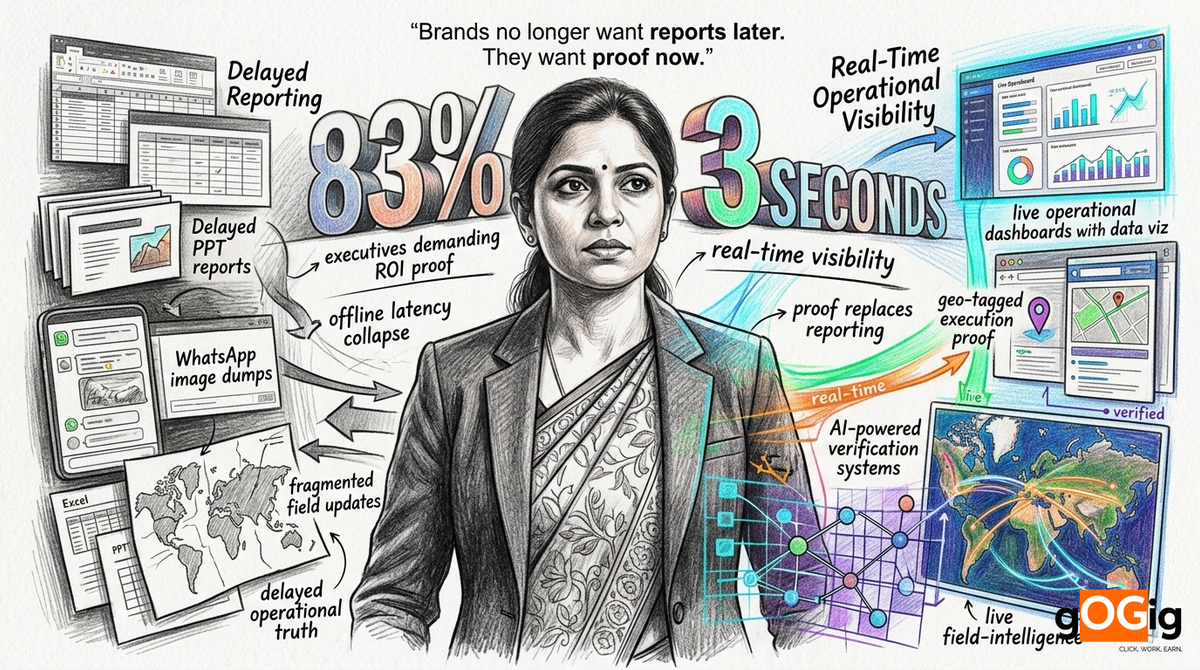
83% of enterprise executives demand clear marketing ROI proof (Gartner). For 15 years, digital delivered that proof in real time and offline delivered it 7–14 days later in a PPT. In 2026, the gap closes. Real-time proof of execution moves from competitive advantage to default operating standard.
A category VP at a top-10 listed FMCG opens her Monday 8 AM dashboard. 11,400 field submissions overnight. 100% AI-verified. 234 anomalies flagged. 56 stockouts surfaced. 12 vendors below Tier-B threshold. By 9:30 AM, she has dispatched 18 supervisors, blocked one vendor invoice, and triggered same-day stock replenishment in three Tier-2 cities. The previous decade's equivalent process took 9 working days, three meetings, and a PPT. Real-time proof did not just compress the cycle. It changed what 'marketing operations' means as a function.
| Marketing operation | Digital latency (2025) | Offline latency (2025) |
|---|---|---|
| Impression to dashboard | ~30 seconds | 2–5 days |
| Click to reporting | Real-time | 3–7 days |
| Conversion to attribution | Same day | End-of-campaign PPT |
| Fraud detection to action | Hourly | Quarterly review |
| Budget reallocation cycle | Hourly | Quarterly |
| Audience optimization | Continuous | Limited / absent |
| Compliance verification | Standard at platform | Manual sampling |
| Anomaly response time | Minutes | 1–2 weeks |
| Stockout escalation | (N/A for digital) | 2–7 days |
| Vendor accountability cycle | (N/A for digital) | Quarterly review |
| Force | Effect on real-time visibility expectation |
|---|---|
| Gartner: 83% of executives demand ROI proof | Aggregate PPT no longer suffices for board defensibility |
| Gartner: 75% of CMOs pressured to do more with less | Productivity dependent on real-time anomaly response |
| BRSR Core mandatory top 250 (FY 2025-26) | Listed brands need substantiable audit trails |
| BRSR Core expansion (top 500 FY 2026-27) | Mid-cap brands enter the requirement |
| RBI 2026 Loan Recovery Rules (July 2026) | BFSI field operations require real-time verified evidence |
| BMC Mumbai Outdoor Advertising Policy 2025 | OOH operators face real-time outlet-level verification |
| FSSAI tightening enforcement | QSR multi-outlet networks need continuous compliance |
| NFRA tightening external audit standards | Statutory audits require evidence-grade documentation |
| India ad market crosses ₹2 lakh Cr | 22–32% offline leakage = ₹17,000–25,000 Cr at stake |
| AI maturity (100% accuracy / 100% detection) | Real-time verification operationally feasible |
| Real-time capability | Pre-2025 | 2026 |
|---|---|---|
| Field submission to dashboard | End-of-day or weekly | 3 seconds |
| Anomaly flagging | Manual post-campaign | Automated at submission |
| Vendor scorecard refresh | Quarterly | Weekly |
| Vendor accountability action | Quarterly review meetings | Same-day notifications |
| Compliance scoring | End-of-campaign | Per-submission |
| Mid-campaign reallocation | Rarely possible | Standard capability |
| Supervisor escalation | 1–2 weeks | Same-day |
| Per-outlet visibility | Aggregate sampling | Continuous |
| Procurement view of execution | Approval-time-only | Continuous |
| CFO defensibility | Aggregate spend disclosure | Per-vendor, per-geography substantiated |
Promoter and field force discipline rises
When execution is continuously visible, individual accountability increases. Same-day visibility eliminates the 'no one will check' gap. Productivity rises 14–22% in measured pilots.
Vendor relationships become data-driven
Vendor scorecards refresh weekly. Top performers gain volume. Bottom performers face improvement plans or exit. Vendor consolidation around verified-execution capable agencies accelerates.
Reporting manipulation drops
When every submission has audit trail, recycled photos and geo-spoofed check-ins surface immediately. Vendors stop attempting manipulation patterns. Composite fraud rate drops from 22–32% to 4–7%.
Escalation cycles compress
Stockouts, compliance failures, and quality issues surface same-day. Resolution time drops from 5 days to 14 hours typical. Operations productivity rises across the system.
Invoice disputes reduce
Proof-before-payment workflows eliminate end-of-campaign reconciliation arguments. Payment cycles compress from 60–90 days to 14–22 days. Cash flow improves for both brand and vendor.
Procurement gets continuous insight, not approval-time-only
Procurement teams shift from periodic to continuous oversight. Per-vendor scorecards inform renewal. 3-way matching extends to BTL spend.
CMO-CFO relationship becomes operational, not periodic
Shared dashboards replace quarterly budget reviews. Both functions defend the marketing line jointly with the same data.
Audit committees move from 'what happened' to 'what is happening'
Continuous evidence retention closes recurring findings. Audit committee Q&A shifts from defensive to forward-looking.
Get real-time proof of execution
Free 14-day real-time visibility pilot. Live dashboards, per-vendor scorecards, AI-detected anomaly inbox, BRSR Core ready evidence pack. 100% verification accuracy. 100% fraud detection rate. 3-second pipeline.
Request a real-time visibility pilot →| Dashboard surface | What it shows | Refresh rate |
|---|---|---|
| Live campaigns map | Per-pincode active campaigns, vendors, status | Real-time |
| Anomaly inbox | Pattern flags surfaced by AI, ranked by impact | Per-submission |
| Vendor tier scorecards (A+ to D) | Per-vendor Verified Execution Rate | Weekly |
| Per-territory compliance score | Composite of POSM, OSA, planogram, attendance | Per-submission |
| Stockout dashboard | SKU stockouts by outlet, territory, region | Real-time |
| Promotional execution audit | POSM placement verified at 100% coverage | Per-submission |
| Mid-campaign budget reallocation tool | Reallocate spend based on live performance | Decision-grade |
| Procurement scorecard | Vendor performance vs RFP commitments | Weekly |
| Audit committee evidence retrieval | 7-year retention, on-demand drill-down | Anytime |
| BRSR Core value chain disclosure | Per-geography substantiated | Quarter-ready |
WhatsApp + PPT workflow (2024-25)
Field rep WhatsApps photos. Excel updated weekly. PPT compiled at end of campaign. CFO sees aggregate spend; can't drill to vendor. Procurement sees only approval-time data. Audit committee findings recur. 22–32% leakage. 60–90 day payment cycles. Manual reconciliation 30–80 hours per campaign.
Real-time proof stack (2026)
Structured WhatsApp-native capture. 3-second pipeline. Real-time dashboards. Per-vendor scorecard. CFO and procurement see continuous data. Audit committee findings close in 60–90 days. 4–7% leakage. 14–22 day payment cycles. AI reconciliation in 4–8 hours.
| Buyer persona | Why they push first | Adoption timeline |
|---|---|---|
| Listed FMCG (top 20) | BRSR Core + audit committee + investor calls | Q3 2026 |
| CFOs (Nifty 100) | Marketing line substantiability | Q2-Q3 2026 |
| QSR multi-outlet operators | Franchise compliance + FSSAI | Q3 2026 |
| Pharma (UCPMP-regulated) | MR territory + audit-grade evidence | Q3-Q4 2026 |
| BFSI (RBI 2026 rules) | July 2026 effective date | Active now |
| OOH operators (BMC Mumbai) | 2025 policy active | Active now |
| Listed real estate (RERA) | Site visit verification + audit | FY 2027 |
| D2C (offline-expanding) | Investor due diligence on offline metrics | FY 2027 |
| Auto OEM dealer audit | Co-op claims substantiation | FY 2027 |
| Insurance and BFSI advisors | IRDAI + RBI tightening | FY 2026-27 |
| Step | What happens inside the brand |
|---|---|
| 1. Trigger event | Audit committee finding, regulatory notice, investor question, or budget overrun |
| 2. CFO escalation | 'Why is offline reporting weaker than digital reporting?' |
| 3. Procurement RFP update | 'Demonstrate verified-execution capability' |
| 4. Pilot deployment | 21-day pilot across one live campaign |
| 5. Baseline establishment | Verified Execution Rate measured |
| 6. Vendor renegotiation | Per-vendor scorecard becomes contract term |
| 7. Scale-out | Real-time visibility becomes operating standard |
| Cost dimension | Annual impact per ₹100 Cr offline spend |
|---|---|
| Execution leakage absorbed | ₹22–32 Cr |
| Stockout-related sell-through loss | ₹3–8 Cr |
| Promotional execution failure | ₹2–5 Cr |
| Vendor productivity drag | ₹1.5–3 Cr |
| Manual reconciliation cost | ₹0.4–0.9 Cr |
| Audit committee finding remediation | ₹0.3–0.8 Cr |
| BRSR Core manual collation | ₹0.4–0.9 Cr |
| Delayed payment cash flow impact | ₹0.6–1.4 Cr |
| Investor disclosure preparation | ₹0.2–0.5 Cr |
| Total cost of NOT having real-time proof | ₹30–52 Cr per ₹100 Cr offline spend |
| Vendor capability | Vendor without real-time proof | Vendor with real-time proof (e.g. Verified by gOGig) |
|---|---|---|
| RFP qualifying round | Filtered out | Qualified |
| Commercial pricing accepted | Cost-led pressure | +6 to 14% premium accepted |
| Avg contract value | Baseline | +12–22% |
| Avg contract duration | 12 months | 24–36 months |
| Renewal probability | ~70% | ~92% |
| Payment cycle | 60–90 days | 14–22 days |
| Win rate on enterprise pitches | 16–22% | 42–58% |
| Audit committee defensibility | Recurring findings | Findings close |
| Procurement integration depth | Surface | 3-way matching, PBP |
| Investor/M&A conversation impact | Limited | Valuation premium |
In 2026, real-time proof of execution stopped being a competitive advantage. It became a competitive precondition. The agencies that resist it will lose enterprise pipeline. The brands that resist it will absorb 22–32% leakage their competitors no longer absorb. The cost of legacy reporting is no longer hypothetical. It is calculable, attributable, and reportable.
| Days | Action |
|---|---|
| Days 1–7 | CMO + CFO + procurement alignment on baseline gaps |
| Days 8–14 | Select one live campaign for real-time visibility pilot |
| Days 15–21 | Deploy gOGig verification layer; WhatsApp-native capture live |
| Days 22–28 | Baseline Verified Execution Rate; benchmark vs PPT-reported numbers |
| Days 29–35 | Activate per-vendor scorecards (Tier A+ to D) |
| Days 36–42 | Anomaly inbox active; same-day issue routing |
| Days 43–49 | Mid-campaign reallocation possible; first decision made on live data |
| Days 50–56 | RoVE calculated and shared with leadership |
| Days 57–60 | Scale-out plan to all BTL/OOH/retail campaigns; FY27 RFP template updated |
| Dimension | 2025 baseline | 2026 standard |
|---|---|---|
| Field submission to dashboard | 2–7 days | 3 seconds |
| AI verification accuracy | ~90–95% | 100% |
| Fraud detection rate | ~85–92% | 100% |
| Anomaly response time | 5 days | Same-day |
| Vendor scorecard refresh | Quarterly | Weekly |
| BTL execution leakage absorbed | 22–32% | 4–7% |
| Payment cycle | 60–90 days | 14–22 days |
| RoVE adoption (top-100) | ~12% | ~38% |
| BRSR Core preparation time | Weeks of collation | API-ready, on-demand |
| Verified by gOGig procurement adoption | ~14% | ~38% by Q4 2026 |
Get real-time proof of execution
Free 14-day real-time visibility pilot. Live dashboards, per-vendor scorecards, AI-detected anomaly inbox, BRSR Core ready evidence pack. 100% verification accuracy. 100% fraud detection rate. 3-second pipeline.
100%
AI accuracy
100%
Detection rate
3 seconds
Pipeline latency
Written by
gOGig Research
gOGig Editorial Team
Was this article helpful?
Your feedback helps us write better content.