Single-vendor vs multi-vendor BTL campaign management: 2026 decision framework
2 min read

Struggling to measure branding campaigns? Explore verification strategies using real time analytics, geo tagging, and automated reporting with gOGig.
Running a branding campaign for one to three months sounds like enough time to get results. And it is,if the campaign actually runs the way it was planned.
Here's the problem most brand managers quietly deal with: a long-term campaign isn't one execution. It's the same execution repeated, week after week, across multiple locations, managed by vendors and field teams who are juggling other work at the same time. What starts as a compliant, well-installed campaign in week one starts drifting by week four. Creative gets damaged and not replaced. Locations that were active in month one go quiet in month two. Vendors report 100% uptime while half the assets on the ground are faded, missing, or wrong.
By the time the campaign ends and someone reviews the final report, the damage is already done budget spent, visibility lost, and ROI impossible to calculate honestly.
This is one of the most common gaps in offline campaign tracking and it gets more expensive the longer a campaign runs. Brands investing in outdoor branding, retail displays, transit media, or van campaigns all face the same core issue: execution visibility drops sharply after launch day.
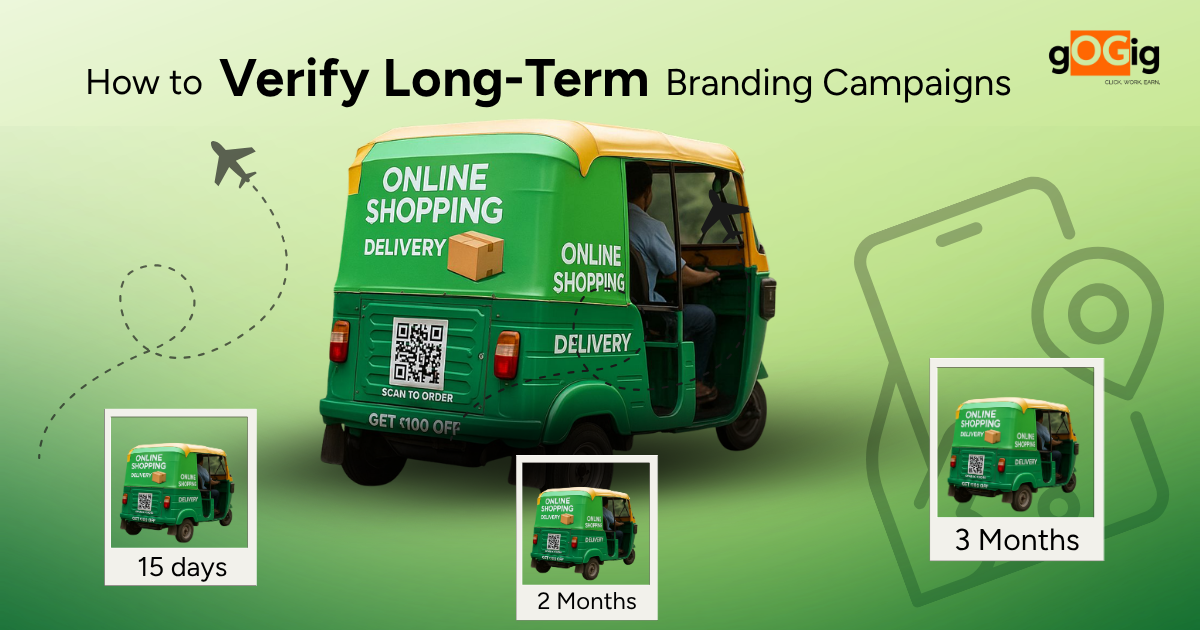
The only way to protect a long-term branding campaign is to verify it continuously, not just at launch. This guide covers exactly how to do that.
A two-week campaign has one job: get it installed, check it's live, confirm it ran. Verification is relatively straightforward.
A campaign running one to three months is a completely different challenge. Time introduces variables that a one-time check cannot catch.
Creativity degrades. Outdoor branding, whether it's hoardings, transit ads, shop branding, or cooler displays gets exposed to weather, wear, and human interference. What looks sharp in week one can be faded, torn, or partially obscured by week six. Without periodic verification, nobody flags it.
Vendor attention drifts. At the start of any campaign, vendors are attentive. By month two, your campaign is competing with their other clients. Assets that need maintenance don't get it. Locations that drop off quietly aren't reported.
Creative versions get mixed up. Longer campaigns often involve mid-campaign creative updates, a new offer, a season change, an updated product. Without a verification system tied to specific creative versions, old artwork stays up while the new brief is sitting in someone's email.
Locations go dark silently. A retail outlet closes. A hoarding gets taken down due to permissions. A vehicle leaves the fleet. In a short campaign, these gaps are visible quickly. In a three-month campaign, they can run for weeks before anyone in the brand team notices.
The core issue is simple: duration creates invisibility. The longer a campaign runs, the more the brand team trusts that things are fine because they were fine at the start. That assumption is where budget gets wasted.
Before building a verification system, it helps to be specific about what you are actually trying to catch.
Proof fatigue from vendors. In the early weeks, vendors submit photos and updates regularly. By month two, submissions slow down. By month three, you are chasing them. And when proof does arrive, it tends to be the same high-quality locations submitted repeatedly not a genuine cross-section of the entire campaign.
No baseline for comparison. Most brands don't document the exact state of every asset at campaign launch. When something goes wrong later, there is nothing to compare it against. Was that location always underperforming, or did something change in week five?
Creative compliance drift. Without a centralised system tracking which version of the creative is live at each location, it is almost impossible to enforce a mid-campaign update. Field teams work from whatever they have. Old creative stays up.
Multi-vendor accountability gaps. Longer campaigns typically involve multiple vendors across different cities or formats. When something goes wrong, accountability gets diffused. Everyone points to someone else. Without location-level verification tied to specific vendors, there is no way to identify where the failure actually happened.
The single most overlooked step in long-term campaign verification. Before the campaign starts, document the exact state of every location, geotagged photos, asset condition, creative version, placement position. This becomes your reference point for every subsequent verification check. Without a baseline, you are comparing vendor claims against nothing.
For campaigns running one to three months, verification needs to be scheduled, not reactive. A practical cadence for most campaigns:
Weeks 1–2: Daily or every-other-day verification during the installation phase. Catch compliance issues while corrections are still easy.
Month 1 ongoing: Weekly verification across all locations. Flag any assets that have degraded, gone missing, or show creative version mismatches.
Month 2–3: Bi-weekly verification minimum, with automated alerts for any location that hasn't submitted a fresh proof within a defined window. Monthly full-campaign compliance reports reviewed against the baseline.
The goal is to make non-compliance impossible to hide for more than a week not to catch problems after the campaign ends.
A photo submitted without a GPS coordinate and a timestamp is not verification, it is a claim. For long-term campaigns, every proof submission needs to be tied to a specific location, a specific time, and a specific creative version.
This matters especially in month two and three, when vendor submissions naturally thin out and the ones that do arrive are more likely to be pulled from earlier in the campaign. Tamper-proof, live-capture photo verification closes this gap entirely.
Knowing that branding is present at a location is not the same as knowing the right branding is present. Long-term campaigns need a verification layer specifically for creative version accuracy confirming that the current approved artwork is installed, not a previous version or a damaged partial installation.
This is especially critical for brands running seasonal campaigns or mid-campaign creative refreshes. Without version tracking, the refresh exists only on paper.
A three-month campaign running at 80% overall compliance sounds acceptable. But if that 20% non-compliance is concentrated in one vendor's territory consistently, across multiple weeks that is a vendor problem that needs a direct conversation, not a campaign-level average that hides it.
Location-level and vendor-level compliance breakdown is what turns a monitoring dashboard into an accountability tool.
gOGig is built specifically for the kind of continuous, multi-location verification that long-term branding campaigns need. Rather than replacing your field team's existing workflow, it works through WhatsApp - meaning field agents submit geotagged proof the same way they already send updates, with no app to download and no training required.
Tamper-proof photo submissions throughout the campaign duration. Every photo submitted through gOGig is instantly verified for GPS coordinates, timestamp, and live camera capture. This means the proof you receive in month three is as reliable as the proof you received in week one, not a recycled submission from earlier in the campaign.
Creative version tracking across locations. gOGig links specific creative versions to specific locations and flags any mismatch between what's been submitted and what's currently approved. Mid-campaign creative updates are tracked automatically, making it impossible for outdated artwork to go undetected for weeks.
Vendor-level compliance visibility across the full campaign period. The gOGig dashboard shows compliance rates broken down by vendor, by city, and by location across the entire campaign timeline. If a specific vendor's execution starts drifting in month two, the data makes it visible before it becomes a month-three problem.
A complete campaign audit trail from day one to final day. At the end of a three-month campaign, gOGig provides a full compliance report every submission, every location, every creative version, flagged issues and their resolution status across the entire campaign period. This is what genuine campaign accountability looks like, and it's what makes the ROI conversation with stakeholders honest rather than approximate.
How often should a long-term branding campaign be verified? Weekly verification is the minimum for campaigns running one to three months. During the installation phase in the first two weeks, daily or every-other-day checks are worth the effort , this is when most compliance issues are easiest to correct. In months two and three, bi-weekly verification with automated alerts for submission gaps keeps the campaign accountable without creating unsustainable workload for the brand team.
How do you verify branding compliance across multiple cities over several months? Through a centralised system that collects geotagged, timestamped photo proof from every location not just the high-priority ones and aggregates it into a single dashboard showing compliance by city, by vendor, and by creative version. Manual WhatsApp group management and spreadsheet tracking do not scale beyond a few locations and consistently under-report non-compliance.
What is the biggest risk in a 3-month branding campaign that brands don't plan for? Creative degradation and vendor attention drift in months two and three. Most brands plan for installation compliance in week one. Very few plan for what happens when the same assets need to look the same in week ten. Weather damage, missing materials, outdated creative, and location dropouts all compound over time and they are almost invisible without a structured periodic verification system.
Can vendors be held accountable for compliance failures in long-term campaigns? Yes, but only with location-level evidence tied to specific time periods. A vendor compliance conversation based on general impressions is easy to dispute. The same conversation backed by a dashboard showing that a specific vendor's locations were non-compliant for three consecutive weeks, verified through GPS-confirmed photo proof, is not. Data is what makes accountability real.
How do you track creative version compliance during a mid-campaign update? By linking each approved creative version to specific location IDs in your verification system before the update goes live. Every subsequent submission from that location is then checked against the new version. Without this, field teams work from whatever materials they have on hand, and old creative stays up indefinitely.
Does gOGig work for campaigns running across Tier 2 and Tier 3 cities? Yes. Because gOGig operates through WhatsApp rather than requiring a dedicated app, field agents in any market can submit verified proof without technical onboarding. This is particularly valuable in Tier 2 and Tier 3 markets where physical supervision is limited and vendor accountability has historically relied on self-reporting.
A one-month campaign that runs at 60% compliance for the full duration costs the same as one that ran at 95% compliance but delivers dramatically less. The brand paid for presence across every location for every week. What it actually got was partial presence, drifting creative, and vendor reports that looked fine on paper.
Long-term campaigns are where marketing budgets either compound into strong brand visibility or quietly evaporate into execution gaps nobody documented. The difference is whether verification is treated as a launch-day activity or a continuous discipline across the full campaign period.
gOGig gives brand teams the infrastructure to make it easier with live alerts, tamper-proof proof, creative version tracking, and a complete audit trail from day one to the final week. For any campaign running longer than a month, this is not optional. It is the only way to know whether the investment actually delivered what it was supposed to.
Written by
Was this article helpful?
Your feedback helps us write better content.