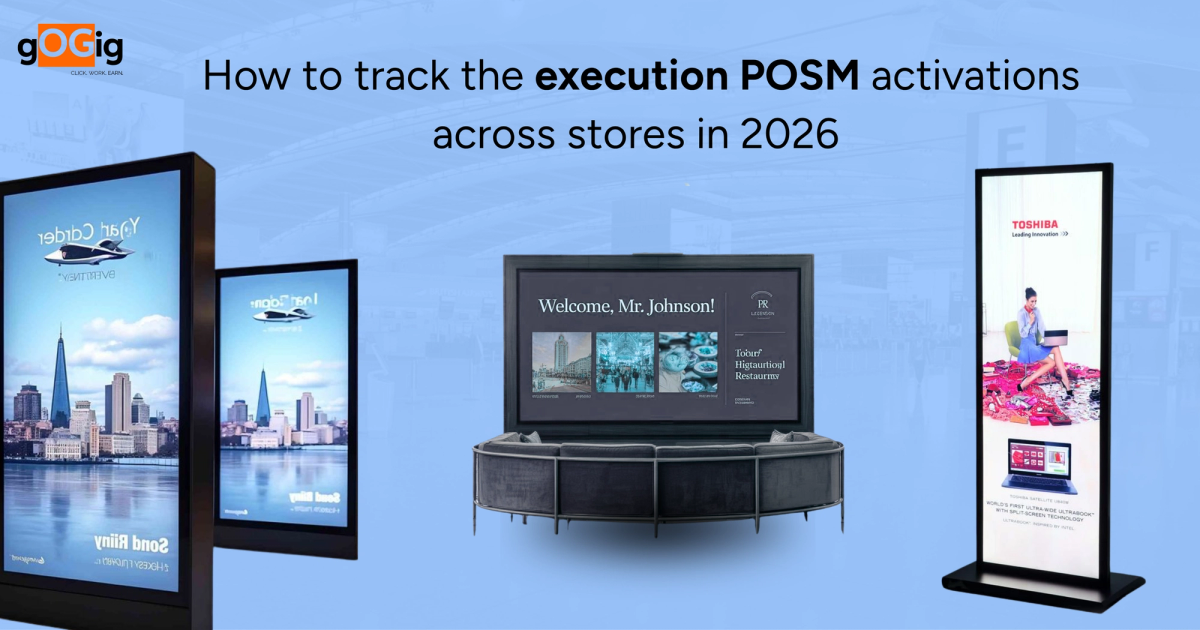
How to Track POSM Activation Execution Across Stores in 2026: The Complete Brand & Agency Guide
Discover real-time verification tools, geo-tagged proof of execution, and how gOGig eliminates fake submissions and missed installations across store networks.
Every year, brands pour crores into Point of Sale Material. Standees, shelf talkers, wobblers, counter display units, LED displays, FSUs, and more. The creative is approved, the material is printed, the vendor is briefed, and the rollout begins. And then, almost universally, the same problem surfaces: you have no real idea what actually happened in those stores.
Did the standee go up at the right outlet? Was it placed at eye level near the billing counter, or tucked behind a rack in the back? Did the retailer in Ludhiana actually receive and install the shelf branding, or is it sitting in a box in a distributor's warehouse? Was the same photo submitted for three different store locations?
In 2026, POSM execution tracking has moved from a nice-to-have audit function to a core capability for any brand serious about retail performance. Whether you're managing a 200-store activation or a 20,000-outlet POSM rollout, the tools and workflows now exist to give youreal-time retail execution visibilityat the store level, city by city, in live time.
This guide covers everything: why traditional POSM tracking fails, what modern in-store activation monitoringlooks like, how platforms like gOGig are transforming the space, and answers to the questions brand managers and agency heads ask most.
Why POSM Execution Is One of the Hardest Things to Track in Marketing
POSM activations sit at the intersection of logistics, field sales, trade marketing, and retail compliance. That's what makes them notoriously difficult to manage at scale. Unlike a digital ad where impressions are logged automatically, a shelf talker installation depends on a field executive, a cooperative retailer, and someone actually documenting it correctly.
Here's why retail POSM compliance tracking breaks down in practice.
The scale and geography involved in a national POSM rollout can be enormous. It can span thousands of outlets across hundreds of cities and towns, often executed by multiple regional vendors simultaneously. There is no central view without dedicated infrastructure.
The dependency on self-reporting makes things worse. Field teams submit photos to WhatsApp groups. Supervisors compile them. Agencies assemble them into PPTs. By the time a brand sees "execution proof," the campaign may already be over and none of that chain of custody was ever verified.
Then there's the fake photo problem. One photo of a standee placed correctly in Mumbai can be submitted twenty times for twenty different outlets. Without location and time metadata attached to every submission, this is almost impossible to detect manually.
Even when POSM is genuinely installed, placement quality often goes unchecked. The material may be in a low-visibility corner, blocked by another brand's display, or showing an outdated creative. None of this surfaces in a standard photo submission.
And because there's no live dashboard, brand managers operate completely blind during the campaign window. By the time issues are identified, the activation period has ended.
What Real-Time POSM Execution Tracking Looks Like in 2026
Modern store-level activation tracking in 2026 is not about collecting more photos. It's about collecting verified, structured, actionable data from every execution point, in real time.
Here's what a robust POSM tracking framework looks like today.
Store-Level Task Structuring
Every outlet in the activation plan is treated as an individual execution unit with its own task. Before the rollout begins, the full universe of stores gets structured inside a tracking platform. This can be segmented by city, format, distributor zone, or channel type. The result is that you know exactly how many activations are planned versus completed at any given moment.
Geo-Tagged and Time-Stamped Proof of Execution
Every photo submitted by a field executive carries GPS coordinates and a precise timestamp captured at the moment of submission. It's not editable and not transferable. This makes it immediately verifiable whether the executor was physically at the store and whether the submission was made within the activation window.
Automated Compliance Verification
Submissions are checked automatically against pre-set rules. Is the executor within the geo-fenced boundary of the store? Was the photo taken during the approved campaign period? Has this image or this location been submitted before? Any submission that fails these checks is flagged instantly, without a human reviewer needing to manually cross-check hundreds of entries.
Live Dashboard with Coverage Intelligence
A centralized command view shows in real time how many stores are pending, in progress, and completed, broken down by city, region, vendor, or any other dimension. Managers can identify coverage gaps and act before the activation window closes.
One-Click Reporting
All verified execution data is available for instant report generation at any time, whether it's for internal reviews, client presentations, or billing reconciliation.
How gOGig Enables End-to-End POSM Execution Tracking
gOGig is built precisely for the kind of execution complexity that POSM activations involve. Distributed field teams, high outlet counts, multiple vendors, and the constant risk of misreporting. Here is how the platform handles each stage of a POSM campaign.
Task Creation at Store Level
Each store in the activation plan is configured as a task unit within gOGig. Campaign managers can structure the execution universe by store format, city cluster, distributor territory, or any other segmentation. This gives complete pre-execution visibility into the scope of the activation before a single executive steps into a store.
WhatsApp-First Execution for Field Teams
gOGig's biggest differentiator for POSM campaigns is that field executives need zero new apps. Tasks are delivered and proofs are submitted entirely through WhatsApp, the app every distributor's field rep, merchandiser, and promotional staff already uses every day. Adoption is near-instant, there's no training overhead, and the platform works even in Tier-3 markets where getting people onto new software is a real barrier.
Geo-Fencing at Store Level
the client fixes their geo - fencing boundary and If an executor submits from outside that radius, the submission is automatically flagged as non-compliant. This single feature eliminates the most common form of POSM fraud, which is submitting a photo from outside the store or from a completely different location.
Real-Time Verification
The moment a field executive submits proof, gOGig runs automated checks across location match, timestamp validity, image duplication detection, and guideline compliance. Brand managers and agency supervisors see a clean, verified execution feed and not a raw dump of unvalidated photos.
Map-Based Execution View
Every verified submission appears on a live map, giving area managers and brand teams a geographic picture of where execution has happened and where gaps remain. For a campaign covering 500 outlets across a metro city, this view replaces hours of spreadsheet analysis with an instant visual.
Smart Campaign Filters
When managing multiple simultaneous POSM rollouts, say a summer activation for one brand running alongside a new product launch for another, gOGig's Smart Campaign Filter lets managers instantly isolate the campaign, city, or store cluster they need to review, without scrolling through unrelated data.
Creative Compliance Checks
For POSM specifically, displaying the wrong creative version is a significant risk, especially when campaigns involve seasonal updates, regional language variations, or regulatory changes. gOGig's guideline checks flag incorrect or outdated creative submissions, ensuring the right material is being displayed at the right time.
Independent Verification Layer
One of gOGig's most important roles in a POSM execution context is acting as a neutral, third-party verification layer between brands and their execution agencies. All proof and execution data is captured directly on the gOGig platform rather than assembled by the vendor and handed over. This removes the conflict of interest that's inherent in self-reported execution data and resolves billing disputes before they even start.
POSM Formats You Can Track with gOGig
gOGig's retail and trade branding tracking module covers the full range of in-store and trade POSM formats.
Retail Shelf and Counter Branding includes shelf talkers, wobblers, counter display units, and price communicators. Each outlet is a task and each submission is verified.
Shop Fascia and Name Boards covers branded signage at the entrance or exterior of retail outlets, tracked at the individual store level with geo-verification.
In-Shop Display Materials includes FSUs, standees, hanging displays, and pillar branding. Placement location within the store can be specified in task guidelines.
Flanges and Outdoor Shop Branding covers roadside and entrance branding tied to individual retail points, verified for location and installation quality.
Society and Community Retail Points are also supported. For brands activating within residential complexes, cooperative stores, or gated communities, geo-fencing ensures execution within approved premises.
Who Needs a POSM Execution Tracking Platform?
Trade Marketing and Brand Teams who design POSM programs need verified, real-time proof that their investment is reaching the shelf and not just the distributor's go-down.
National Sales Managers and RSMs want outlet-level execution visibility across their territory without depending on field team calls and WhatsApp forwards.
BTL and Retail Activation Agencies want to demonstrate verified, trustworthy proof of work to clients and reduce disputes around delivery and compliance.
Merchandising and Field Force Managers who oversee large distributor-driven field teams need structured task assignment and progress tracking at scale.
Audit and Compliance Teams need to verify POSM installation without physically visiting every store, which is particularly important for multi-state and pan-India rollouts.
Frequently Asked Questions About POSM Execution Tracking
1Q: What is POSM execution tracking? POSM execution tracking is the process of monitoring, verifying, and documenting whether Point of Sale Materials have been installed correctly at the right retail outlets, within the planned campaign window, and in compliance with brand guidelines. This covers standees, shelf branding, display units, shop boards, and related trade marketing materials. In 2026, this is done through platforms that capture geo-tagged, time-stamped proof and verify it automatically.
2Q: Why is POSM execution so difficult to track across large store networks? The core challenges are scale, geography, and self-reporting. A national POSM activation may span thousands of outlets executed by multiple vendors across dozens of cities simultaneously. Traditionally, field teams self-report through WhatsApp photo submissions, which have no location or time verification, making it easy for fake or reused submissions to pass undetected. Without a structured platform, there is simply no mechanism for real-time visibility at the store level.
3Q: How does geo-fencing work for individual retail stores? In gOGig, each store task is assigned a geo-fence, which is a defined GPS radius around the store's location. When a field executive submits execution proof, the platform checks whether the submission originates from within that radius. If the executor is outside the approved zone, the submission is automatically flagged as non-compliant. This prevents submissions from the wrong location or from outside the store entirely.
4Q: Can gOGig detect if the same photo is submitted for multiple store locations? Yes. gOGig's automated verification includes image duplication detection, which identifies when the same photo or a near-identical image is being submitted across different tasks or locations. This is one of the most common forms of POSM execution fraud, and it is caught at the point of submission and not discovered weeks later during a manual audit.
5Q: Do field merchandisers and promoters need to install a separate app? No. gOGig is built on a WhatsApp-first execution model. Field teams receive tasks and submit evidence directly through WhatsApp, with no additional app installation or training required. This is particularly valuable for POSM campaigns that rely on distributor-managed field teams, contract merchandisers, or gig-based execution staff who may not be comfortable with new technology.
In 2026, running a POSM activation without real-time execution tracking is the equivalent of running a digital campaign with no analytics. You're spending without knowing, and in a cost-sensitive trade marketing environment, that's a risk most brand managers can no longer justify.
The shift happening right now is from trust-based vendor management to evidence-based execution accountability. Brands that adopt platforms like gOGig aren't just eliminating fraud. They're building a structured data layer around their retail marketing that improves planning, speeds up decisions, and creates a paper trail for every rupee spent in trade.
Your POSM budget deserves the same rigour as your digital media budget. Real-time tracking makes that possible.