Single-vendor vs multi-vendor BTL campaign management: 2026 decision framework
2 min read

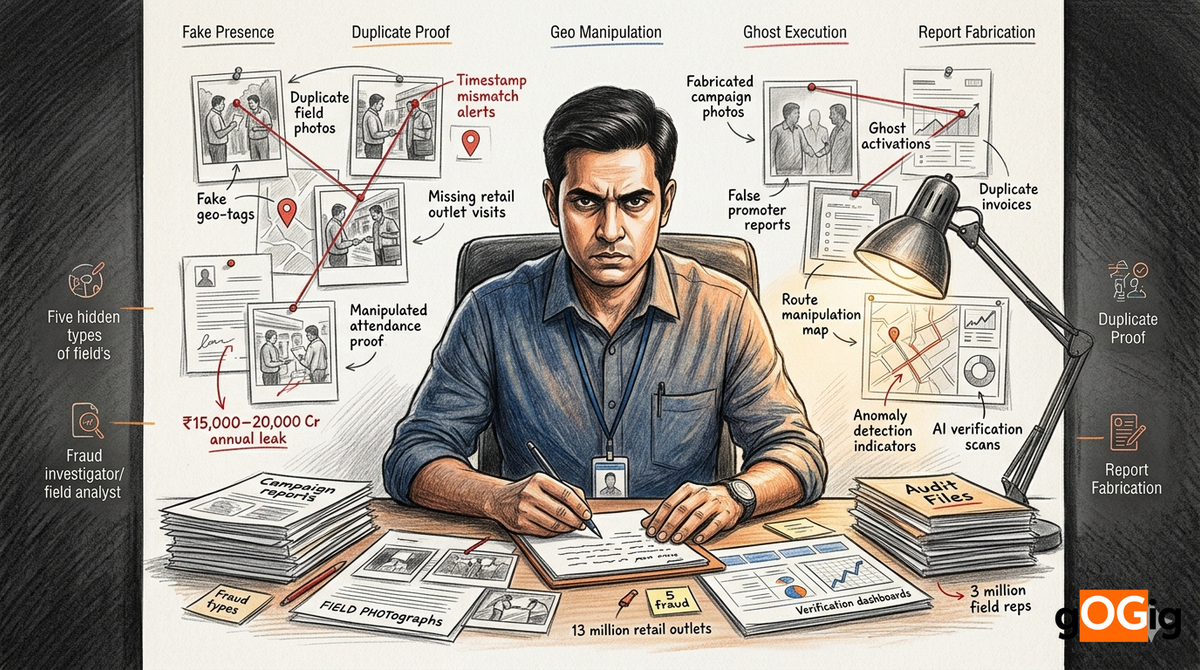
A complete taxonomy of how India's ₹80,000 crore physical economy is being silently drained. Five fraud types, twenty sub-categories, real campaign examples, and the detection capabilities that surface each one.
₹15,000–20,000 Cr
Annual leak across India's physical economy from the five fraud types catalogued in this blog. Every rupee categorised, every mechanic mapped, every detection method documented.
A senior CFO at a top FMCG brand asks: "Which fraud is costing us the most this year?" The marketing team cannot answer. Not because the fraud is hidden, but because no one has classified it. This blog is the classification.
| Fraud type | Estimated industry-wide annual cost | Detection difficulty |
|---|---|---|
| 1. Ghost retail coverage | ₹3,500–5,000 Cr | High (requires outlet-level verification) |
| 2. Duplicate & fake retailer onboarding | ₹2,500–3,500 Cr | Medium (requires de-duplication logic) |
| 3. Proof-of-performance fraud | ₹4,000–5,500 Cr | Medium (requires AI image verification) |
| 4. Field force productivity leakage | ₹3,000–4,000 Cr | High (requires real-time visibility) |
| 5. Manual reporting manipulation | ₹2,000–2,500 Cr | Low (requires platform-based capture) |
| Total industry-wide annual cost | ₹15,000–20,500 Cr | Varies by category |
| Rank | Fraud type | Time to detect (legacy) | Time to detect (FEI) |
|---|---|---|---|
| 1 (easiest with FEI) | Manual reporting manipulation | Months or never | At submission |
| 2 | Proof-of-performance fraud | Weeks | At submission (AI) |
| 3 | Duplicate retailer onboarding | Quarterly audit | At onboarding (OTP + geo) |
| 4 | Ghost retail coverage | Annual audit / never | Continuous (geo-verification) |
| 5 (hardest) | Field force productivity leakage | Year-end performance review | Real-time dashboards |
Ghost retail coverage is when outlets that have closed, never existed, or no longer stock the brand still appear as "active" in DMS systems, sales reports, and target sheets. The brand pays for distribution, sales effort, and trade promotions tied to outlets that are functionally invisible.
| Sub-type | Mechanic | Industry impact |
|---|---|---|
| Closed outlets still active | Outlets that shut down still counted in distribution targets | 2,000+ shut stores still counted in single city audits (Ahmedabad example) |
| Phantom outlets | Outlets that never existed, fabricated in DMS | 1–3% of any large FMCG database typically |
| Inactive outlets billed as active | Outlets that exist but no longer stock the brand | 5–8% of typical DMS records |
| Wrong address / location mismatch | Outlet name correct, location wrong for billing | 2–4% of records typically |
| Multiple billing under one outlet | One physical store split into 2–3 billing IDs | 1–2% of records typically |
| Drain channel | Mechanism | Typical % of trade spend lost |
|---|---|---|
| Inflated distribution targets | ASMs hit targets by selling to ghost outlets | 3–5% |
| Trade scheme payouts | Schemes claimed for outlets that didn't stock | 2–3% |
| Promoter deployment | Promoters scheduled at outlets that don't exist | 1–2% |
| Visual merchandising spend | POSM material billed for ghost locations | 1–2% |
| Sales incentive payouts | Reps earn incentives against ghost coverage | 2–3% |
| Stock allocation | Inventory pushed to outlets that don't sell | 1–2% |
| Total typical impact | -- | 10–17% of trade spend |
| Indicator | Reported | Verified |
|---|---|---|
| Active outlets in city | ~20,000–25,000 | ~18,000–22,000 (estimated) |
| Closed shops still in DMS | Hidden | 2,000+ reported by distributor body |
| Ghost rate (closed/total) | 0% reported | 8–12% estimated |
| Annual trade investment per outlet | ₹3,500–5,000 | -- |
| Estimated ghost cost (city level) | -- | ₹70 lakh–1 Cr per brand per city |
| Industry | Ghost outlet rate | Annual industry impact |
|---|---|---|
| FMCG (food & beverage) | 8–12% | ₹1,200–1,800 Cr |
| FMCG (personal care) | 6–10% | ₹800–1,200 Cr |
| FMCG (home care) | 5–9% | ₹500–800 Cr |
| Telecom / consumer durables | 4–7% | ₹400–600 Cr |
| Auto parts & lubricants | 5–8% | ₹300–450 Cr |
| Pharma OTC | 4–6% | ₹250–400 Cr |
| Total estimated impact | -- | ₹3,500–5,000 Cr |
| Method | Effectiveness | Implementation cost |
|---|---|---|
| Manual annual audit (third-party) | 40–60% detection | ₹50–200 per outlet |
| OTP-verified outlet onboarding | 75–85% detection | ₹5–15 per outlet |
| Geo-locked outlet verification | 85–95% detection | ₹5–15 per outlet |
| AI deduplication + image fingerprinting | 90–98% detection | ₹2–8 per outlet |
| Continuous quarterly verification | 95%+ detection sustained | ₹20–40 per outlet annually |
Duplicate retailer onboarding happens when the same outlet is registered multiple times in the DMS with slight variations (different spellings, addresses, owner names). Fake retailer onboarding happens when retailers that do not exist at all are added to inflate distribution numbers and trigger schemes.
| Sub-type | Mechanic | Typical detection signal |
|---|---|---|
| Spelling variants | Same retailer entered as "Shree Krishna", "Shri Krishna", "Sri Krishna" | Fuzzy name matching |
| Address variants | Same physical location entered with shop number / pincode variants | Geo-coordinate clustering |
| Owner name variants | Same owner registered under different shop names | Phone number / GSTIN matching |
| Phone number variants | Same shop with different phone numbers each entry | Geo + name combination matching |
| Phantom outlets | Outlets fabricated with fake names and addresses | OTP verification failure |
| Shell registration | Real outlet registered as a different category | GSTIN + category match |
| Sub-stockist passthrough | Sub-stockist registered as direct retailer | Order pattern analysis |
| Stage | Outlets recorded | Status |
|---|---|---|
| Pre-audit DMS database | ~1.6 million | Considered authoritative by brand |
| Duplicates identified | ~150,000–250,000 | 9–15% duplication rate |
| Phantom outlets identified | ~30,000–60,000 | 2–4% fake rate |
| Genuine outlets missed (under-registered) | ~1 million | Discovered through OTP + geo expansion |
| Post-audit verified universe | ~2.6 million | 98%+ accuracy |
| Net database change | +1 million net | Combination of corrections and expansion |
| Cost dimension | Per-duplicate annual cost | Brand-level impact |
|---|---|---|
| Inflated distribution KPIs | ₹500–1,500 | Misallocation of growth investment |
| Trade scheme over-payment | ₹2,000–5,000 | 2–3% of scheme budget |
| POSM material wastage | ₹300–800 | 3–5% of merchandising spend |
| Sales rep time wastage | ₹1,000–2,500 | 4–7% of field force productivity |
| Data analytics distortion | Difficult to quantify | Trade strategy built on wrong data |
| Quarterly business review accuracy loss | -- | Incorrect investment decisions next quarter |
| Industry | Typical duplication rate | Industry annual impact |
|---|---|---|
| FMCG general trade | 8–15% | ₹1,000–1,500 Cr |
| FMCG modern trade | 1–3% | ₹100–200 Cr |
| Consumer durables | 5–10% | ₹400–600 Cr |
| Pharma OTC distribution | 6–12% | ₹300–500 Cr |
| Auto parts | 4–8% | ₹200–300 Cr |
| Telecom retail | 3–7% | ₹250–400 Cr |
| Total estimated impact | -- | ₹2,500–3,500 Cr |
| Technique | What it catches | Accuracy |
|---|---|---|
| OTP verification at onboarding | Phantom outlets, fake phone numbers | 80–90% |
| Geo-coordinate de-duplication | Address variants of same location | 85–95% |
| GSTIN matching | Single owner multiple registrations | 95%+ |
| Phone number + name fuzzy match | Spelling variants | 85–92% |
| Image fingerprinting (shop photos) | Same physical shop, different IDs | 90–95% |
| Combined multi-signal verification | All sub-types | 98%+ |
Proof-of-performance fraud happens at the moment of submission. Photos are recycled from previous campaigns, GPS coordinates are spoofed, hoardings are photographed once and submitted as five installations, attendance is faked for promoter deployment, and lead lists are fabricated.
| Sub-type | Mechanic | Time to execute |
|---|---|---|
| Recycled campaign photos | Photos from previous campaigns submitted as new | 30 seconds |
| GPS spoofing via mock-location apps | Free Play Store apps spoof location coordinates | 3–5 minutes |
| Same hoarding photographed multiple angles | One physical asset becomes 3–5 reported installs | 2 minutes |
| Pre-dated photo submission | Photos taken weeks ago submitted as fresh | 2 minutes |
| Photo of competitor brand's setup | Wrong brand's installation submitted | 1 minute |
| Fabricated lead lists | Names and phone numbers invented | 15–30 minutes |
| Recycled lead databases | Old leads submitted as new captures | 5 minutes |
| Fake promoter attendance | Promoter signed in but not present | 1 minute |
| Setup-and-dismantle billing inflation | 4-hour deployment billed as 8 hours | End of shift |
| Wrong-location photo with right caption | Photo from accessible spot, claimed at contracted spot | 5 minutes |
| Indicator | Reported | Verified |
|---|---|---|
| Hoardings contracted | 1,200 | 1,200 |
| Cities covered | 180 | 180 |
| Reported compliance | ~96% | Photo-based agency report |
| Non-compliance found | 0% | 4.2% (50 sites) |
| Recycled proofs detected | Hidden | Identified across multiple sites |
| Media spend protected | ₹0 | ₹18.6 lakh in single campaign cycle |
| Extrapolated annual impact (sector) | -- | ₹120–180 Cr nationally |
| Submission type | Typical fraud rate | Per-submission cost | Annual industry impact |
|---|---|---|---|
| OOH installations | 4–8% | ₹2,000–8,000 | ₹500–700 Cr |
| Wall painting proofs | 10–15% | ₹1,500–4,000 | ₹250–400 Cr |
| Pole board installations | 15–25% | ₹400–800 | ₹350–500 Cr |
| Mobile van route proofs | 20–30% | ₹12,000–18,000 | ₹300–500 Cr |
| Promoter attendance | 15–25% | ₹1,200–3,000 per day | ₹700–1,000 Cr |
| Lead generation submissions | 25–40% | ₹15–50 per lead | ₹600–900 Cr |
| Sampling drive proofs | 15–25% | ₹50–200 per outlet | ₹500–700 Cr |
| Visual merchandising audits | 10–18% | ₹800–2,500 per outlet | ₹400–600 Cr |
| Field sales visit proofs | 20–30% | ₹150–400 per visit | ₹400–700 Cr |
| Total estimated impact | -- | -- | ₹4,000–5,500 Cr |
| Sub-type | Detection method | Accuracy |
|---|---|---|
| Recycled photos | Image hash fingerprinting | 95–98% |
| GPS spoofing | Mock-location flag + EXIF cross-check | 85–92% |
| Same hoarding multiple angles | Image similarity scoring + geo clustering | 88–95% |
| Pre-dated submissions | Server-side timestamp validation | 99%+ |
| Wrong brand setup photos | AI logo and brand element detection | 92–96% |
| Fabricated leads | OTP verification + first-call validation | 95–99% |
| Fake promoter attendance | Geo-fenced check-in + selfie verification | 90–95% |
| Setup-dismantle inflation | Time-stamped activity proofs at intervals | 92–96% |
Field force productivity leakage is the invisible drain from sales reps, merchandisers, and promoters spending billable time on activities that don't deliver business outcomes. Shelf failures, stockouts, route deviation, and unverified merchandising activities all sit in this category.
| Sub-type | Mechanic | Typical share of field time lost |
|---|---|---|
| Route deviation | Reps skip contracted outlets, visit easier ones | 15–25% of route plan |
| Stockout invisibility | OOS condition unreported, no replenishment trigger | 1 in 10 planned purchases lost |
| Shelf failure (planogram drift) | Planogram goes 10% out of compliance per week | 30–50% drift by end of quarter |
| Substitution rearrangement | Store teams refill empty shelves with whatever's available | 5–15% of planogram breaks |
| Idle time on shift | Promoter present but inactive during deployment | 20–40% of deployment hours |
| Phantom outlet visits | Visits logged from one location for multiple outlets | 10–20% of daily call reports |
| Manual reporting overhead | Reps spend 2–3 hours daily on Excel/WhatsApp updates | 15–30% productivity loss |
| Skipped audit checkpoints | Visual merchandising audits filled without entering store | 5–15% of audits |
| Promotional non-installation | POSM material billed but not installed | 10–25% of POSM spend |
| Metric | Industry benchmark | Source |
|---|---|---|
| Planogram out-of-compliance rate | 10% per week | National Association of Retail Marketing |
| Planogram compliance in highly managed retail | 70–85% | Industry research |
| Planogram compliance in informal retail | 40–60% | Industry research |
| Trade promotion failure rate | ~60% | RIS News |
| Planned purchases lost to stockouts | 1 in 10 | Retail execution studies |
| Sales loss per retailer from poor execution | $1M–$30M (US) | RIS News |
| FMCG scheme leakage (% of gross margin) | 2–3% | Industry estimates |
| Field force time on manual reporting | 15–30% | Retail execution studies |
| Smart real-time scheme ROI uplift | 20–25% | DMS industry data |
| Role | Typical workforce size (FMCG major) | Productivity loss % | Annualised cost per role |
|---|---|---|---|
| Sales rep / ASM | 500–2,000 | 15–25% | ₹1.5–3 Cr per 1,000 reps |
| Merchandiser | 1,000–5,000 | 20–30% | ₹2–4 Cr per 1,000 |
| Promoter | 5,000–15,000 | 20–40% | ₹3–6 Cr per 1,000 |
| Field auditor | 200–800 | 10–20% | ₹0.5–1.5 Cr per 1,000 |
| Regional sales manager (RSM) | 50–200 | 10–15% | ₹1–2 Cr per 100 |
| Distributor sales personnel | 10,000+ | 25–40% | ₹4–7 Cr per 1,000 |
| Industry | Field force size (India) | Productivity leak % | Annual impact |
|---|---|---|---|
| FMCG (food, personal care, home care) | 3 million+ | 20–30% | ₹1,500–2,000 Cr |
| Pharma medical reps | 800K–1M | 15–25% | ₹500–800 Cr |
| Telecom retail | 200K+ | 20–30% | ₹250–400 Cr |
| BFSI field sales | 500K+ | 15–25% | ₹300–500 Cr |
| Consumer durables | 150K+ | 20–30% | ₹200–300 Cr |
| Auto field sales | 100K+ | 15–25% | ₹150–250 Cr |
| Total estimated impact | -- | -- | ₹3,000–4,000 Cr |
Manual reporting manipulation is the manipulation that becomes possible when verification depends on WhatsApp groups, Excel sheets, and supervisor sign-offs. Each tool was built for communication or modelling, not for fraud-resistant verification.
| Sub-type | Mechanic | Why it works |
|---|---|---|
| WhatsApp metadata stripping | WhatsApp removes GPS and EXIF in standard mode | Compression destroys forensic evidence |
| Excel cell editing without audit log | "Execution %" updated without version control | No history captured |
| Forwarded photos as fresh submission | Old photos forwarded into new campaign group | "Forwarded" tag often invisible |
| End-of-day batch upload of fake work | All photos uploaded at 9 PM after the workday | Bulk uploads escape scrutiny |
| Supervisor voice notes as "verification" | "All done sir" voice note treated as sign-off | No identity verification |
| PDF report compilation by interested party | Same vendor writes the report on their own work | Conflict of interest structural |
| Selective photo sharing in campaign group | Only flattering photos shared with brand | Brand sees curated subset |
| Multi-group fragmentation | Different photos to different stakeholder groups | No single source of truth |
| Metadata field | Original photo | After WhatsApp standard send |
|---|---|---|
| GPS coordinates | Latitude + longitude embedded | Removed |
| Capture timestamp | Original time captured | Replaced with download time |
| Camera make / model | Device identifier | Removed |
| File size | 4–8 MB typical | ~73% smaller after compression |
| Image dimensions | 3456 x 4608 pixels | 1599 x 1200 pixels |
| EXIF metadata block | Full block intact | Block effectively emptied |
| Hash fingerprint | Identifiable | Altered by compression |
| Industry | % of brands still on WhatsApp/Excel | Annual impact |
|---|---|---|
| FMCG (general trade) | 85–90% | ₹700–900 Cr |
| OOH media | 80–90% | ₹400–500 Cr |
| BTL agencies (mid-size brands) | 90%+ | ₹300–450 Cr |
| Pharma (field force) | 60–75% | ₹200–300 Cr |
| Telecom (retail audits) | 70–85% | ₹150–250 Cr |
| BFSI (lead generation) | 75–85% | ₹150–250 Cr |
| Total estimated impact | -- | ₹2,000–2,500 Cr |
| Industry | Ghost retail | Duplicate onboarding | Proof fraud | Productivity leak | Manual reporting | Total annual |
|---|---|---|---|---|---|---|
| FMCG (food & beverage) | ₹1,200–1,800 Cr | ₹600–800 Cr | ₹800–1,000 Cr | ₹600–800 Cr | ₹300–400 Cr | ₹3,500–4,800 Cr |
| FMCG (personal & home care) | ₹800–1,200 Cr | ₹400–500 Cr | ₹500–700 Cr | ₹500–700 Cr | ₹200–300 Cr | ₹2,400–3,400 Cr |
| Pharma | ₹250–400 Cr | ₹300–500 Cr | ₹400–600 Cr | ₹500–800 Cr | ₹150–250 Cr | ₹1,600–2,550 Cr |
| Telecom & durables | ₹400–600 Cr | ₹250–400 Cr | ₹300–450 Cr | ₹250–400 Cr | ₹150–250 Cr | ₹1,350–2,100 Cr |
| Auto & lubricants | ₹300–450 Cr | ₹200–300 Cr | ₹250–400 Cr | ₹150–250 Cr | ₹100–150 Cr | ₹1,000–1,550 Cr |
| BFSI field operations | ₹100–200 Cr | ₹150–250 Cr | ₹300–450 Cr | ₹300–500 Cr | ₹150–250 Cr | ₹1,000–1,650 Cr |
| Real estate & OOH-heavy | ₹100–150 Cr | ₹50–100 Cr | ₹500–700 Cr | ₹100–200 Cr | ₹100–150 Cr | ₹850–1,300 Cr |
| QSR & multi-outlet retail | ₹150–250 Cr | ₹100–150 Cr | ₹200–300 Cr | ₹200–300 Cr | ₹100–150 Cr | ₹750–1,150 Cr |
| Format | Most common fraud types | Typical exposure % |
|---|---|---|
| Wall painting (rural) | Proof fraud, productivity leak, manual reporting | 15–25% |
| Mobile van & roadshows | Proof fraud (route), productivity leak | 20–30% |
| OOH hoardings & pole boards | Proof fraud (recycled photos) | 15–25% |
| No-parking boards | Proof fraud (duplicate boards) | 25–35% |
| Bus & cab branding | Proof fraud (vehicle swap) | 15–25% |
| Auto rickshaw branding | Proof fraud, productivity leak | 20–30% |
| Shop name boards | Ghost retail, proof fraud | 10–20% |
| Visual merchandising | Ghost retail, productivity leak | 15–25% |
| Sampling drives | Proof fraud (stock diversion) | 20–35% |
| Promoter activations | Proof fraud (attendance), productivity leak | 15–25% |
| Field sales visits | Productivity leak, manual reporting | 20–30% |
| Lead generation | Proof fraud (fabricated leads) | 30–50% |
| Trade scheme payouts | Ghost retail, duplicate onboarding | 12–18% |
| RWA / society activation | Proof fraud, productivity leak | 15–25% |
| Technician verification | Proof fraud (location) | 10–15% |
| Franchise compliance audit | Productivity leak, manual reporting | 15–25% |
| Geography | Submission count share | Anomaly rate | Dominant fraud type |
|---|---|---|---|
| Tier-1 metros (8 cities) | 45% | 14–15% | Manual reporting manipulation |
| Tier-2 cities (40 cities) | 27% | 20–21% | Proof of performance fraud |
| Tier-3 cities (200+ cities) | 17% | 27–28% | Field force productivity leak |
| Rural BTL belt | 11% | 32–33% | Ghost retail + proof fraud |
| City | Anomaly rate |
|---|---|
| Mumbai | 11.4% |
| Bangalore | 12.1% |
| Delhi NCR | 13.7% |
| Hyderabad | 14.3% |
| Pune | 15.2% |
| Chennai | 15.8% |
| Kolkata | 16.6% |
| Ahmedabad | 17.4% |
| Detection method | Ghost retail | Duplicate | Proof fraud | Productivity leak | Manual reporting |
|---|---|---|---|---|---|
| OTP verification | Strong | Strong | Medium | Weak | Strong |
| Geo-locked capture | Strong | Strong | Strong | Strong | Strong |
| Time-locked submission | Medium | Weak | Strong | Strong | Strong |
| AI image fingerprinting | Medium | Strong | Strong | Medium | Strong |
| EXIF integrity check | Medium | Medium | Strong | Medium | Strong |
| Mock-location detection | Medium | Strong | Strong | Strong | Strong |
| Accelerometer cross-check | Weak | Weak | Strong | Strong | Medium |
| Geo-fence violations | Strong | Strong | Strong | Strong | Medium |
| Real-time dashboard | Medium | Medium | Strong | Strong | Strong |
| Cross-vendor deduplication | Medium | Strong | Strong | Weak | Strong |
Run a free audit of your last campaign.
Pick one BTL or retail campaign you closed in the last 90 days. Run it through gOGig's verification engine. See how many of these five fraud types show up in your data.
Book a free campaign audit →| Fraud type | Pre-FEI detection rate | Post-FEI detection rate | Improvement |
|---|---|---|---|
| Ghost retail coverage | 10–20% (audit-dependent) | 90–95% | 5–7x |
| Duplicate onboarding | 30–50% (quarterly checks) | 95–98% | 2–3x |
| Recycled photos | 5–15% (manual review) | 95–98% | 10–15x |
| GPS spoofing | 0–5% | 85–92% | 20x+ |
| Pre-dated submissions | 0–5% | 99%+ | 20x+ |
| Fake attendance | 10–20% | 90–95% | 5–7x |
| Fabricated leads | 20–30% (post-call check) | 95–99% | 3–4x |
| Route deviation | 15–25% | 95–98% | 4–5x |
| Manual reporting fraud | 15–25% | 98–99% | 5x |
| Setup-dismantle inflation | 10–20% | 92–96% | 5–8x |
| Compound combination | Multiplier effect | Example |
|---|---|---|
| Ghost retail + duplicate onboarding | 2–3x cost | One ghost outlet registered 3 ways |
| Proof fraud + manual reporting | 2x cost | Recycled photo submitted via WhatsApp where verification is impossible |
| Productivity leak + ghost retail | 2.5x cost | Reps spend hours visiting ghost outlets and reporting it |
| Manual reporting + GPS spoofing | 3x cost | Field rep spoofs location and reports via WhatsApp with no metadata |
| Duplicate onboarding + scheme leakage | 2–3x cost | Same outlet claims schemes under multiple IDs |
| Proof fraud + setup-dismantle inflation | 2x cost | 4-hour activation billed for 8 hours with recycled photos |
| Productivity leak + planogram drift | 2x cost | Merchandiser visit billed but planogram never refreshed |
| Fake attendance + lead fabrication | 3x cost | Promoter not present, fabricated lead list submitted |
Pre-FEI environment
5 fraud types active simultaneously. Detection rates 5–30% per type. Combined exposure 20–30% of physical economy spend. Time to surface fraud: weeks to never. Re-execution costs 30–60% of original spend. Compounding cost across quarters.
FEI environment
All 5 types detected at submission. Detection rates 85–99% per type. Combined exposure reduced to 5–10% of spend. Time to surface fraud: real-time. Re-execution avoided through mid-campaign correction. Quarterly improvement compounding.
| Year of FEI adoption | Fraud exposure remaining | Cumulative savings |
|---|---|---|
| Pre-adoption baseline | 20–30% | -- |
| Year 1 of adoption | 8–12% | 60–70% of pre-baseline |
| Year 2 of adoption | 5–8% | 75–80% of pre-baseline |
| Year 3 of adoption | 3–5% | 85–90% of pre-baseline |
| Year 4–5 of adoption (steady state) | 2–3% | 90–95% of pre-baseline |
| Warning sign | What it indicates |
|---|---|
| Agency reports 90%+ execution consistently | Self-reporting bias; verified rate likely 65–75% |
| No GPS or EXIF integrity check at submission | Proof fraud detection effectively absent |
| WhatsApp groups are primary campaign tool | Manual reporting manipulation enabled |
| Trade scheme leakage in 12–18% range | Ghost + duplicate retailer fraud active |
| Field force time spent on Excel >20% | Productivity leak compounding |
| OTP verification absent at outlet onboarding | Duplicate / phantom onboarding active |
| Annual audit only, no real-time verification | All five fraud types operating undetected |
Days 1–15: Outlet universe verification
Run OTP + geo validation on existing retailer database. Identify ghost outlets, duplicates, and phantom records.
Days 16–30: Proof of performance audit
Sample 10% of last quarter's campaign submissions. Run AI image fingerprinting, EXIF check, GPS validation.
Days 31–45: Field force productivity diagnostic
Deploy real-time dashboards for 30 days. Measure baseline route compliance, reporting overhead, and planogram drift.
Days 46–60: Combined fraud exposure report
Quantify exposure across all 5 fraud types. Present to CFO and audit committee. Begin PBP rollout for top 3 fraud sources.
Run a free audit of your last campaign
Pick one BTL or retail campaign closed in the last 90 days. We will run it through gOGig's verification engine and show you which of these five fraud types showed up in your data. First audit is free.
₹15,000–20,500 Cr
Annual industry fraud cost
60–70%
Year-1 exposure reduction with FEI
Real-time
Detection speed under FEI
Written by
Field Execution Intelligence Research
The gOGig Editorial team covers Field Execution Intelligence, BTL verification, and the future of India's physical marketing ecosystem.
Was this article helpful?
Your feedback helps us write better content.