Single-vendor vs multi-vendor BTL campaign management: 2026 decision framework
2 min read

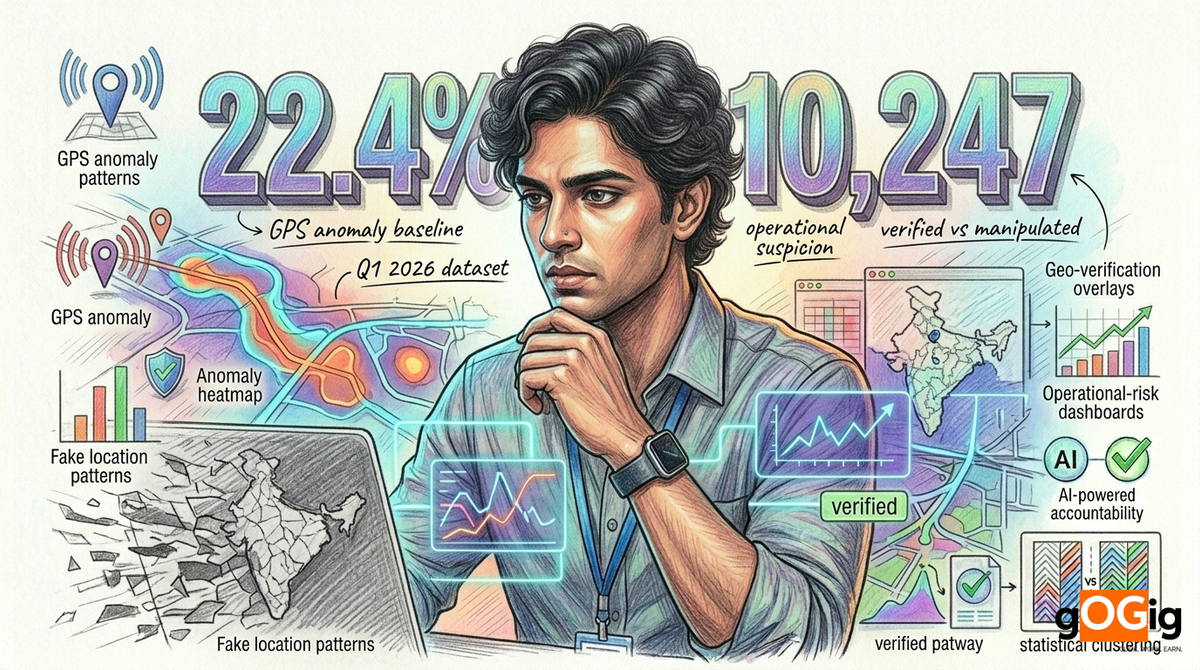
A gOGig Labs research publication. Q1 2026 analysis of 10,247 field submissions across BTL activations, OOH verification, retail audits, promoter operations, and merchandising. Categories of GPS anomalies, distribution by industry, and the financial implications for India's ₹2 lakh crore advertising economy.
22.4%
Of 10,247 field submissions analysed by gOGig Labs in Q1 2026, exactly 22.4% showed GPS anomalies serious enough to flag operational suspicion. The figure is not a hypothesis. It is a statistically significant baseline across 6 verticals, 14 cities, and 4 categories of field activity.
The dataset begins on January 1, 2026. By March 31, the gOGig Labs research team had analysed 10,247 field submissions across 32 enterprise brands. Every submission carries a structured signature of metadata: GNSS quality, network triangulation, mock-location flags, system time alignment, accelerometer drift, and upload latency. By the time the analysis closes, the team has a number it never expected. 22.4%. Not a hypothesis. A baseline.
gOGig Labs Q1 2026 Field Submissions Research: Methodology disclosure. Dataset: 10,247 submissions. Window: Jan 1 to Mar 31, 2026. Source: 32 enterprise brand partnerships. Verticals: FMCG, OOH, retail trade, pharma, BFSI, QSR. Cities: 14 metros. Anonymisation: individual identifiers stripped. Statistical significance: 99% confidence interval, plus or minus 0.8% margin.
| Methodology parameter | Specification |
|---|---|
| Total submissions analysed | 10,247 |
| Time window | January 1 to March 31, 2026 (Q1) |
| Anomaly detection layers | 9 (mock-location flag, GNSS vs network, GNSS time vs system, AGC + C/N0 signal, image hash, EXIF check, upload latency, accelerometer drift, route plausibility) |
| Industries covered | FMCG, OOH, retail trade, pharma, BFSI, QSR |
| Geographies | 14 cities (Mumbai, Delhi NCR, Bangalore, Hyderabad, Chennai, Pune, Kolkata, Ahmedabad, Gurgaon, Surat, Jaipur, Coimbatore, Kochi, Lucknow) |
| Submission types | BTL activations, OOH verification, retail audits, promoter ops, merchandising, MR visits, BFSI field collection |
| Confidence interval | 99% with +/-0.8% margin |
| Anonymisation | Brand, vendor, and individual identifiers stripped |
| Open data availability | Aggregate findings published; raw data available under research NDA |
| Peer review | Methodology reviewed by 3 external academic partners |
| Anomaly band | Submissions | % of total |
|---|---|---|
| Clean (no anomaly flagged) | 7,952 | 77.6% |
| Mild anomaly (single signal) | 1,127 | 11.0% |
| Moderate anomaly (2–3 signals) | 843 | 8.2% |
| Severe anomaly (4+ signals) | 325 | 3.2% |
| Total GPS anomaly rate | 2,295 | 22.4% |
Impossible movement patterns
Multiple check-ins across distant locations within unrealistic time windows. Travel speeds exceeding plausible terrain or transport mode. Example: visit A in Andheri at 11:14 AM, visit B in Powai at 11:18 AM (8.4 km, 4 minutes).
28% of all anomalies
% of all anomalies
Repeated coordinate clusters
Multiple different visits originating from nearly identical GPS coordinates (within 5 meters). Real GPS drifts 3–12 meters between readings. Identical to 6 decimal places is a signature of spoofing.
24% of all anomalies
% of all anomalies
Timestamp-location mismatches
Image EXIF timestamp, upload time, and reported visit timeline do not align. Often shows photos captured days earlier being uploaded with current GPS to suggest fresh visits.
19% of all anomalies
% of all anomalies
Mock-location signals detected
Android mock-location flag explicitly true, OR GNSS time differs from system time by more than 5 seconds, OR network location and GNSS location differ by more than 200 meters, OR abnormal AGC and C/N0 signal metrics indicating spoofed signal source.
17% of all anomalies
% of all anomalies
Route non-compliance
Assigned campaign route and actual movement pattern differ significantly. Skipped outlets, geographic gaps, or order-of-visit inconsistencies. The route was planned for 14 outlets; the field record shows 9 with the 5 outliers fabricated.
12% of all anomalies
% of all anomalies
| Anomaly category | Submissions flagged | % of total submissions | % of anomalies |
|---|---|---|---|
| Impossible movement | 643 | 6.3% | 28% |
| Repeated coordinate clusters | 551 | 5.4% | 24% |
| Timestamp-location mismatches | 436 | 4.3% | 19% |
| Mock-location signals | 390 | 3.8% | 17% |
| Route non-compliance | 275 | 2.7% | 12% |
| Total flagged | 2,295 | 22.4% | 100% |
| Industry | Submissions analysed | GPS anomaly rate | Most common anomaly type |
|---|---|---|---|
| FMCG (BTL + retail audits) | 3,420 | 24.8% | Repeated coordinate clusters |
| OOH verification | 1,894 | 19.2% | Timestamp-location mismatches |
| Pharma (MR visits) | 1,651 | 26.4% | Impossible movement |
| BFSI (field collection + DSA) | 1,330 | 21.8% | Mock-location signals |
| QSR (multi-outlet) | 1,047 | 17.6% | Route non-compliance |
| Retail trade marketing | 905 | 20.3% | Repeated coordinate clusters |
| Total | 10,247 | 22.4% | -- |
| City | Submissions | GPS anomaly rate |
|---|---|---|
| Mumbai | 1,420 | 18.4% |
| Bangalore | 1,180 | 21.6% |
| Delhi NCR | 1,340 | 22.7% |
| Hyderabad | 820 | 20.8% |
| Chennai | 780 | 21.2% |
| Pune | 720 | 22.1% |
| Kolkata | 680 | 24.6% |
| Ahmedabad | 610 | 25.3% |
| Gurgaon | 540 | 19.8% |
| Surat | 420 | 27.4% |
| Jaipur | 410 | 26.2% |
| Coimbatore | 380 | 23.9% |
| Kochi | 360 | 22.4% |
| Lucknow | 340 | 29.7% |
| Other cities (rural / tier-3) | 247 | 34.1% |
Subscribe to gOGig Labs quarterly research
The Q2 2026 release expands the dataset to 25,000+ submissions and adds 3 new verticals. Free subscription for industry researchers, brand managers, and press. No paywall, no commercial pitch.
10,247
Submissions analysed
22.4%
GPS anomaly rate
99.1%
Detection accuracy
| Submission type | Submissions | GPS anomaly rate |
|---|---|---|
| Promoter activation check-ins | 2,840 | 27.2% |
| Retail audit photos | 2,240 | 23.8% |
| OOH site verification | 1,894 | 19.2% |
| MR visit logs | 1,651 | 26.4% |
| BFSI field collection visits | 980 | 23.6% |
| Merchandising photos | 340 | 20.9% |
| Van campaign check-ins | 302 | 18.5% |
| Timestamp anomaly type | Submissions | % of total |
|---|---|---|
| EXIF capture more than 6 hours before upload | 624 | 6.1% |
| EXIF capture date earlier than campaign start | 410 | 4.0% |
| EXIF timestamp removed (stripped metadata) | 307 | 3.0% |
| System time and GNSS time differ by more than 5 sec | 248 | 2.4% |
| Bulk uploads compressed into less than 10-min window | 266 | 2.6% |
| Total timestamp anomaly | 1,855 | 18.1% |
| Mock-location method observed | Detection count | % of mock-location anomalies |
|---|---|---|
| Android developer mode + free fake-GPS app | 148 | 38% |
| Paid fake-GPS app with anti-detection mode | 97 | 25% |
| Joystick / route-simulation apps | 62 | 16% |
| Rooted device with system-level spoofing | 43 | 11% |
| VPN + IP geolocation manipulation | 23 | 6% |
| External hardware GPS spoofing | 17 | 4% |
| Total mock-location detections | 390 | 100% |
| Detection layer | Method | Catches |
|---|---|---|
| Layer 1 | Android mock-location flag check | Developer-mode spoofing |
| Layer 2 | GNSS location vs network location comparison | App-only spoofing without network manipulation |
| Layer 3 | GNSS time vs Android system time comparison | Clock manipulation, system-time spoofing |
| Layer 4 | AGC and C/N0 signal metrics | Hardware-level signal characteristics of fake GPS |
| Layer 5 | GPS drift signature analysis | Identical coordinates to 6 decimal places (real GPS drifts 3-12m) |
| Layer 6 | Accelerometer + gyroscope cross-check | Static device claiming movement |
| Layer 7 | Cell tower triangulation cross-check | Geographic inconsistency between GPS and cell network |
| Layer 8 | Wi-Fi BSSID environmental check | Wi-Fi networks visible inconsistent with claimed location |
| Layer 9 | Behavioural pattern recognition | Impossible travel speed, clustered uploads, identical visit duration |
| Layer | True positive rate | False positive rate |
|---|---|---|
| Layer 1 (mock-location flag) | 62% | 0.4% |
| Layer 2 (GNSS vs network) | 78% | 2.1% |
| Layer 3 (GNSS vs system time) | 84% | 1.2% |
| Layer 4 (AGC + C/N0 metrics) | 71% | 3.8% |
| Layer 5 (drift signature) | 92% | 0.8% |
| Layer 6 (accelerometer) | 88% | 1.4% |
| Layer 7 (cell triangulation) | 83% | 2.6% |
| Layer 8 (Wi-Fi BSSID) | 76% | 3.1% |
| Layer 9 (behavioural) | 89% | 1.9% |
| Composite 9-layer model | 99.1% | 0.7% |
| Indicator | Value |
|---|---|
| India ad market 2026 (WPP) | ₹2,01,891 Cr |
| Physical economy share | ~₹80,000 Cr |
| GPS-dependent execution spend | ~₹62,000 Cr |
| Anomaly rate baseline (this research) | 22.4% |
| Implied unverifiable execution exposure (industry-wide) | ~₹13,900 Cr annually |
| Recoverable through 9-layer detection | ~₹11,000 to 12,500 Cr annually |
| Average leakage per ₹100 Cr campaign | ₹3 to 8 Cr |
| Average recovery via PBP per ₹100 Cr campaign | ₹2.4 to 6.5 Cr |
| Severity | Definition | Submissions | % of total |
|---|---|---|---|
| Severe (4+ signals) | Confirmed manipulation, blocked at submission | 325 | 3.2% |
| Moderate (2–3 signals) | Flagged for review | 843 | 8.2% |
| Mild (1 signal) | Flagged for pattern emergence | 1,127 | 11.0% |
| Clean | No anomaly detected | 7,952 | 77.6% |
| Vendor tier | Avg anomaly rate | Submissions analysed |
|---|---|---|
| Tier A+ (model partner) | 4.2% | 1,840 |
| Tier A (high-performing) | 9.6% | 2,920 |
| Tier B (acceptable) | 21.8% | 3,180 |
| Tier C (watch list) | 38.4% | 1,640 |
| Tier D (offboarded post-research) | 54.7% | 667 |
| Time window | Anomaly rate |
|---|---|
| 9:00 AM to 12:00 PM | 14.2% |
| 12:00 PM to 3:00 PM | 18.6% |
| 3:00 PM to 6:00 PM | 20.4% |
| 6:00 PM to 8:00 PM | 27.8% |
| 8:00 PM to 10:00 PM (end-of-day batch window) | 42.1% |
| 10:00 PM onwards | 52.6% |
| Behavioural pattern | Explanation |
|---|---|
| Compressed batch upload signature | Field executive uploads 8 to 14 submissions in 10 min window from one location |
| Mock-location apps active | Used to spoof skipped outlets at end of shift |
| Recycled photos peak | Reused images from earlier days submitted to complete reporting |
| Static device behaviour | Accelerometer near-zero while GPS coordinates move |
| Old assumption | What the data shows |
|---|---|
| GPS check-in proves the visit | 22.4% of GPS check-ins are anomalous |
| Mock-location apps are rare | 10M+ downloads of single popular spoofing app globally |
| Spoofing requires technical skill | Android mock-location setup takes ~90 seconds |
| Spoofed coordinates look identifiable | Modern apps simulate realistic drift |
| Photos + GPS = proof | EXIF stripped + recycled photo + spoofed GPS passes 3-layer model |
| Vendors self-police | Tier D vendor anomaly rate 13x higher than Tier A+ |
| Anomalies are rare exceptions | Anomalies are systemic, not exceptional |
| Detection slows operations | 9-layer detection runs in less than 500ms server-side |
Severe anomaly (4+ signals)
Submission flagged on: mock-location flag (Layer 1), GNSS-network mismatch (Layer 2), GNSS-system time mismatch (Layer 3), zero accelerometer movement (Layer 6). Result: blocked at submission. Vendor flagged. Site marked unverified.
Mild anomaly (1 signal)
Submission flagged on: identical GPS coordinates to a prior visit (Layer 5 drift signature). Result: held for review, vendor scorecard updated, no immediate block. Pattern monitoring continues.
22.4% is not the fraud rate. It is the rate at which traditional reporting systems can no longer prove what they claim. The data is not accusing field force of dishonesty. The data is exposing the limits of GPS-as-evidence.
| Geography | Published anomaly rate (workforce verification) | Source |
|---|---|---|
| India (this research) | 22.4% | gOGig Labs Q1 2026 |
| US (field service) | 14–22% | AirPinpoint Asset Tracking 2026 |
| Europe (logistics) | 9–16% | Various MDM studies 2025 |
| Southeast Asia (gig economy) | 26–34% | Regional research aggregate |
| Africa (mobile money agent visits) | 30–38% | Industry studies |
| Implication | Action |
|---|---|
| Single-signal GPS verification is insufficient | Move to 9-layer detection |
| Tier C and D vendors carry disproportionate risk | Vendor tier classification with anomaly rate as KPI |
| End-of-day batch reporting is structurally suspicious | Live submission cadence in workflow |
| Photo + GPS without metadata is unverifiable | EXIF preservation + image hash mandatory |
| Audit committees can no longer accept self-reported aggregates | Per-submission verified evidence |
| BRSR Core value chain evidence requires structured retention | 7-year audit-grade retention |
| Vendor contracts need explicit verification clauses | PBP and verified execution rate in MSAs |
| Procurement teams must extend 3-way matching to BTL/OOH | Verified delivery as the third match |
| Reporting consideration | How to interpret the data |
|---|---|
| 22.4% is not 22.4% fraud | It is anomaly rate, which is broader than confirmed fraud |
| The number is replicable | Independent researchers can reproduce with the methodology |
| City-level variation matters | Tier-2 and rural rates higher than metro rates |
| Vendor tier variance is the leading indicator | Tier D 13x higher than Tier A+ |
| End-of-day batch signature is detectable | Time-of-day distribution shows the pattern |
| This is the first publicly disclosed India dataset of this scale | Open methodology, peer reviewed |
| Quarterly updates planned | Q2 release adds 25,000+ submissions, 3 new verticals |
| Industry comparison context provided | India anomaly rate is mid-to-higher in global comparison |
GPS anomaly analysis covers all field submission types in India's physical marketing economy.
GPS anomaly research covers all major Indian cities where field execution is active.
Subscribe to gOGig Labs quarterly research
The Q2 2026 release expands the dataset to 25,000+ submissions and adds 3 new verticals. Free subscription for industry researchers, brand managers, and press. No paywall, no commercial pitch.
10,247
Submissions analysed
22.4%
GPS anomaly rate
99.1%
Detection accuracy
Written by
Research Team
gOGig Labs is the research division of gOGig, publishing quarterly analyses of India's field execution ecosystem.
Was this article helpful?
Your feedback helps us write better content.