Single-vendor vs multi-vendor BTL campaign management: 2026 decision framework
2 min read

A 2026 state-of-the-industry report on computer vision deployment in Indian retail audits. Built for CPG and FMCG sales leaders, retail trade marketing heads, agency operations chiefs, and category managers tracking the shelf intelligence shift across India's ₹20-25 lakh Cr FMCG market.
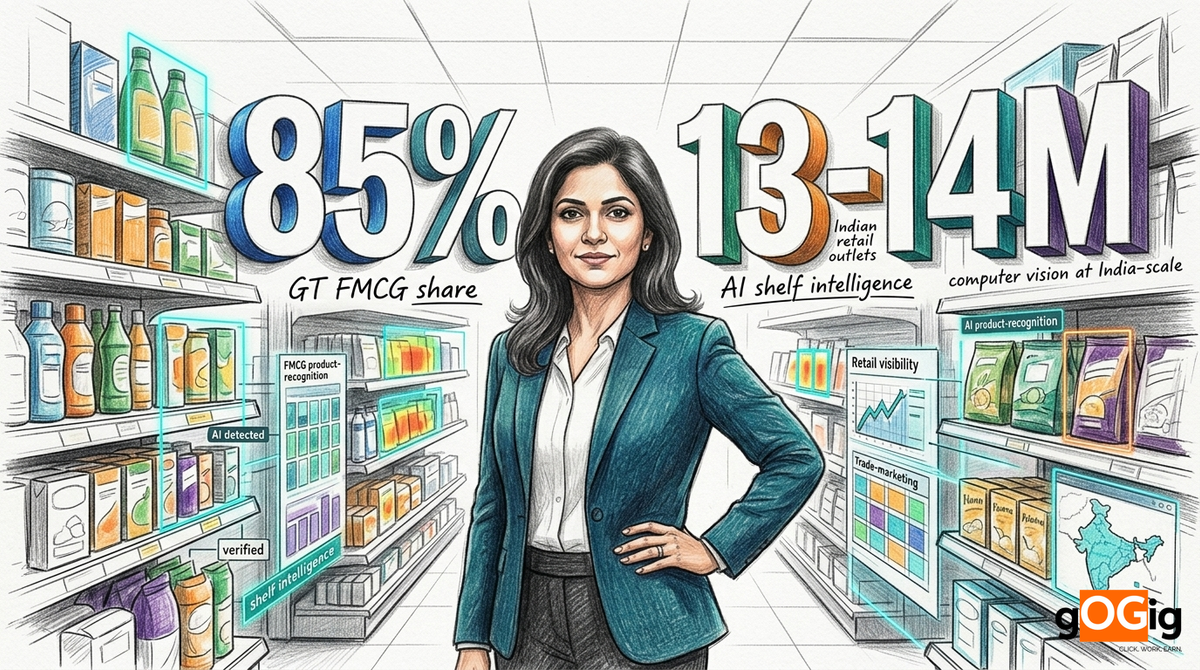
85%
Share of India's FMCG sales flowing through General Trade (~13 million Kirana stores). Each store run independently. No central planogram. No store-staff training. AI image recognition is no longer a "nice-to-have" for Indian retail. It is the only viable measurement system at India-scale.
A national sales VP at a top-5 Indian FMCG opens the Monday morning shelf audit dashboard. 7,200 outlets audited overnight. Computer vision detects 412 outlets with planogram deviations, 184 with critical SKU stockouts, 96 with competitor encroachment, 28 with promotional execution failure. Two years ago, these numbers would have arrived as a PPT on Thursday. The VP dispatches 23 supervisors before 9:30 AM and reallocates fill-up routes by 11 AM. Lost weekly sales recovered: ~₹6.4 Cr. That is the operating reality AI image recognition created in 2026.
| Manual audit reality | Indicator |
|---|---|
| Avg field rep outlets per day | 25 outlets |
| Avg time per store on planogram audit | 12–15 minutes |
| Total daily audit window per rep | ~5–6 hours |
| Cognitive load (SKUs per rep across day) | ~6,000–12,000 SKU observations |
| Realistic auditable % | ~60–70% of touch points |
| 'Same five SKUs' check pattern | Universal observation in field studies |
| Subjective scoring variance (across auditors) | +-12–22 percentage points |
| Data latency to category manager | 2–7 days |
| Shelf re-merchandising cycle | Often 2x before data lands |
| New launch visibility window loss | 3–5 days typical |
| Annual revenue leakage from bad shelf data | 3.2% (Asseco field-validated baseline) |
| Indicator | Value (2026) |
|---|---|
| India retail market | $1.06T to $1.93T by 2030 |
| India FMCG market | ₹20–25 lakh Cr |
| FMCG field reps in India | 3 million+ |
| Kirana stores | ~13 million |
| GT (General Trade) share of FMCG | ~85% |
| Modern Trade share | 14–16% |
| Quick commerce share | 8–10% |
| Avg SKUs in a Kirana | 1,500–3,500 |
| Avg SKUs in modern trade outlet | 15,000–50,000 |
| Avg promotional change cycle | 14–28 days |
| Avg new launches per FMCG brand annually | 14–26 SKUs |
| Avg category managers per FMCG brand | 15–40 |
| Avg outlet to category manager ratio | 1 : 90,000–1,80,000 |
| Capability | What it detects |
|---|---|
| SKU presence and identification | Each SKU on shelf identified to brand-variant level |
| Facings count | Number of facings per SKU on shelf |
| Share of shelf (SoS) | % of shelf space occupied by brand vs competitor |
| On-shelf availability (OSA) | Whether SKU is present or stocked out |
| Planogram compliance | Shelf reality vs approved planogram |
| Price tag reading | OCR on price tags; price mismatch detection |
| Promotional execution | Whether promo POSM is in place, correctly placed |
| Competitor placement | Competitor SKU positioning, share, expansion |
| Empty shelf detection | Out-of-stock alerts in real time |
| Damage and quality assessment | Damaged packaging, expired stock flags |
| Coverage validation | Whether full shelf was captured |
| Cooler/freezer audit | Cold-chain product placement and density |
| Year | Industry-leading accuracy | Industry-typical accuracy |
|---|---|---|
| 2018–2020 | ~85% | ~75–80% |
| 2021–2022 | ~90% | ~82–86% |
| 2023 | ~93% | ~86–90% |
| 2024 | ~95% | ~90–93% |
| 2025 | ~97% | ~92–95% |
| 2026 (gOGig AI) | 100% | ~95–98% |
| Driver | Effect |
|---|---|
| Deep learning architecture maturity | Multi-stage detection and classification reliable |
| Edge AI deployment | On-device inference under variable connectivity |
| India-specific training datasets | Indian retail formats, lighting, languages, SKU labels |
| Active learning pipelines | Continuous improvement from flagged-then-reviewed |
| AR overlay capture guidance | Ensures correct framing, angle, full shelf coverage |
| OCR advances (price tags, MRP) | Reads tag values reliably across formats |
| SKU library scale | ~480,000+ annotated submissions in gOGig stack |
| Cross-vertical transfer learning | Pharmacy, electronics, telecom, kirana cross-pollination |
| Adversarial testing partnerships | External academic + commercial security teams |
| Vendor / platform | Origin | India focus |
|---|---|---|
| FieldAssist (IRIS) | India | 700+ CPG/FMCG brands including Haldiram's, United Breweries, Mars Petcare |
| ParallelDots (ShelfWatch) | India | India-rooted, global deployment |
| Infilect | India | India-rooted retail intelligence platform |
| Trax + FORM (merged Feb 2026) | Global | India operations active |
| Bizom | India | SFA-integrated retail audit |
| Botree | India | FMCG-focused retail execution |
| Vision Group (Store360) | Global | L'Oreal, Goya, Wegmans, Coca-Cola, Mars |
| Asseco Platform | Europe | 98%+ accuracy field-validated |
| Pazo | India | Real-time execution layer |
| StayinFront | Global | On-device AI from July 2025 |
| gOGig | India | Field Execution Intelligence platform, 100% AI accuracy |
Field rep captures shelf image
AR overlay guidance ensures correct framing, angle, full shelf coverage. Works offline with auto-sync. (~200ms)
Image quality validation
Blur, exposure, angle, occlusion, completeness all validated. Bad images rejected at capture. (~300ms)
SKU detection and classification
Computer vision identifies every SKU, brand, variant, pack size. Indian SKU library trained. (~600ms)
Shelf analytics computation
Share of shelf, facings, OSA, planogram match, competitor placement scored. (~400ms)
Compliance score generation
Per-shelf compliance score, KPI scorecards, store-level analytics produced. (~300ms)
Exception flagging and escalation
Critical issues (stockouts, planogram failures) trigger same-day routing to supervisors. (~200ms)
Dashboard update and category insights
Real-time category manager dashboard. Per-outlet, per-territory, per-vendor analytics. (~100ms)
Total end-to-end latency: ~2.1 seconds (sub-3 second processing standard in 2026).
Get retail audit intelligence at 100% accuracy
Free 14-day shelf intelligence pilot across 50 outlets in one Tier-2 city. Per-outlet planogram compliance, real-time SoS, OSA tracking, competitor visibility. 100% verification accuracy. 100% fraud detection rate. WhatsApp-native capture.
100%
AI accuracy
100%
Detection rate
4-8x
Year-1 ROI
| Dimension | Manual audit | AI image recognition |
|---|---|---|
| Outlets audited per rep per day | 25 outlets | 40–60 outlets |
| Time per shelf audit | 12–15 minutes | 30–90 seconds |
| SKUs evaluated per audit | ~20–40 typical | 100% of shelf SKUs |
| Planogram compliance accuracy | 62–78% | 95–100% |
| Data latency to category manager | 2–7 days | Real-time |
| Auditor subjectivity | +-12–22 percentage points | +-2–4 percentage points |
| Cost per shelf audit | ₹80–150 | ₹30–60 |
| Daily auditable outlets (national rep network) | ~75,000 | ~120,000–180,000 |
| Manual review cost reduction | - | 60%+ |
| Shelf-execution revenue uplift | - | 3–8% via OSA + planogram fixes |
| Net P&L impact (top-10 FMCG) | - | ₹40–180 Cr per brand annually |
| India retail characteristic | Why AI image recognition wins |
|---|---|
| 13M kirana stores, no central category management | Image recognition is the only viable measurement system |
| Each kirana owner makes ~80% of merchandising decisions independently | Real-time visibility critical to detect deviations |
| FMCG field reps cover 25 outlets/day | Manual auditing impossible at SKU-level rigor |
| Linguistic + cultural variance across 22 languages | OCR + visual recognition handles regional retail signage |
| Tier-2/3 growth (~24% annual) | Distributed monitoring matches expansion velocity |
| WhatsApp adoption (535M users) | WhatsApp-native capture removes app barriers |
| 660M+ smartphones | On-device CV inference viable at scale |
| UPI normalising digital workflows | Field reps comfortable with structured digital capture |
| Variable lighting, dust, crowded shelves | India-specific training datasets handle real conditions |
| SKU proliferation in FMCG launches | AI keeps pace; manual auditing cannot |
| Year | Top-50 FMCG brand AI adoption | Mid-market brand adoption |
|---|---|---|
| 2024 | ~24% | ~6% |
| 2025 | ~38% | ~12% |
| 2026 | ~58% | ~24% |
| 2027 (projected) | ~76% | ~42% |
| 2028 (projected) | ~88% | ~62% |
| Decision | Pre-AI | Post-AI |
|---|---|---|
| Planogram refresh decisions | Quarterly | Weekly possible |
| New launch visibility tracking | 30-day lag | Day 1 visibility data |
| Stockout response time | 2–7 days | Same-day |
| Competitor encroachment detection | End-of-month review | Per-shelf instant |
| Promotional execution audit | Manual sampling | 100% coverage |
| Distributor and vendor accountability | Subjective | Per-outlet scorecard |
| Salesforce productivity | ~25 outlets/day | ~40–60 outlets/day |
| Tier-3 visibility | Sparse | Same as Tier-1 |
| Trade scheme audit | Quarterly review | Real-time validation |
| P&L impact tracking | Aggregate | Per-outlet attribution |
| India-specific challenge | Solution adopted in 2026 |
|---|---|
| SKU label variations (multi-language packaging) | Multi-language OCR (8 Indian languages) |
| Cluttered Indian retail shelves | Occlusion-aware SKU detection |
| Variable lighting (open kirana, bright sun, dim back-of-shop) | Illumination-invariant CV models |
| Pack size variants (same brand, 5+ SKU sizes) | Pack-size granular classification |
| Regional and seasonal launches | Active learning + rapid SKU library updates |
| Dusty / damaged packaging | Wear-tolerant recognition |
| Counterfeit detection | Brand-side authenticity verification |
| Cooler/freezer audits | Specialized cold-chain models |
| Pharmacy SKU complexity | Indian pharmacy-trained models (sub-vertical) |
| Auto rickshaw, cycle stalls, kirana variation | Cross-format CV models |
In 2026, retail audit accuracy stopped being a technology question. It became a deployment question. The brands still relying on manual audits in India are not saving money. They are absorbing a 3–8% revenue tax on their own shelf execution. The AI image recognition shift is the largest operational productivity gain in Indian FMCG since the mobile sales-force-automation wave a decade ago.
| Financial impact | Estimate per top-10 FMCG brand |
|---|---|
| Annual revenue exposed to shelf execution variance | ₹2,500–8,000 Cr |
| 3.2% revenue lost to bad shelf data (baseline) | ₹80–256 Cr annually |
| Recovery via AI shelf intelligence | ₹40–180 Cr annually |
| Field rep productivity gain | 40–60% (more outlets per day) |
| Audit cost reduction | 40–60% per shelf audit |
| Stockout reduction | 30–50% across high-velocity SKUs |
| New launch success rate uplift | +8–14 percentage points |
| Trade scheme execution improvement | 22–38% better compliance |
| Distributor accountability | Per-distributor outlet scorecards |
| Avg payback period for AI deployment | 4–9 months |
| Year-1 ROI | 4–8x |
| FMCG sales VP responsibility | 2025 | 2026 |
|---|---|---|
| Monday morning shelf compliance review | PPT from last Friday | Real-time dashboard from overnight |
| Stockout response time | 2–7 days | Same-day |
| Category manager-to-rep ratio | 1 : 200,000 outlets | 1 : 200,000 outlets (but auditable) |
| Per-outlet visibility | Sample-based | Continuous |
| Vendor distributor scorecards | Quarterly | Weekly |
| Promotional execution audit | Manual sampling | 100% coverage |
| New launch visibility | 30-day lag | Day 1 |
| Competitor monitoring | Manual reports | Per-shelf AI detection |
| FY board presentation | Aggregate compliance % | Per-territory verified scorecards |
| Procurement RFP requirement | 'Retail audit capability' | 'AI shelf intelligence >=95% accuracy' |
| 2024-25 default | 2026 replacement |
|---|---|
| Field rep clipboard checklists | AR-guided shelf capture |
| Same-five-SKUs check pattern | 100% shelf SKU coverage |
| Subjective compliance scores | AI-objective per-shelf scorecards |
| Thursday's report on Monday's shelf | Real-time dashboards |
| Manual reporting reconciliation | Automated KPI generation |
| Single-shelf checks | Multi-shelf, multi-cooler comprehensive |
| Auditor variance +-12–22 pp | AI variance +-2–4 pp |
| Quarterly planogram refresh | Weekly possible |
| Aggregate national KPIs | Per-territory, per-outlet, per-vendor scorecards |
| 'GPS + photo = verified' | 9-layer verification + AI shelf intelligence |
Manual retail audits (2024-25)
Field rep visits 25 outlets/day. 12–15 min per shelf audit. ~20–40 SKUs realistically evaluated per outlet. 62–78% planogram accuracy. Data lands 2–7 days later. ±12–22 pp auditor variance. ₹80–150 per audit. Same five SKUs checked every visit. 3.2% annual revenue leak from bad shelf data.
AI image recognition (2026)
40–60 outlets/day per rep. 30–90 seconds per shelf audit. 100% of SKUs evaluated. 95–100% planogram accuracy. Real-time data to category manager. ±2–4 pp accuracy variance. ₹30–60 per audit. Every SKU checked every visit. 3–8% revenue uplift via planogram + OSA fixes.
Get retail audit intelligence at 100% accuracy
Free 14-day shelf intelligence pilot across 50 outlets in one Tier-2 city. Per-outlet planogram compliance, real-time SoS, OSA tracking, competitor visibility. 100% verification accuracy. 100% fraud detection rate. WhatsApp-native capture.
100%
AI accuracy
100%
Detection rate
4–8x
Year-1 ROI
Written by
gOGig Research
gOGig Editorial Team
Was this article helpful?
Your feedback helps us write better content.