Single-vendor vs multi-vendor BTL campaign management: 2026 decision framework
2 min read

A practical 2026 shelf-defense playbook for FMCG sales heads, trade marketing leads, category managers, and field operations directors managing 5,000 to 5,00,000+ retail outlets across India. Built around the 5 encroachment patterns, the 3 critical retail KPIs (SOS, OSA, Planogram Compliance), AI image recognition, and the real-time alerting model that replaces monthly merchandising audits.
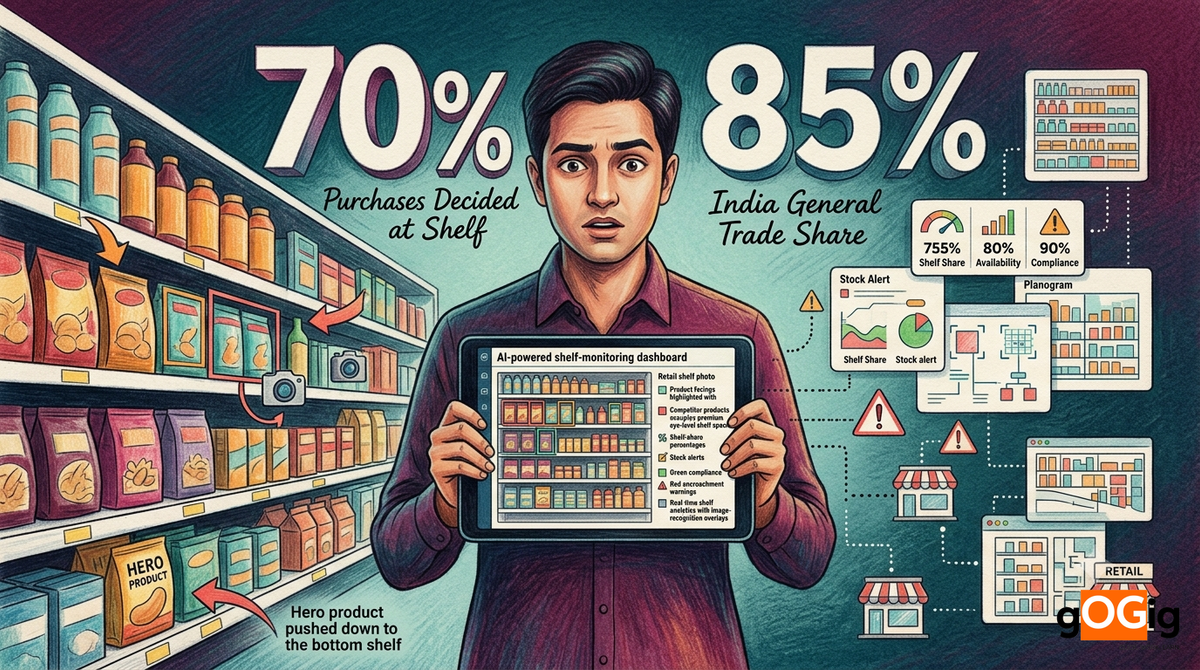
70%
Of FMCG purchase decisions are made in-store at the shelf, not during advertising exposure. Shelf space is not a merchandising metric. It is a revenue interception point. When a competitor takes your eye-level facing, your secondary display, or your promotional space, they are not stealing visual real estate. They are stealing the last moment before purchase conversion.
A merchandiser walks into a 200 sq ft Kirana in Vijayawada at 11 AM on a Saturday. The shopkeeper has rearranged the shelf overnight to fit a new soft drink crate. The brand's hero SKU is now on the bottom row behind a stack of detergent. The promotional pricing tag from last quarter is still on display. A regional competitor has bought three facings of prime real estate that nobody at the FMCG brand's HQ has seen yet. This is the gap. It sits between every CPG brand and the shopper, in every market, every day. By the time the next planogram audit reaches the category manager, the shelf has been re-merchandised twice and three new launches have already lost their visibility window. Field rep covers 25 outlets per day at 12-15 min per audit. Across a brand running 60,000 outlets and 240 merchandisers, the math is mathematically broken.
Planogram drift
Stores gradually deviate from approved layouts. Retailer rearranges shelf overnight for incoming stock. Hero SKU drops from eye-level to bottom row. Drift compounds undetected between audits.
2-4%
per month
Competitor merchandiser activity
Rival brand's merchandiser visits the same outlet, negotiates extra facings with retailer, or physically rearranges your facings to expand competitor presence. Common in tier 2/3 markets where store owners decide.
8-14%
of outlets weekly
Stock-out driven encroachment
Your SKU goes out of stock. Retailer fills the gap with competitor product. Even after replenishment, your shelf share has been permanently reduced. Hardest pattern to reverse once normalised.
~4%
OOS daily
Promotional display takeover
Temporary displays installed for a competitor campaign become permanent. End-cap rentals expire but display remains. Brand pays for premium space; competitor occupies it.
14-22%
of secondary displays
Lack of audit frequency
Audits happen monthly or quarterly. Shelf changes daily. The longer the audit interval, the higher the probability of cumulative space loss. Audit cycle becomes the encroachment opportunity window.
Compounds
daily
| India retail dynamic | Why it amplifies encroachment |
|---|---|
| General Trade = 85% of FMCG sales | Retailer owns shelf decision; no contractual planogram enforcement |
| 14M+ retail outlets nationally | Manual supervision impossible at scale |
| 200 sq ft avg Kirana footprint | Every square foot contested; competition for facings is intense |
| Multi-brand merchandisers | Same merchandiser may handle competitor brands; encroachment incentive present |
| Trade scheme intensity | Retailers reallocate space based on most-recent scheme attractiveness |
| Quick commerce ($7-8B FY25) | Dark store shelf-share becomes a parallel battle |
| 3-5 new product launches per category per quarter | Constant fight for facings; existing brands defended only by ongoing visibility |
| Regional competitor variants | Local Tier 2/3 brands enter and exit shelf rapidly |
| Tier 2/3 = 40%+ of growth | Encroachment risk is rising in emerging markets where supervision is weakest |
| Highly fragmented distribution | Brand-to-shelf data chain has many points of failure |
Share of Shelf (SOS)
The percentage of category shelf space your brand occupies relative to competitors. The most under-tracked yet most predictive shelf KPI. SOS shifts are leading indicators of market share shifts 2-4 quarters out. Benchmark: SOS ≈ Market Share ± 2-4 pp
On-Shelf Availability (OSA)
The percentage of SKUs that are physically available on the shelf at the moment of shopper visit. A product can be in inventory, in the backroom, and still unavailable to shoppers. Low OSA drives 70% brand switching. India FMCG average OSA: ~96% (NielsenIQ benchmark)
Planogram Compliance
The percentage of outlets where the actual shelf arrangement matches the approved planogram. Includes SKU position, facing count, eye-level placement, secondary displays, POSM, and pricing tag accuracy. Best-in-class benchmark: ≥92%; India avg: 68-82%
Measure Share of Shelf weekly, not monthly
If your SOS falls from 30% to 24%, you have already lost 20% of your visibility, even before sales numbers react. Weekly tracking catches the decline; monthly tracking confirms it after damage is done.
| SOS measurement approach | Cadence | Accuracy |
|---|---|---|
| Manual count by field rep | Monthly | ±8-14% |
| Photo + manual review at HQ | Bi-weekly | ±5-9% |
| AI image recognition | Weekly (or continuous) | ±1-3% |
| SOS by zone, channel, format | Weekly | Granular benchmarking |
| SOS competitor breakdown (top 5 rivals) | Weekly | Competitive intelligence |
| Eye-level SOS sub-metric | Weekly | Premium shelf battle visibility |
| Secondary display SOS | Weekly | End-cap and FSDU tracking |
Use AI shelf image recognition at every outlet visit
A single shelf photo can identify missing SKUs, competitor encroachment, compliance failures, eye-level violations, and pricing tag errors automatically.
| What AI shelf recognition detects from one photo | Manual detection | AI detection |
|---|---|---|
| Brand SKUs and their positions | Time-consuming | Per-photo SKU map |
| Competitor SKUs and their positions | Rarely captured | Per-photo competitor map |
| Facing count per brand | Manual count | Automated count |
| Eye-level position verification | Subjective | Vertical position scored |
| Out-of-stock detection | ~75% | 100% |
| Planogram deviation detection | ~65% | 100% |
| Promotional pricing tag accuracy | Often missed | OCR-verified |
| POSM presence and condition | Manual photo review | Per-element verified |
| Secondary display and end-cap detection | Reported in passing | Tracked as separate KPI |
| Shelf-strip and barker verification | Rarely tracked | Per-strip captured |
| Per-outlet SOS calculation | Hours of manual work | ~3 seconds per photo |
Track On-Shelf Availability (OSA) as a daily KPI
Empty shelf equals competitor acquisition opportunity. Every OOS event is a 70% probability of brand switch by that shopper.
| OSA dimension | Standard tracking | 2026 best practice |
|---|---|---|
| Frequency | Monthly | Daily per outlet |
| Granularity | Outlet-level | SKU + outlet + time-of-day |
| Detection method | Field rep visit | AI shelf recognition + camera + POS feed |
| Causal analysis | Rare | Distribution gap / forecast gap / merchandising gap separated |
| Backroom availability check | Manual | AI-detected (if inventory but no shelf) |
| Restock SLA | Variable | 2-4 hours from detection |
| Sales attribution | Estimated | OSA-to-revenue correlation per SKU |
| Phantom OOS detection | ~0% | 100% (inventory vs shelf gap analysis) |
Create outlet-level visibility (per-store live dashboard)
Every outlet should show its own Share of Shelf, OSA, Planogram Compliance, Competitor Encroachment, and Last Audit. Not a monthly aggregate. An always-on, per-outlet view.
| Per-outlet KPI | Sample value |
|---|---|
| Share of Shelf (this brand) | 32% |
| On-Shelf Availability | 97% |
| Planogram compliance score | 91% |
| Competitor encroachment events (last 7 days) | 3 locations |
| Eye-level position score | 88% |
| Secondary display compliance | 2 of 3 active |
| POSM compliance | 94% |
| Last verified audit | 2 days ago |
| Outlet trend (4-week) | ↓ 3 pp SOS |
| Intervention status | Merchandiser visit scheduled tomorrow |
Move from audits to alerts
The traditional model takes weeks. The 2026 model takes hours. AI detection → instant alert → same-day correction.
Problem occurs at shelf → Field rep visits weeks later → Audit report sent to HQ → HQ reviews on Thursday → Action issued via WhatsApp → Correction (2-4 weeks later)
Problem occurs at shelf → Merchandiser photo at visit captures it → AI detects encroachment / OOS / planogram drift → Instant alert to outlet manager + area manager → Same-day intervention → Re-audit at next visit confirms correction
Defend your shelf with AI-driven visibility before competitors move
Free 30-Day Verification Challenge for FMCG brands. AI shelf image recognition, weekly Share of Shelf tracking, OSA monitoring at SKU level, planogram compliance scoring, competitor encroachment alerts, per-outlet dashboards, real-time intervention workflow. 100% verification accuracy. 100% fraud detection rate.
Request a FMCG shelf defense pilot →| Brand A SOS | Brand A approx market share (12 months later) | Revenue impact (₹500 Cr brand) |
|---|---|---|
| 30% → 30% (defended) | 30% | ₹0 impact |
| 30% → 28% (small drift) | ~28-29% | ₹5-10 Cr revenue loss |
| 30% → 26% (moderate encroachment) | ~26-27% | ₹15-20 Cr revenue loss |
| 30% → 24% (significant) | ~24-25% | ₹25-30 Cr revenue loss |
| 30% → 22% (severe) | ~22-24% | ₹30-40 Cr revenue loss |
| 30% → 20% (collapse) | ~20-22% | ₹40-50 Cr revenue loss |
| OOS scenario | Direct OOS sales loss | Brand switch losses (70%) | Store switch losses (30%) |
|---|---|---|---|
| 4% OOS (NielsenIQ India avg) | 4% | 2.8% | 1.2% |
| 6% OOS (moderate) | 6% | 4.2% | 1.8% |
| 8% OOS (poor) | 8% | 5.6% | 2.4% |
| 12% OOS (very poor) | 12% | 8.4% | 3.6% |
Note: The brand switch + store switch losses are not all permanent; some shoppers return. But for category leaders, each OOS event is a measurable revenue interception risk.
Pre-2025 shelf defense
Field rep covers 25 outlets per day at 12-15 min each. WhatsApp photos to HQ. Excel for SOS estimates. Monthly category review. Quarterly planogram audit. Lagging detection 2-4 weeks behind actual events. Competitor encroachment held undetected for 30-90 days. Reactive corrections after sales drop.
2026 shelf defense
Same field rep visits 25 outlets per day. AI shelf recognition runs at every visit (~3 sec per photo). SOS, OSA, planogram compliance, competitor encroachment all computed automatically. Per-outlet dashboard updated real-time. Same-day intervention. Encroachment held to <5% of outlets at any time. Proactive defense.
| India FMCG retail indicator | Value |
|---|---|
| India FMCG market 2026 | ~₹20-25 lakh crore |
| General Trade share | ~85% |
| Modern Trade share | ~14-16% |
| Quick commerce share | ~8-10% (rising) |
| India quick commerce 2026 GOV | ~$10-12B |
| Total retail outlets | ~14M+ |
| Avg Kirana footprint | ~150-300 sq ft |
| FMCG field force (national) | ~3M field reps |
| New mall retail space added (top 7 cities by end 2026) | 16.6M sq ft |
| Avg field rep daily outlet coverage | 25 outlets |
| Avg audit time per outlet | 12-15 minutes |
| Avg revenue lost to shelf inefficiency | 3-5% of brand sales annually |
| Red flag | What it suggests |
|---|---|
| SOS reported uniform across all outlets | Self-attestation, not measurement |
| Merchandiser photo cropped to show only brand SKUs | Hides competitor presence |
| OSA reported as 100% across outlets | Statistically impossible at scale |
| Planogram compliance reported above 95% in tier 3 | Inflated; tier 3 baseline is 65-78% |
| Same merchandiser handles competitor brand | Encroachment incentive present |
| Photos all shot at similar time of day | One morning visit, not throughout the day |
| Competitor encroachment never reported | Real markets have 4-12% encroachment continuously |
| Promotional pricing tags missing in photos | Scheme execution not verified |
| Eye-level position never assessed | Highest-value real estate not tracked |
| Trade scheme execution not photo-verified | Per-outlet scheme leakage unaudited |
| FMCG outlet network | Verification cost (gOGig annual) | Avg revenue protected (3-5% baseline) | Net ROI |
|---|---|---|---|
| 5,000 outlets | ₹40-80 L | ₹3-7 Cr | 4-9x |
| 15,000 outlets | ₹1.2-2.5 Cr | ₹9-20 Cr | 5-12x |
| 30,000 outlets | ₹2.5-4.5 Cr | ₹18-40 Cr | 5-15x |
| 60,000 outlets | ₹5-9 Cr | ₹35-75 Cr | 5-15x |
| 100,000+ outlets | ₹8-15 Cr | ₹60-120 Cr | 5-15x |
| Dimension | Manual audit | gOGig shelf defense |
|---|---|---|
| Coverage of outlets audited monthly | 3-8% sampling | 100% on every visit |
| Time per outlet shelf audit | 12-15 minutes (field rep) | 30-60 seconds (photo capture) |
| SOS calculation accuracy | ±8-14% | ±1-3% |
| OOS detection rate | ~75% | 100% |
| Competitor encroachment detection | ~12-22% | 100% |
| Planogram deviation detection | ~65% | 100% |
| Eye-level position scoring | Subjective | Quantitative |
| Time from problem to alert | 2-4 weeks | Same day |
| Time from alert to correction | 2-4 weeks | Same day to 48 hours |
| Per-outlet trend tracking | Manual quarterly | Real-time |
| Per-merchandiser scorecard | Monthly | Daily |
| BRSR Core / vendor audit-ready | Manual collation | API-ready |
| Year-1 ROI | Baseline | 4-15x |
Shelf space is not lost during annual reviews. It is lost every day, in 200 sq ft Kiranas across 14 million outlets, while HQ waits for Thursday's audit summary. The brands that win in 2026 are not the ones with the biggest A&P budgets. They are the brands that ensure when a shopper reaches for a product, their product is still occupying the space they paid for.
Weekly Share of Shelf measurement via AI image recognition
Daily On-Shelf Availability tracking at SKU level
Planogram compliance scoring on every merchandiser visit
Eye-level position verification per outlet
Competitor SKU detection and mapping at every audit
Secondary display and end-cap tracking as separate KPI
POSM presence + condition verification
Promotional pricing tag OCR verification
Geofenced merchandiser visit logging with 9-layer mock-location detection
SHA-256 + perceptual hash on every shelf image
Per-outlet, per-merchandiser scorecards refreshed real-time
Same-day intervention workflow for high-priority alerts
Outlet Tier A+ to D classification by shelf compliance
SOS-to-market-share correlation tracking across rolling 12 months
7-year audit-grade retention + BRSR Core-ready evidence pack
Verified by gOGig certification or equivalent independent verification standard
gOGig's AI shelf recognition and SOS/OSA tracking works across every FMCG and CPG category fighting for retail shelf space.
gOGig's shelf-defense verification spans every Indian retail channel where shelf space is contested, from Kiranas to quick-commerce dark stores.
Defend your shelf with AI-driven visibility before competitors move
Free 30-Day Verification Challenge for FMCG brands. AI shelf image recognition, weekly Share of Shelf tracking, OSA monitoring at SKU level, planogram compliance scoring, competitor encroachment alerts, per-outlet dashboards, real-time intervention workflow. 100% verification accuracy. 100% fraud detection rate.
100%
AI accuracy
100%
Detection rate
4-15x
Year-1 ROI
Written by
gOGig Editorial Team
The gOGig Editorial team publishes research, frameworks, and field intelligence drawn from gOGig Labs' dataset of 10,000+ verified field submissions across FMCG, OOH, BTL, pharma, and BFSI sectors.
Was this article helpful?
Your feedback helps us write better content.