Single-vendor vs multi-vendor BTL campaign management: 2026 decision framework
2 min read

A practical 2026 remote-execution playbook for FMCG, agri-input, cement, paint, automobile, and rural marketing operations heads running wall painting campaigns across villages with patchy connectivity, multi-state spread, and contractor networks deployed far from supervision reach. Built around the 7-step framework and the offline-first capture stack that replaces WhatsApp + Excel + PPT closeouts.
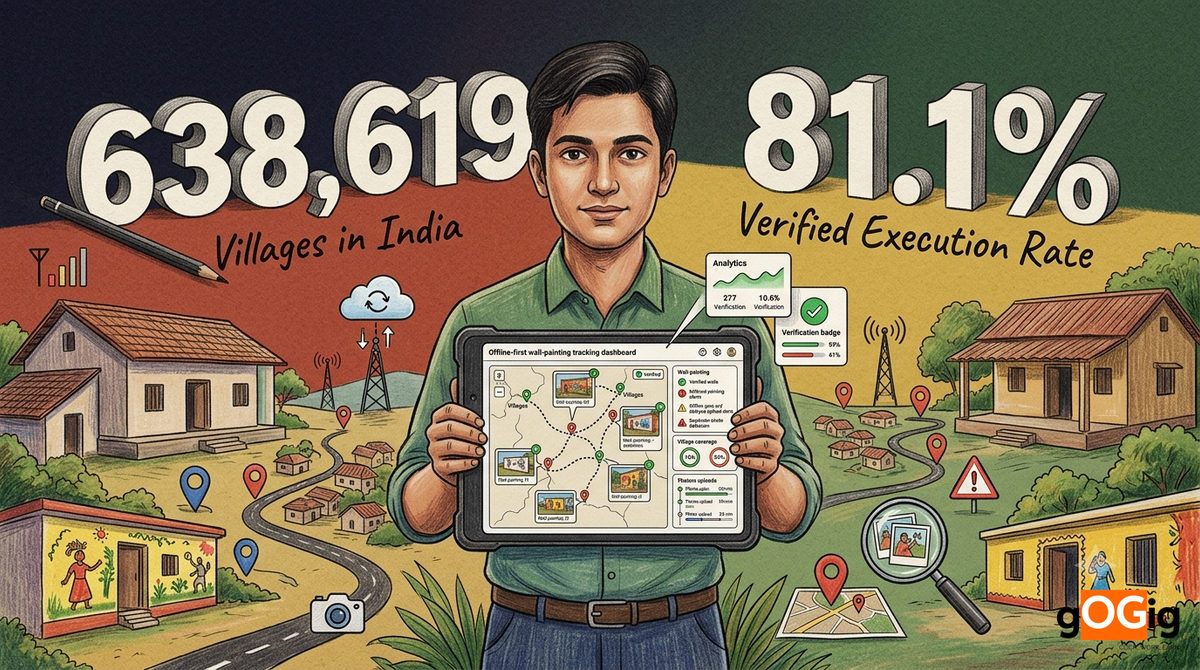
638,619
Villages in India. 250,000+ Gram Panchayats. Rural tele-density of 46 (against urban 148). Two-thirds of India lives outside the metros. This is the geography wall-painting campaigns operate in. The hardest part of tracking rural execution is not finding the walls. It is staying online long enough to verify them.
A Hindustan Unilever sales head running a Tamil Nadu rural insecticide campaign opens his Monday-morning closeout PPT. 312 villages reportedly covered. 1,840 walls painted. 5,820 photos in the campaign Google Drive. Three contractors. ₹9.6 L invoice. He notices one detail: 174 photos were uploaded between 9 PM and 11 PM on the last day of the campaign. The contractor's explanation is "we had connectivity issues in interior villages." It is plausible. But every audit head knows the reality: late-night batch uploads are a classic signature of fabricated execution. The brand's procurement team runs a SHA-256 sweep on the 5,820 photos. 412 are exact duplicates across villages. 86 walls show coordinates more than 800 meters from the registered village center. Of the 1,840 walls claimed, ~1,492 are independently verifiable. The verified execution rate is 81.1%. The leakage is ₹1.82 L on a single campaign. The connectivity problem was real. The fraud was bigger.
Connectivity gaps
3G or no signal in 18-32% of Indian villages. Batch uploads delayed by hours or days. Real-time supervision impossible without offline-first capture.
18-32%
of villages
Distance from supervision
Avg distance between rural walls 14-28 km. Supervisor capacity 4-8 villages per day. National campaigns span multiple states; physical supervision at full scale is unaffordable.
14-28 km
between walls
Multiple languages
Painters and supervisors work in 7-12 Indian languages depending on geography. Single-language mobile apps fail in mixed-language deployments.
7-12
languages
Owner consent complexity
Rural walls are owned by individuals, panchayats, or shared community structures. Consent forms require local-language capture and OTP confirmation.
~85%
private
Wall durability variance
Mud walls weather faster than brick. Painted-over rates vary by region. 30-90 day degradation audits become essential for multi-year contracts.
30-90 day
check
Multi-village fraud opportunity
Village-name spelling variants (Kolar/Kolaar, Mahabubnagar/Mahbubnagar) allow same village to be logged multiple times. Geo-coordinates eliminate this; village names alone do not.
Spelling
drift
| Problem | Operational impact |
|---|---|
| 2,000-6,000 photos in one WhatsApp group | Chat scrolls past faster than human can review |
| EXIF/GPS stripped on standard upload | ~89% of submissions lose location data |
| Connectivity-driven batching | Photos submitted days after actual work |
| No per-wall unique ID linking | 1,800 walls but 5,400 photos with no anchor |
| Village-name spelling variants | Same village logged 2-3 different ways |
| No coverage map in real time | Missed villages invisible until campaign end |
| Painter face-match impossible at scale | Substitute painter risk continuous |
| Cross-contractor duplicate detection | Manual review on 5,000+ photos infeasible |
| Wall degradation not tracked post-execution | Mud walls fail within 30 days; brand pays for full annual visibility |
| No audit-grade retention | Chat archives unstructured for compliance review |
Map every wall before painting starts (per-wall master)
Track campaigns by wall, not by village. Convert "200 villages completed" into 1,247 individually trackable walls.
| Per-wall asset field (pre-locked) | Value |
|---|---|
| Wall ID | WP-NNN (unique) |
| Village name | Master-list standardised |
| Village PIN code | Postal Index Number |
| Gram Panchayat | Linked from village master |
| District, state | Pre-locked |
| GPS coordinates | Pre-mapped during scouting |
| Wall type | Mud / brick / concrete / plaster |
| Wall dimensions (planned) | Width × height in feet |
| Visibility class | Highway / market / temple / school / lane |
| Owner consent reference | Form + OTP captured |
| Creative variant assigned | Language + design version |
| Contractor + painter ID | Pre-locked |
| Expected painting date | Campaign timeline |
Per-wall IDs run sequentially across the campaign master: WP-001 · WP-002 · WP-003 · WP-004 · WP-005 · WP-006 · WP-007 · … · WP-1247.
Use GPS-locked capture with offline-first sync
3G or no signal cannot break the verification chain. Offline capture + delayed sync + server-side timestamp closes the connectivity gap.
| Capture rule | Implementation |
|---|---|
| Offline-first capture | Photos, GPS, metadata stored locally on phone |
| Auto-sync on connectivity restore | App resumes upload silently when signal returns |
| Geofenced capture | 25-50 meter radius around pre-mapped wall coordinate |
| Live-capture validation | Photo must come from camera at moment of capture |
| 9-layer mock-location detection | Catches location-spoofing apps |
| Server-side timestamp | Independent of device clock; captures actual photo time |
| EXIF + GPS metadata preserved | Stripped EXIF = invalid submission |
| Painter face-match | Aadhaar-validated photo at start of wall |
| Pre + post-painting image pair | Baseline + completion for AI comparison |
| Local-language voice notes | Painter can describe wall in Hindi, Tamil, Telugu, etc. |
Run AI duplicate detection across all village submissions
The biggest rural fraud pattern is not fake photos. It is the same wall photographed three times from three angles, claimed as three walls.
| Duplicate pattern | Manual detection | AI detection (gOGig) |
|---|---|---|
| Exact pixel match | 10-18% | 100% (SHA-256) |
| Cropped / rotated near-duplicate | 3-6% | 100% (perceptual hash) |
| Same wall, different angle | ~0% | 100% (CNN feature match) |
| Same wall, different lighting | ~0% | 100% |
| Cross-village duplicate | ~0% | 100% (cross-database hash) |
| Cross-campaign re-use (prior project) | ~0% | 100% (historical hash database) |
| Photoshopped / AI-altered | ~0% | 100% (edit-signature) |
| Time-of-day clustering anomaly | ~0% | 100% (batch-upload signature) |
Create village-level coverage visibility
The biggest blind spot is not knowing which villages are still pending. Real-time per-village dashboard closes the gap.
| Live dashboard metric | Value |
|---|---|
| Campaign | RURAL_INSECTICIDE_TN_2026 |
| Planned villages | 312 |
| Covered villages (at least 1 verified wall) | 286 (91.7%) |
| Villages with 0 walls (pending) | 26 |
| Planned walls | 1,840 |
| Walls reported painted | 1,711 |
| Walls AI-verified (live + GPS + creative-match) | 1,492 |
| Walls flagged for review | 219 |
| Cross-village duplicates flagged | 86 photos / 27 walls |
| Cross-campaign re-use flagged | 42 photos / 14 walls |
| Mock-location flags | 11 walls |
| Coverage % (villages) | 91.7% |
| Verified Execution Rate (VER) | 81.1% |
| Per-contractor scorecards | A: 94% | B: 78% | C: 71% |
| 30-day degradation audit | Scheduled T+30 days |
Verify square footage wall-by-wall
100 sq ft claimed vs 82 sq ft actual = 18% inflation. Across 1,000 walls, that becomes 18,000 sq ft of inflated billing.
| Measurement method | Accuracy | Operational fit |
|---|---|---|
| Painter self-claim (no measurement) | ±15-25% biased up | Default; needs verification |
| Supervisor tape audit | ±5-8% | 5-10% sample only |
| AI photogrammetry from wall photo | ±2-5% | Wall-level on every photo |
| Reference object scaling (A4 sheet, brick course) | ±1-3% | Wall-level on every photo |
| Smartphone AR tape measure | ±2-5% | Painter-side measurement |
| LiDAR (premium phones) | ±0.5-1.5% | Audit-grade for premium walls |
| Drone survey (large walls) | ±1-2% | Industrial or highway walls |
Conduct random physical audits at 5-10% sample
Verify 100% digitally. Physically re-audit 50-100 walls. Contractors behave differently when they know any wall could be checked.
| Audit attribute | 1,000-wall campaign protocol |
|---|---|
| Sample size | 50-100 walls (5-10%) |
| Sampling method | Random + stratified by contractor + district |
| Tape re-measurement | Width × height, photographed |
| Cross-check against vendor claim | Per-wall variance flagged |
| 30-day degradation check | Wall still visible vs painted over |
| 90-day degradation check | Long-term durability sample |
| Owner re-confirmation | OTP to registered owner mobile |
| Cross-vendor accuracy index | Per-contractor inflation pattern tracked |
| Audit independence | Third-party auditor, not contractor-side |
Shift to proof-before-payment workflow
Do not approve payment because photos exist. Approve payment because walls are verified.
Wall painted in remote village → Offline-first capture (live photo, GPS, painter face-match) → Auto-sync on connectivity restore → Server-side timestamp + 9-layer mock-location check → AI image verification (SHA-256, perceptual hash, creative-match) → AI photogrammetry computes verified area → Coverage dashboard updated real-time → 30-day + 90-day degradation audit on random sample → 3-way matching: PO + invoice + verified delivery → Payment released
Track every village wall before it disappears into a PPT
Free 14-day Field Execution Intelligence pilot for FMCG, agri-input, cement, paint, and rural marketing brands. Pre-mapped village + per-wall master, offline-first capture, 9-layer mock-location detection, AI image verification, AI photogrammetry for area, 30/90-day degradation audit, per-village + per-contractor scorecards. 100% verification accuracy. 100% fraud detection rate.
Request a remote-village wall painting pilot →| Capability | Why it matters in remote villages |
|---|---|
| Photo + GPS + metadata captured locally | Works without signal |
| Auto-resume sync on connectivity restore | No painter intervention needed |
| Local language UI (Hindi, Tamil, Telugu, etc.) | Painters operate naturally |
| Server-side timestamp on sync | Captures actual moment of capture, not upload |
| Aadhaar-validated painter identity | Substitute painter detection |
| Voice note capture | Painter can describe wall in local language |
| Battery-efficient capture mode | Phones last full day without charge |
| Compressed image upload (sub-MB) | Sync over 2G/3G feasible |
| Wall ID barcode / QR scanning | Painter confirms exact wall being painted |
| Pre-paint baseline + post-paint completion pair | AI before/after comparison |
| India rural OOH indicator | Value |
|---|---|
| India rural population | ~65% of total (~910M+) |
| India villages | 638,619 |
| India Gram Panchayats | 250,000+ |
| Rural FMCG share of total | ~35-40% |
| India FMCG market projected 2026 | ~$220B |
| Rural tele-density | 46 |
| Urban tele-density | 148 |
| Rural broadband connections share | ~1.5% |
| India rural OOH 2026 | ~₹2,500-3,500 Cr (estimate) |
| Per sq ft wall painting cost | ₹5-15 |
| Avg wall size | 80-150 sq ft |
| Typical wall life | 1-3 years |
| Painter network (national agencies) | 500-2,000+ painters per top firm |
| National wall-painting agency coverage | 86+ cities, 563 districts |
| Avg leakage (unverified rural campaigns) | 18-32% |
| Red flag | What it suggests |
|---|---|
| All photos uploaded between 9 PM and 11 PM | Connectivity-driven batching from one location, not real-time capture |
| All photos shot in similar weather / season | Single-day shoot for multi-week campaign |
| Village name spellings vary across submissions | Same village logged multiple times |
| Wall coordinates cluster at village center only | Painter never went to outer / high-visibility walls |
| Wall sizes uniformly round (100 sq ft, 120 sq ft) | Estimated, not measured |
| Vendor refuses pre-paint baseline images | Cannot prove before vs after change |
| No owner consent OTP capture | Wall may not actually have permission |
| Vendor objects to 30/90-day degradation audit | Walls may be painted over or removed quickly |
| Coverage reaches 100% in first 50% of timeline | Statistically improbable; rural execution slows in monsoon, festivals, etc. |
| Same painter ID logged in 12+ villages in one day | Painter movement physically impossible |
| Leakage scenario | Lost area / walls | Hidden invoice value |
|---|---|---|
| 5% leakage (60 walls / 6,000 sq ft) | 6,000 sq ft | ₹50,000 |
| 8% leakage | 9,600 sq ft | ₹80,000 |
| 14% leakage | 16,800 sq ft | ₹1.4 L |
| 18% leakage | 21,600 sq ft | ₹1.8 L |
| 22% leakage | 26,400 sq ft | ₹2.2 L |
| 28% leakage | 33,600 sq ft | ₹2.8 L |
| 32% leakage | 38,400 sq ft | ₹3.2 L |
| Campaign scale | Verification cost (gOGig) | Avg leakage prevented | Net ROI |
|---|---|---|---|
| 50 villages (250 walls) | ₹18,000-32,000 | ₹60,000-1.5 L | 3-7x |
| 100 villages (500 walls) | ₹35,000-65,000 | ₹1.2-3 L | 4-8x |
| 200 villages (1,000 walls) | ₹65,000-1.2 L | ₹2.5-5.5 L | 4-9x |
| 500 villages (2,500 walls) | ₹1.4-2.5 L | ₹6-14 L | 4-10x |
| 1,000 villages (5,000 walls) | ₹2.6-4.5 L | ₹12-28 L | 5-11x |
| 2,500 villages (12,500 walls) | ₹6-10 L | ₹30-70 L | 5-12x |
| Dimension | Manual review | gOGig AI pipeline |
|---|---|---|
| Coverage of submissions audited | 5-12% sampling | 100% |
| Time per submission verified | 10-15 seconds | ~3 seconds |
| Connectivity tolerance | Real-time required | Offline-first capture + auto-sync |
| Duplicate detection rate | 10-22% | 100% |
| Mock-location detection | ~0% | 100% (9-layer) |
| Cross-village duplicate detection | ~0% | 100% |
| Cross-campaign re-use detection | ~0% | 100% |
| Per-wall area accuracy | ±15-25% (painter self-claim) | ±2-5% (AI photogrammetry) |
| Local-language painter UI | Limited | 7+ Indian languages |
| 30/90-day degradation tracking | Manual flyby (5%) | Random sample + AI scoring |
| Per-contractor scorecard refresh | Monthly | Real-time |
| Audit-grade retention | Manual collation | 7-year structured retention |
| BRSR Core readiness | Manual exercise | API-ready, on-demand |
| Year-1 ROI | Baseline | 4-12x |
The most effective way to track wall painting in remote villages is not more supervisors, more photos, or more WhatsApp groups. It is converting every wall into a trackable asset, every village into a coordinate, every square foot into a verifiable line item, and every painting event into proof that survives the connectivity gap. The campaign is not the photos. The campaign is the audit trail underneath them.
Pre-mapped village + per-wall master with locked GPS coordinates
Per-wall unique ID (WP-NNN) for every campaign asset
Owner consent form + OTP for every wall
Offline-first capture with auto-sync on connectivity restore
Live-capture validation on every photo
9-layer mock-location detection on every GPS
Painter face-match + Aadhaar verification at every wall
Pre-paint baseline + post-paint completion image pair
SHA-256 + perceptual hash on every photo
Cross-village + cross-campaign duplicate detection
AI creative-match scoring at wall level
AI photogrammetry for verified area measurement
Multi-language painter UI (Hindi, Tamil, Telugu, Kannada, Bengali, Gujarati, Marathi)
Per-village + per-contractor scorecards
30-day + 90-day degradation audit on 5-10% random sample
Verified Execution Rate (VER) + Verified Area Rate (VAR) as contractual KPIs
Proof-before-payment workflow for invoice 3-way matching
7-year audit-grade retention + BRSR Core-ready evidence pack
Verified by gOGig certification or equivalent independent verification standard
gOGig's offline-first verification stack works across every rural marketing and field execution format, from wall painting to haat-bazaar branding.
gOGig's offline-first rural verification runs across every Indian state where multi-village wall painting campaigns are commissioned.
Track every village wall before it disappears into a PPT
Free 14-day Field Execution Intelligence pilot for FMCG, agri-input, cement, paint, and rural marketing brands. Pre-mapped village + per-wall master, offline-first capture, 9-layer mock-location detection, AI image verification, AI photogrammetry for area, 30/90-day degradation audit, per-village + per-contractor scorecards. 100% verification accuracy. 100% fraud detection rate.
100%
AI accuracy
100%
Detection rate
4-12x
Year-1 ROI
Written by
gOGig Editorial Team
The gOGig Editorial team publishes research, frameworks, and field intelligence drawn from gOGig Labs' dataset of 10,000+ verified field submissions across FMCG, OOH, BTL, pharma, and BFSI sectors.
Was this article helpful?
Your feedback helps us write better content.