Single-vendor vs multi-vendor BTL campaign management: 2026 decision framework
2 min read

A 2026 trend brief on India's structural shift from metro-centric national campaigns to neighborhood-level hyperlocal execution. Built for CMOs, agency leaders, regional brand managers, and procurement heads navigating the post-national India marketing economy.
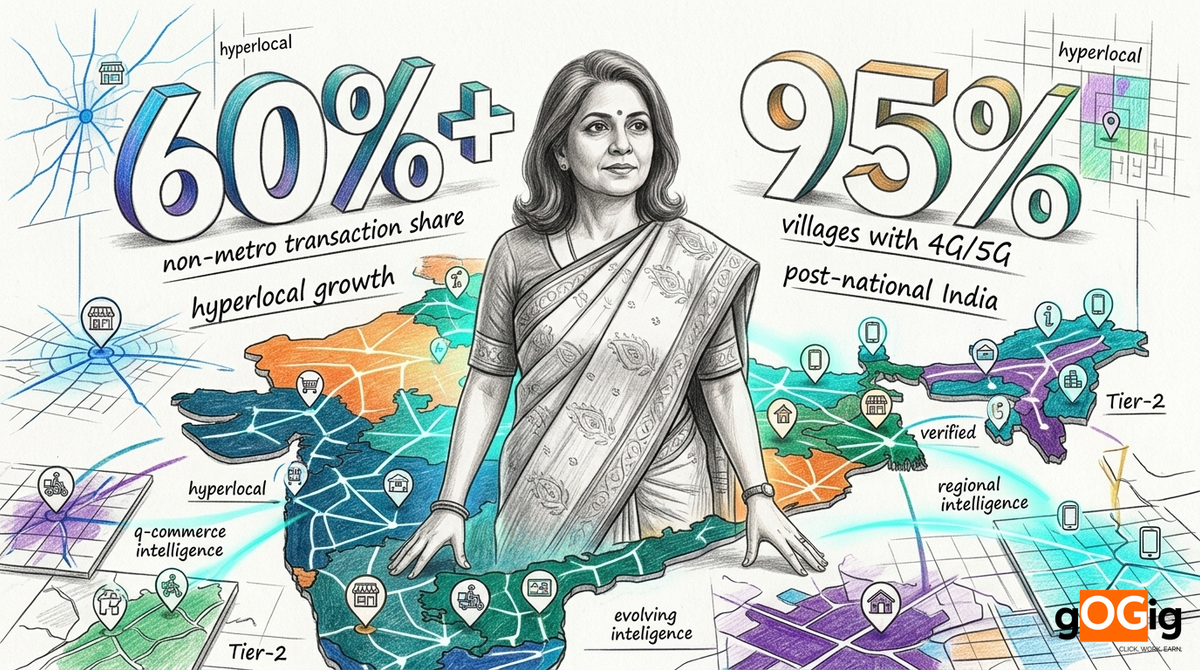
60%+
Share of India's e-commerce transactions now originating from non-metro India. The "one India" national campaign era is structurally ending. Brands operating across 3,000+ Tier-2 and Tier-3 towns face a fundamentally different execution challenge than brands managing 8 metros.
A national FMCG brand reviews its FY26 spend allocation. National TV: 38% of budget. Metro-based digital: 22%. Tier-2/3 activation: 11%. The CMO notes that 60% of category growth came from Tier-2/3 cities last year. The math no longer adds up. By the next quarter, the brand restructures spend: national TV 26%, metro digital 18%, Tier-2/3 hyperlocal execution 28%. The 17 percentage point shift is the entire trend in one budget reallocation.
| Hyperlocal indicator | Value (2026) |
|---|---|
| India retail market (current) | ~$1.06 trillion |
| India retail market (2030 projected) | $1.93 trillion (Deloitte) |
| India quick commerce market 2026 | ~$6.94–8 billion |
| Q-commerce gross order value FY25 | ₹64,000 Cr |
| Q-commerce gross order value FY28 projected | ₹2 lakh Cr (3x growth) |
| India retail outlets | 13–14 million |
| Pincodes serviced by major brands | 13,850+ |
| Tier-2/3 towns with rising digital adoption | 3,000+ |
| Hyperlocal delivery CAGR (last 5 years) | 51.84% |
| Hyperlocal delivery AOV FY24 | ₹546.25 |
| Indian villages with 4G/5G connectivity | 95% |
| India internet users | 900M+ |
| Regional language preference (Tier-2/3 consumers) | 60%+ |
| Q-commerce share of FMCG spend | 8–10% |
| National campaign assumption | 2026 reality |
|---|---|
| India behaves like one market | India behaves like 3,000+ hyperlocal economies |
| Metro purchasing drives the brand | 60%+ of growth from non-metro India |
| English + Hindi covers the country | 60%+ Tier-2/3 consumers prefer regional language |
| Celebrity endorsements drive trust | Local micro-influencers outperform celebrities in trust |
| National TV reaches everyone | Discovery happens via creators, gaming, social commerce |
| Modern Trade is the future | General Trade still 75% of FMCG; quick commerce 8–10% |
| Q-commerce is metro-only | Q-commerce expanding aggressively in 30+ Tier-2 cities |
| Centralised execution scales | Centralised execution breaks at city-by-city behavioural variance |
| Single creative works pan-India | Regional creative + local context drives engagement |
| WhatsApp updates suffice for visibility | Real-time verified execution intelligence required at scale |
| City | Tier | Population (Cr) | Hyperlocal opportunity score (/10) |
|---|---|---|---|
| Indore | 2 | ~32 lakh | 9.2 |
| Coimbatore | 2 | ~22 lakh | 8.8 |
| Lucknow | 2 | ~36 lakh | 8.6 |
| Rajkot | 2 | ~16 lakh | 8.4 |
| Guwahati | 2 | ~10 lakh | 8.0 |
| Kochi | 2 | ~17 lakh | 8.7 |
| Mysuru | 2 | ~10 lakh | 7.6 |
| Jaipur | 2 | ~40 lakh | 8.9 |
| Nagpur | 2 | ~26 lakh | 8.2 |
| Surat | 2 | ~45 lakh | 9.1 |
| Vadodara | 2 | ~21 lakh | 8.0 |
| Bhubaneswar | 2 | ~12 lakh | 7.8 |
| Visakhapatnam | 2 | ~20 lakh | 7.9 |
| Siliguri | 2 | ~7 lakh | 7.2 |
| Patna | 2 | ~23 lakh | 7.6 |
| Q-commerce infrastructure parameter | Value (2026) |
|---|---|
| Major Q-commerce platforms in India | Blinkit, Zepto, Swiggy Instamart, BigBasket Now, Flipkart Minutes, JioMart Express, Amazon Fresh, Dunzo Daily |
| Dark store size (typical) | 2,500–5,000 sq ft |
| SKUs per dark store | 2,000–3,000 |
| Dark store catchment radius | 2–3 km |
| Avg delivery time (metros) | 10–20 minutes |
| Avg delivery time (Tier-2) | 15–30 minutes |
| Amazon India EV fleet | 10,000+ across 500+ cities |
| Q-commerce expected market 2026 | $6.94 to $8 billion |
| Q-commerce ad spend 2026 | ₹6,000 Cr (+50% YoY) |
| Tier-2 city dark store expansion (top 4 platforms) | 30+ cities active |
| Hyperlocal delivery market CAGR | 51.84% (last 5 years) |
| Execution challenge | National campaign | Hyperlocal campaign (200 cities) |
|---|---|---|
| Number of execution locations | 1 central hub | 200+ cities, 5,000+ outlets |
| Vendor partners required | 2–4 agencies | 20–40 regional vendors |
| Languages required | 2–3 (English, Hindi, occasionally one regional) | 8+ regional languages |
| Creative variants | 1–3 | 15–25 (city + language) |
| Field force coordination | Centralised supervisor | 20–30 regional managers |
| Reporting complexity | Aggregated PPT | Per-city, per-outlet, per-vendor dashboards |
| Verification difficulty (without AI) | Manageable | Impossible without intelligence layer |
| Avg leakage exposure | 10–18% | 28–38% (without verification) |
| Operational team size | 4–8 people | 14–22 people + AI infrastructure |
| Real-time visibility need | Optional | Mission-critical |
Run a verified hyperlocal campaign
Free 14-day pilot across one Tier-2 city or 50-outlet hyperlocal campaign. Real-time dashboard, per-vendor scorecards, AI-detected anomaly inbox, BRSR Core ready evidence pack. 100% verification accuracy. 100% fraud detection rate.
13,850+
Pincode coverage
100%
AI accuracy
100%
Detection rate
| Metric | National campaign | Hyperlocal campaign |
|---|---|---|
| Cost per impression | Lower (mass reach) | Higher per impression |
| Cost per qualified lead | Higher | 40–60% lower |
| Conversion rate | Baseline | 2–3x higher |
| Customer acquisition cost (CAC) | Baseline | 30–45% lower |
| Brand trust score (Tier-2/3) | Lower | Significantly higher |
| Regional language engagement | Limited | 2.5–4x higher |
| Repeat purchase rate | Baseline | +18–26% |
| Local market share gain | Difficult to measure | Measurable per geography |
| Speed of competitive response | Slow (national rebuild) | Fast (city-specific adjust) |
| Investor and ESG analyst defensibility | Aggregated | Per-geography substantiated |
| Operational requirement | Why it matters in 2026 |
|---|---|
| Per-pincode coverage map (13,850+ pincodes) | Identify white spaces and overlap |
| Regional language WhatsApp workflow (8 languages) | Field force operates natively |
| Per-city vendor tier classification | Quality variance is sharp at hyperlocal scale |
| Real-time dashboards per region | Mid-campaign reallocation possible |
| 9-layer mock-location detection | Higher fraud risk in tier-2/3 verification gap |
| OTP confirmation for retailer visits | Third-party verification of outlet coverage |
| AI creative-match per local creative variant | 15–25 variants to verify |
| Auto-rickshaw and mobile van verification | Tier-2 outreach formats need execution proof |
| FSSAI tier-3 enforcement readiness | Food and beverage categories |
| BRSR Core value chain per geography | Listed parent assurance at granular level |
| Language indicator | Value |
|---|---|
| Indian languages with 10M+ speakers | 22+ |
| Regional language internet users | ~700M+ |
| % of Tier-2/3 consumers preferring regional content | 60%+ |
| ShareChat regional active users | 200M+ |
| Daily Hunt + ShareChat combined reach | ~400M MAU |
| Voice search "near me" query growth | +40% YoY |
| Regional language video consumption growth | +38% YoY |
| Hinglish, Tanglish, Marglish (hybrid) usage | Standard in Tier-2/3 |
| gOGig regional language WhatsApp workflow | 8 languages active |
| gOGig OCR for shop name boards | 8 languages (English, Hindi, Tamil, Telugu, Kannada, Marathi, Bengali, Gujarati) |
| Vertical | Hyperlocal share of marketing spend (2026) | Direction |
|---|---|---|
| FMCG | 30–38% | Rising rapidly |
| Quick commerce | 72–84% | Predominantly hyperlocal |
| QSR multi-outlet | 42–54% | Outlet-specific activation |
| BFSI retail banking | 22–32% | Branch territory targeting |
| Automotive | 34–46% | Dealer-specific activation |
| Real estate | 62–78% | Inherently hyperlocal |
| Healthcare and pharma | 28–38% | MR territory and chemist coverage |
| D2C (offline-expanding) | 38–52% | Tier-2/3 expansion phase |
| Telecom retail | 56–68% | Store catchment focus |
| Education and EdTech | 34–44% | City-specific student catchment |
| Comparison | National celebrity | Regional micro-influencer |
|---|---|---|
| Reach | Mass (millions) | Niche (10K–100K per creator) |
| Trust score (Tier-2/3) | Moderate | High (2–3x higher) |
| Cost per engagement | High | 40–70% lower |
| Engagement rate | 1–3% | 6–12% |
| Conversion rate | 0.5–2% | 3–6% |
| Brand-creator fit verification | Difficult (one-size-fits-all) | Easier (per-creator alignment) |
| Engagement authenticity | Bot inflation risk | Verified hyperlocal audience |
| Number of creators needed | 1–3 | 50–150 per market |
| Coordination complexity | Low | High (needs execution intelligence) |
| Event verification need | Standard | Critical (OTP-confirmed attendance) |
| Enabler | Impact on hyperlocal viability |
|---|---|
| UPI adoption (21.7B monthly transactions) | Removes payment friction in hyperlocal commerce |
| Aadhaar eKYC (144 Cr+ IDs) | Verifies identity for hyperlocal customer onboarding |
| Affordable smartphones (~900M internet users) | Tier-2/3 digital adoption infrastructure |
| 4G/5G coverage (95% of villages) | Enables real-time hyperlocal execution |
| Quick commerce infrastructure | Hyperlocal fulfillment at 10–30 min SLA |
| Regional language platforms (ShareChat, Lokal, Daily Hunt) | Vernacular content distribution at scale |
| WhatsApp Business API (50M+ Indian SMBs) | Hyperlocal commerce coordination |
| Field Execution Intelligence (FEI) | Real-time verified execution across 13,850+ pincodes |
| gOGig AI (100% accuracy, 100% detection rate) | Verifies hyperlocal execution at scale |
National campaign era (2010–2023)
Metro-centric. 8-city focus. National TV dominant. English + Hindi sufficient. Celebrity endorsements. PPT closeouts. ROAS at aggregate level. Vendor PPTs as evidence. ₹17–25K Cr leaked annually across physical execution. Treated India as single audience.
Post-national era (2024 onwards)
Hyperlocal across 200+ cities. 13,850 pincode coverage. Regional language native. Local micro-influencers. Real-time dashboards. RoVE per geography. AI-verified at 100% accuracy. Vendor tier scorecards. 4–7% leakage. Treats India as 3,000+ hyperlocal economies.
India stopped being one market a long time ago. What changed in 2026 is that brands stopped pretending otherwise. The shift from national to hyperlocal is not about marketing budgets moving cities. It is about brands acknowledging that the most valuable consumer is not the one in Mumbai. It is the one in Indore, in Coimbatore, in Lucknow, who has just discovered a brand through a regional creator in their own language.
| Days | Action |
|---|---|
| Days 1–14 | Audit current spend allocation; identify metro-centric vs Tier-2/3 share |
| Days 15–28 | Pick 5 Tier-2 cities for hyperlocal pilot; baseline VER per geography |
| Days 29–42 | Deploy regional language WhatsApp workflow; recruit 20–30 regional creators |
| Days 43–56 | Activate gOGig verification layer; AI catches all anomalies at 100% detection rate |
| Days 57–70 | Run city-specific activations; measure per-geography RoVE |
| Days 71–84 | Compare pilot data against national campaign benchmarks |
| Days 85–90 | Build scale-out plan to 50 cities; rebalance next-quarter budget allocation |
| Spend category | 2024 share | 2026 share | Direction |
|---|---|---|---|
| National TV | 34% | 26% | Declining |
| National print | 8% | 5% | Declining |
| Metro digital (search + social) | 24% | 20% | Stable |
| Connected TV (CTV) | 3% | 7% | Growing |
| Quick commerce ads (Blinkit, Zepto) | 2% | 6% | Growing rapidly |
| Retail media (Amazon, Flipkart) | 3% | 7% | Growing |
| OOH (Tier-1 + Tier-2) | 9% | 8% | Stable |
| Hyperlocal activation (BTL Tier-2/3) | 6% | 11% | Growing |
| Regional creator marketing | 2% | 6% | Fastest growth |
| Field force + retail visibility | 9% | 4% | Consolidating |
| City tier | Fraud signal baseline | Verification priority |
|---|---|---|
| Tier-1 metros (8 cities) | ~18–22% | High |
| Tier-2 cities (~30 cities) | ~24–30% | Very High |
| Tier-3 cities (~150 cities) | ~30–38% | Critical |
| Tier-4 and rural towns | ~34–44% | Highest urgency |
| Rural / tier-3 with weak supervision | ~38–46% | Highest urgency |
All major hyperlocal marketing formats used across India's Tier-2 and Tier-3 cities.
These Tier-2 and Tier-3 cities have the highest hyperlocal marketing opportunity scores in India.
Run a verified hyperlocal campaign
Free 14-day pilot across one Tier-2 city or 50-outlet hyperlocal campaign. Real-time dashboard, per-vendor scorecards, AI-detected anomaly inbox, BRSR Core ready evidence pack. 100% verification accuracy. 100% fraud detection rate.
13,850+
Pincode coverage
100%
AI accuracy
100%
Detection rate
Written by
gOGig Editorial Team
gOGig is India's Field Execution Intelligence platform. Offline work. Online proof.
Was this article helpful?
Your feedback helps us write better content.