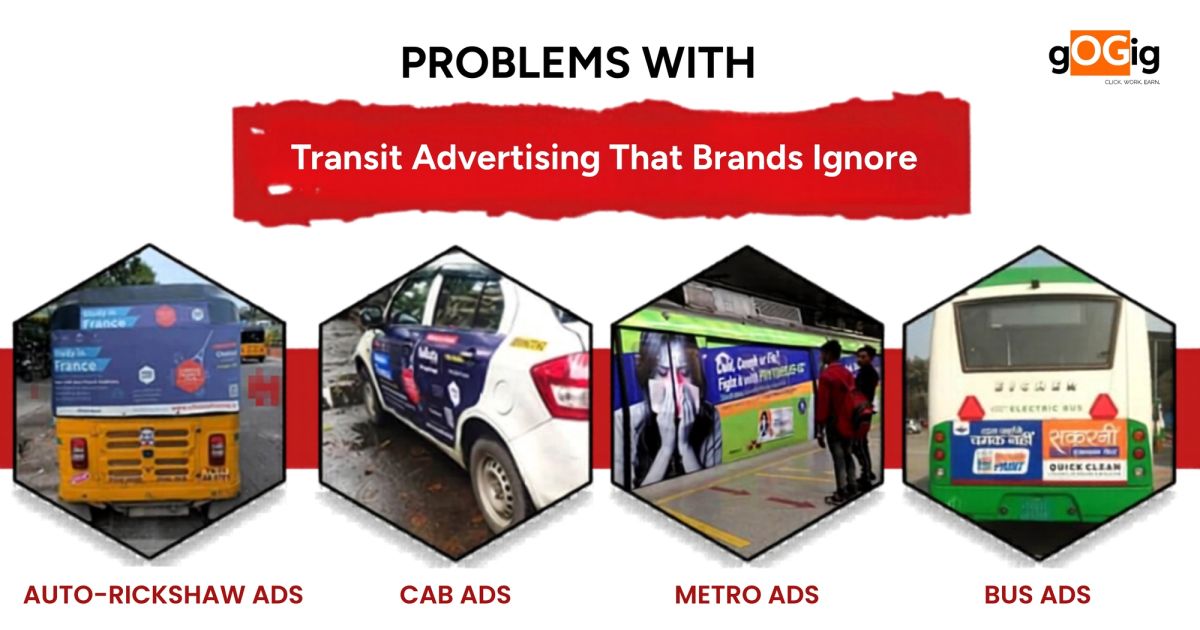
Transit advertising plays a vital role in modern outdoor marketing, and it comes with several hidden challenges that impact campaign performance. From lack of realtime visibility in transit advertising to delayed campaign reporting and fragmented communication, these issues reduce efficiency and ROI. Brands investing in bus branding , cab and metro advertising need better offline campaign trackingsolutions to ensure proper execution.
In today’s fast paced marketing landscape, relying on post campaign reports is no longer effective. Real time transit advertising tracking, campaign monitoring tools, and data driven outdoor advertising strategies help brands identify gaps early, improve coordination, and optimize performance. Addressing these transit advertising challenges is key to maximizing reach, improving brand visibility, and ensuring successful campaign execution.
The Challenge of Real Time Visibility in Transit Campaigns
The Hidden Problems in Transit Advertising No One Talks About often stem from a lack of real time visibility. Limited access to timely data makes it harder for brands to adjust campaigns quickly and capture emerging opportunities.
Consider a major beverage company that faced significant losses due to delayed visibility during a peak advertising period. Without real time insights into their bus ads' performance, they couldn't optimize placements or timings, leading to wasted resources and missed engagement opportunities. Many teams struggle with similar transit advertising challenges, which hinder overall campaign success.
Brands typically rely on outdated reporting methods.
Delayed insights result in ineffective marketing strategies.
Real time data is essential for optimizing ad placements.
Many companies miss critical engagement windows due to slow reporting.
This ongoing issue emphasizes the need for improved systems that provide instant visibility into transit campaigns, helping brands make informed decisions quickly.
Weak Transit Ad Verification Creates Reporting Gaps
Another major challenge in transit advertising is verification. Many campaigns still depend heavily on proof photos submitted by vendors or field teams. While photographic proof does provide some level of confirmation, it only captures isolated moments, not the full execution story.
A proof image may confirm that branding existed at a certain place and time, but it cannot show whether the vehicle followed its complete route, remained active for the expected duration, or maintained consistency throughout the campaign. This creates a dangerous gap between reported execution and actual campaign performance.
Stronger transit ad verification systems solve this by combining geo-tagged proof, timestamps, route-level tracking, and structured reporting. Verification becomes more reliable when it is tied to measurable execution data rather than selective documentation.
Why Transit Ad Fraud Detection Is Becoming More Important
As campaigns become larger and more distributed, fraud risk increases.
This is not always deliberate misconduct. Sometimes it comes from poor reporting discipline, disconnected workflows, or pressure to close execution tasks quickly. But the impact remains the same: inaccurate reporting and reduced campaign transparency.
Transit ad fraud detection has become increasingly important because traditional proof-based systems leave too much room for inconsistency. Reused images, outdated submissions, incomplete execution marked as complete, and incorrect location reporting are all risks when verification systems are weak.
Brands investing in transit advertising need stronger controls not because every vendor is unreliable, but because operational complexity naturally creates room for errors when monitoring systems are outdated.
Verifying Execution Authenticity: Building the Trust Your Brand Deserves
Authenticating execution proof in transit advertising is essential to building trust with consumers and protecting brand reputation.
A real world issue highlights this need: a fashion brand discovered that images from their recent campaign were misrepresented, leading to significant backlash. This incident exemplifies common transit advertising challenges that arise when proof of execution lacks verification.
Many brands struggle to confirm the authenticity of photos taken during campaigns.
Misrepresented images damage consumer trust and lead to a negative perception.
Traditional methods often rely on manual audits, which are time consuming and prone to errors.
Automated solutions provide real time verification, ensuring compliance with campaign guidelines.
Establishing a reliable verification process fosters accountability with field teams.
The ability to verify execution authenticity mitigates risks and enhances overall campaign effectiveness. Brands must prioritize this aspect to maintain integrity in their marketing efforts.
Managing Multi-City Campaigns: Where Things Get Complicated Fast
Synchronizing campaigns across multiple cities presents significant Transit Advertising Challenges. Brands often struggle with maintaining consistent messaging and execution quality, which can lead to brand dilution.
Managing different vendors and ensuring uniformity adds layers of complexity that many teams find overwhelming.
Inconsistent branding leads to customer confusion.
Different local vendors may interpret guidelines differently.
Lack of centralized oversight results in missed deadlines.
Real time communication gaps create operational delays.
The complexity of multicity campaigns requires a structured approach. Without it, you risk jeopardizing your brand's integrity and effectiveness in the bustling world of transit advertising.
The larger the campaign footprint, the more important centralized transit media tracking becomes.
Solutions like gOGig help consolidate execution visibility across cities through a unified dashboard instead of fragmented vendor communication.
Data-Driven Outdoor Advertising: The Smarter Way Forward
The brands that are getting transit advertising right today are not just buying more placements, they are using data-driven outdoor advertising strategies to make every placement work harder. The shift from gut-feel campaign management to evidence-based decision-making is the single biggest operational upgrade a marketing team can make.
Practical strategies that are already delivering results for forward-thinking brands include:
Implementing centralized dashboards for live tracking of campaigns across all cities and routes
Using automated alerts to notify teams instantly about compliance issues or execution gaps
Incorporating geotagging to automatically verify execution locations without relying on manual reports
Integrating communication tools to reduce fragmented coordination between field teams and HQ
Analyzing data from past campaigns to identify patterns and optimize future strategies
One prominent brand that adopted this approach improved its reporting speed by over 70%, allowing the team to make real-time adjustments during active campaigns rather than after the fact. The result was not just better performance it was a fundamentally more accountable way of running transit advertising, which translated directly to stronger client confidence and higher ROI.
How gOGig Addresses These Transit Advertising Challenges Head-On
gOGig was built to solve the operational problems that hold transit campaigns back. It brings together real-time transit advertising tracking, automated transit ad verification, and centralized campaign monitoring tools into a single platform designed for the realities of modern outdoor media.
Whether your campaign runs on buses in Mumbai, cabs in Delhi, or metro advertising networks across multiple cities, gOGig gives you live visibility into what is happening on the ground. Field teams submit geo-tagged, timestamped proof that is automatically validated, eliminating the risk of reused images, incorrect location reporting, or incomplete execution being marked as done.
For brands managing multi-city campaigns, gOGig consolidates everything into one unified dashboard, no more chasing vendors across WhatsApp threads or piecing together execution status from five different spreadsheets. Campaign monitoring is continuous, reporting is instant, and your team always knows exactly where things stand.
Frequently Asked Questions (FAQ)
Transit advertising challenges are often overlooked, and they significantly impact campaign success. Understanding these issues is crucial for brands aiming to maximize their marketing efforts.
What are the primary challenges in transit advertising?
Brands face issues like a lack of real time visibility, fragmented communication, and difficulties in verifying execution proof.
How has visibility and compliance improved?
Effective strategies include utilizing centralized dashboards for live tracking and automated reporting to ensure adherence to campaign guidelines.
What technologies are available for fraud detection?
Advanced technologies like AI-based validation and geotagging can identify inconsistencies in proof submissions, helping brands maintain integrity.
Addressing these transit advertising challenges requires a proactive approach. By leveraging technology, you enhance transparency and boost compliance across your campaigns.
The Hidden Problems in Transit Advertising No One Talks About reveal significant challenges that hinder campaign effectiveness. Understanding these Transit Advertising Challenges is crucial for brands aiming to maximize their impact.
From the inability to verify execution proof to fragmented communication, these issues compromise the integrity of advertising efforts. Adopting technology driven solutions, such as gOGig, is essential for successful campaign execution. With real time visibility and automated verification, brands address operational gaps effectively.
Real time tracking enhances transparency.
Automated reporting minimizes delays.
Centralized control improves compliance oversight.
By leveraging advanced tools like gOGig, companies streamline their operations and significantly boost their return on investment (ROI). Embracing innovative solutions ensures that your transit advertising campaigns are executed flawlessly and deliver measurable results.