Single-vendor vs multi-vendor BTL campaign management: 2026 decision framework
2 min read

A 2026 method-trend piece on how identity-linked, OTP-verified data collection is reshaping India's market research industry. Built for research heads, brand insights teams, agency methodology leads, and procurement teams evaluating panel and field research vendors.
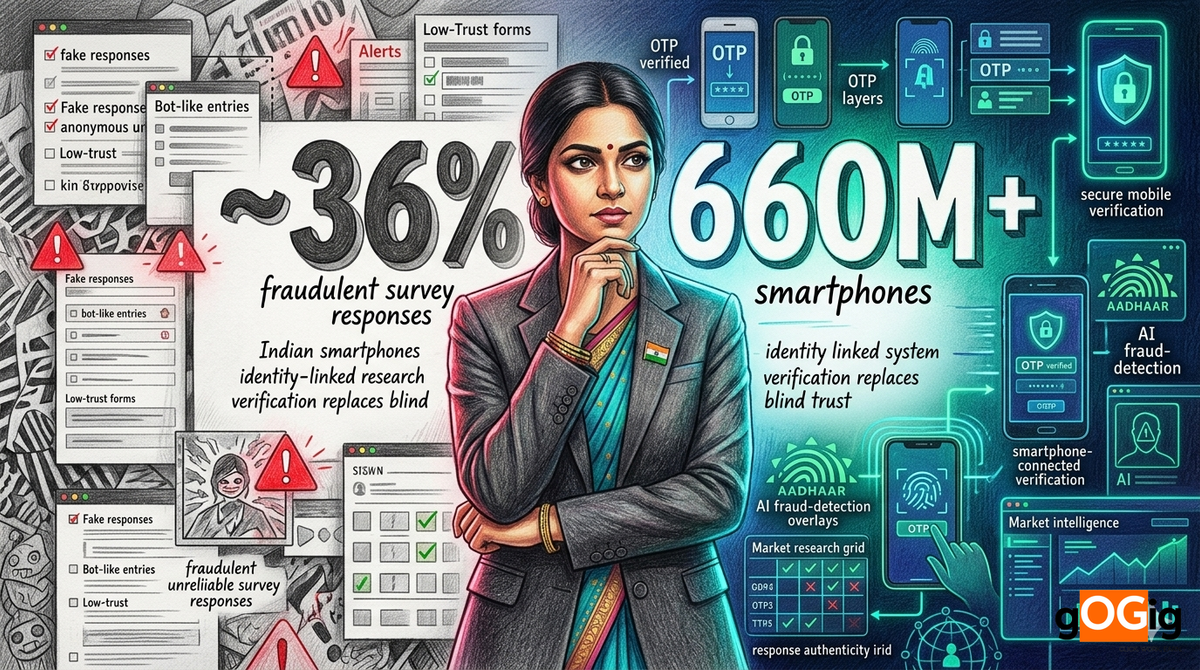
~36%
Share of open-distribution online survey responses identified as fraudulent in academic research (560 of 1,540 responses in a single 91-day study). The fraud epidemic is not theoretical. It is the silent tax on Indian market research, costing brands an estimated ₹2,000–3,500 Cr in misallocated decisions annually.
A brand insights head at a top-15 Indian FMCG opens her quarterly study results. The headline finding: 41% of Tier-2 women aged 25–34 prefer Variant B over Variant A. The brand reformulates and rolls out. Six months later, sell-through is flat. Variant B underperforms Variant A. The post-mortem reveals 38% of survey respondents could not be re-contacted. SIM numbers are inactive. WhatsApp messages bounce. The decision was based on data that never represented real consumers. The next study now has a mandatory line in the methodology section: "Identity-verified, OTP-linked respondents only." That is the trend.
| Research integrity threat | Industry indicator |
|---|---|
| Open-distribution survey fraud rate (academic baseline) | ~36% |
| Indian online panel fraud estimate (industry) | 22–34% |
| 4th generation bots (rotating IPs, ML-adaptive) | Widespread; mimic human behavior accurately |
| 'Professional survey takers' inflation | ~10–18% of panel respondents |
| SIM farm operations in India | Active in 6+ states |
| Duplicate responses (cross-panel) | ~8–14% of typical panel |
| AI-generated open-ended response detection | Emerging 2025-26 threat |
| Demographic spoofing (age/gender/income lies) | ~12–22% in incentivized panels |
| India panel match rate (re-contactability) | ~58–72% post-survey |
| Tier-3 / rural panel quality decline | 10–15 percentage points below metro panels |
| Indicator | Value |
|---|---|
| India market research industry size | ~₹6,500–8,000 Cr |
| Annual growth rate | ~12–15% |
| Online survey share of all methods | ~62–68% |
| CAPI and face-to-face share | ~22–28% |
| CATI (phone interview) share | ~8–12% |
| Mobile-first survey share | ~75% of digital research |
| Top 5 India research agencies (combined) | ~40–48% market share |
| Independent research consultancies | ~5,000+ |
| Annual studies commissioned by top-100 brands | ~22,000+ |
| Avg cost per completed verified response | ₹35–160 (depending on method) |
| Annual research spend lost to fraud (estimated) | ₹2,000–3,500 Cr (in misallocated decisions) |
| OTP adoption indicator in India | Value |
|---|---|
| UPI monthly transactions (2026) | 21.7 billion |
| UPI share of India retail payments | 81% |
| Aadhaar authentications (FY 2024-25) | 2,707 Cr+ |
| Daily OTP volume in India (cross-industry) | ~2–2.5 billion OTPs |
| OTP delivery success rate (SMS + WhatsApp) | ~96–98% |
| Avg OTP delivery latency | ~3–7 seconds |
| WhatsApp Business API in India (consumer adoption) | 535M+ users |
| SBI/HDFC/ICICI customer OTP familiarity | Universal (~100% account holders) |
| UPI-trained behaviour in Tier-2/3 | 89%+ of smartphone users |
| Consumer fatigue with OTPs (research signal) | Lower than enterprise expectations |
| Fraud pattern | Anonymous panel detection | OTP-verified survey detection |
|---|---|---|
| Bot submissions | 30–60% caught | 100% blocked at OTP gate |
| Duplicate registrations | ~60–75% caught | 100% (same number rejected) |
| Survey farm participation | ~40–55% caught | SIM volume patterns surface |
| Demographic spoofing | ~15–25% caught | Verified against telecom database |
| Professional survey takers | ~20–30% caught | Cross-study identity continuity |
| Fake re-entry under different identity | ~30–45% caught | Hash-linked across studies |
| AI-generated response detection | ~20–30% caught | Combined with timing + identity validation |
| VPN/proxy masking | Mixed | Telecom-linked location confirms real geography |
| Re-contactability of respondents | ~58–72% | ~92–97% |
| Trust score for downstream decisions | Moderate | Audit-grade |
Mobile number validation
Number reachable, active, not blacklisted, telecom carrier validated.
Live OTP confirmation
Time-bound 6-digit OTP via SMS + WhatsApp. ~3–7 second delivery latency. 96–98% success rate.
Device fingerprinting
Browser, OS, screen, device model, and behavioural signature. Catches device-level duplication.
Geolocation + IP cross-check
Device location verified against telecom-claimed location. VPN/proxy detection.
Behavioural anomaly classifier
Completion speed, click pattern, scroll behaviour, attention check failures.
AI-generated response detection
NLP signature analysis of open-ended responses. Catches ChatGPT, Gemini, Claude, and similar AI fluff.
Cross-study identity continuity
Hash-linked respondent ID across studies. Detects professional survey takers and incentive manipulators.
SIM farm pattern detection
Volume patterns at telecom-circle level. Coordinated multi-number behaviour surfaced.
DPDP-compliant data retention
Customer consent capture, purpose limitation, right to erasure. Audit-grade record.
Run an OTP-verified survey study with gOGig
Free pilot of 500 OTP-verified respondents across one Tier-2 city or one consumer segment. 9-layer verification. 100% detection accuracy. Audit-grade data delivery. Compare against existing panel data.
100%
Verification accuracy
100%
Fraud detection rate
92-97%
Re-contactability
| Cost dimension | Anonymous panel | OTP-verified survey |
|---|---|---|
| Per-response cost | ₹35–90 | ₹60–140 |
| Effective cost per verified response | ₹50–140 (after fraud removal) | ₹65–145 (zero fraud loss) |
| Study turnaround | 3–5 days | 4–7 days |
| Re-contactability rate | ~58–72% | ~92–97% |
| Fraud rate to manage | 22–34% | 0–2% |
| Effective sample size delivered (1,000 quota) | ~660–780 | ~980–1,000 |
| Cost per effective verified response | ₹55–145 | ₹62–146 |
| Decision-grade confidence | Moderate | High |
| Reusability for longitudinal studies | Limited | Strong |
| Net ROI on research spend | Baseline | +22–38% |
| Downstream decision affected | Avg spend at risk | Avg loss from bad data |
|---|---|---|
| Product launch (FMCG) | ₹30–150 Cr per SKU | 34–58% of launches underperform; data quality contributes |
| Media plan allocation | ₹50–300 Cr per brand annually | 10–22% waste attributed to poor consumer insight |
| Pricing decisions | ₹5–50 Cr revenue impact | 14–26% of price tests fail to translate to market |
| Retail strategy (city expansion) | ₹2–20 Cr per city | Tier-3 expansion failures often rooted in unreliable data |
| Political polling | Major | Polling miss-rate visible publicly post-election |
| Customer satisfaction tracking | Strategic | NPS scores divergent from actual churn |
| Hyperlocal segmentation | ₹5–30 Cr per region | Tier-2/3 segmentation off by 10–22 percentage points |
| Brand health tracking | Strategic | Tracking misses key consumer cohort behavior |
| Concept testing | ₹0.5–3 Cr per concept | Up to 40% of accepted concepts fail in market |
Anonymous panel (2024-25)
22–34% fraud baseline. 58–72% re-contactability. SIM farms undetected. Professional survey takers contaminate 10–18%. Demographic spoofing 12–22%. AI-generated open-ended responses passing through. Decision confidence: moderate. Brand insights teams privately discount findings 15–25%.
OTP-verified survey (2026)
0–2% fraud rate. 92–97% re-contactability. SIM farms detected via pattern signals. Cross-study identity continuity blocks professional takers. Telecom-validated demographics. AI-generated responses caught via NLP signature. Decision confidence: audit-grade. Brand insights teams use data at face value.
| India infrastructure layer | OTP-verification enabler |
|---|---|
| UPI (21.7B monthly transactions) | OTP behaviour normalised across all consumer segments |
| Aadhaar (144 Cr+ IDs, 2,707 Cr annual authentications) | Identity verification at population scale |
| WhatsApp Business API (535M+ Indian users) | WhatsApp OTP as a parallel delivery channel |
| JioMart and quick commerce expansion | Tier-2/3 consumer comfort with OTP at checkout |
| SBI/HDFC/ICICI digital onboarding | Universal OTP familiarity across banking users |
| DigiLocker (30 Cr+ users) | OTP-linked document verification at scale |
| DPDP Act 2023 | Consent-based data collection framework |
| FSSAI, RBI, IRDAI mandates | OTP confirmation becoming sector default |
| Telecom subscriber base | 1.18 billion mobile subscribers |
| Use case | Why OTP-verified is essential |
|---|---|
| Product concept testing | High decision stakes; need real consumer voice |
| Pricing research | Sensitive to 'professional taker' distortion |
| Brand health tracking | Longitudinal; needs identity continuity across waves |
| NPS and CSAT studies | Customer identity verification critical |
| Political polling (state and national) | Public scrutiny requires defensible methodology |
| Mystery shopping (retail audits) | Geolocation-tied verification |
| Tier-2/3 hyperlocal research | Panel quality declines outside metros; OTP closes the gap |
| Pharma post-launch surveys | UCPMP compliance; auditable |
| BFSI customer insights | Sector demands KYC-grade verification |
| Field auditor verification (retail, BTL, OOH) | OTP confirms outlet or store visit |
| Vertical | OTP-verified survey share (2024) | OTP-verified survey share (Q4 2026 projected) |
|---|---|---|
| BFSI customer research | ~22% | ~58% |
| Pharma post-marketing surveys | ~14% | ~46% |
| FMCG concept testing | ~8% | ~32% |
| QSR customer satisfaction | ~6% | ~38% |
| Insurance customer studies | ~18% | ~52% |
| Telecom subscriber research | ~14% | ~44% |
| Automotive dealer studies | ~10% | ~36% |
| D2C consumer research | ~4% | ~28% |
| Political polling | ~6% | ~32% |
| Retail audit and mystery shopping | ~16% | ~52% |
| Capability | OTP alone | gOGig OTP + AI verification stack |
|---|---|---|
| Mobile number validation | Yes | Yes + telecom carrier verification |
| Live OTP confirmation | Yes | Yes + WhatsApp parallel channel |
| SIM farm detection | No | Yes (volume pattern analysis) |
| Device fingerprinting | Sometimes | Always (9-layer verification stack) |
| Behavioural anomaly classification | No | Yes (model 9 from gOGig AI stack) |
| AI-generated response detection | No | Yes (NLP signature on open-ended) |
| Cross-study identity continuity | No | Yes (hash-linked across studies) |
| Geolocation cross-validation | Sometimes | Always (9-layer mock-location detection) |
| DPDP-compliant retention | Manual | Built-in 7-year audit-grade |
| Composite fraud detection | ~70–80% | 100% |
| Composite verification accuracy | ~85% | 100% |
OTP alone is necessary but not sufficient. SIM farms exist. Temporary numbers exist. Coordinated networks pass simple OTP gates. The 2026 standard is OTP combined with device intelligence, behavioural classification, and AI-grade fraud orchestration. Survey integrity at scale requires layers.
| Indicator | 2024 | 2026 | 2028 (projected) |
|---|---|---|---|
| OTP-verified survey share of total | ~9% | ~28% | ~58% |
| Anonymous panel share | ~62% | ~48% | ~22% |
| Hybrid (anonymous + verified) share | ~14% | ~18% | ~14% |
| CAPI / face-to-face share | ~15% | ~6% | ~6% |
| Avg fraud rate in India research output | ~24–30% | ~12–18% | ~4–8% |
| Brand decisions affected by bad data | ~26–38% | ~14–22% | ~5–9% |
| Premium pricing for OTP-verified data | +20–40% | +10–20% | +5–10% (becoming default) |
| Decisions backed by audit-grade data | ~12% | ~36% | ~74% |
| 2024-25 default | 2026 replacement |
|---|---|
| Anonymous online panels without identity verification | OTP-verified, telecom-linked panels |
| 'Captcha solves the bot problem' | 9-layer verification stack |
| Trust-based panel quality scores | Continuous trust scoring + machine-learning baselines |
| IP-based duplicate detection alone | Device fingerprinting + identity continuity |
| Manual response review | AI-led continuous review |
| Single-channel survey delivery | SMS + WhatsApp + in-app parallel |
| One-time data collection | Longitudinal identity-continuous studies |
| Panel-only data quality reporting | Per-respondent provenance trail |
| Quote-based vendor selection | Methodology-based vendor selection |
| '58–72% re-contactability' accepted as normal | 92–97% re-contactability baseline |
OTP-verified survey methodology applies to all major consumer research formats in India.
gOGig OTP-verified survey capability is live across all major Indian cities including key Tier-2 markets.
Run an OTP-verified survey study with gOGig
Free pilot of 500 OTP-verified respondents across one Tier-2 city or one consumer segment. 9-layer verification. 100% detection accuracy. Audit-grade data delivery. Compare against existing panel data.
100%
Verification accuracy
100%
Fraud detection rate
92–97%
Re-contactability
Written by
gOGig Research
gOGig Editorial Team
Was this article helpful?
Your feedback helps us write better content.