Single-vendor vs multi-vendor BTL campaign management: 2026 decision framework
2 min read

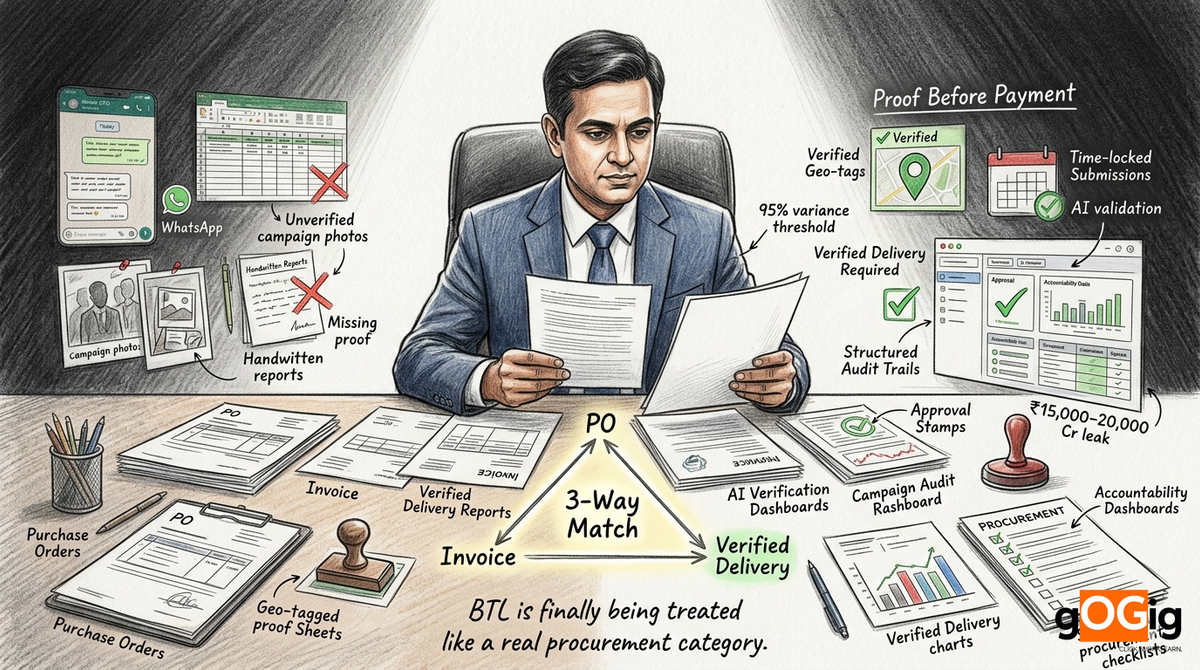
Every other procurement category in the Indian enterprise requires verified delivery before payment. BTL is the structural exception. This is the procurement, contractual, and CFO-grade playbook to end that exception, by the numbers.
3-way matching
PO + invoice + verified delivery. Required by every procurement category in your enterprise. Skipped by exactly one: BTL.
A procurement head opens her IT vendor MSA. Every payment conditioned on verified delivery. Then her BTL agency MSA. WhatsApp photos and self-reported execution. Two completely different standards inside the same procurement function for years.
Proof Before Payment is standard three-way matching applied to BTL, the one category that has been exempt from it for forty years.
| Spend category | Goods receipt equivalent | 3-way match? |
|---|---|---|
| IT hardware | Serial number scan | Yes |
| Office supplies | Stock receipt | Yes |
| Logistics | Signed POD | Yes |
| SaaS subscription | IT activation confirmation | Yes |
| Capex equipment | Commissioning report | Yes |
| Consulting services | Deliverable sign-off | Yes |
| Creative production | File delivery confirmation | Yes |
| Digital media | Platform impression report | Yes |
| TV media | BARC audited ratings | Yes |
| Print media | ABC audited circulation | Yes |
| Radio media | RAM audited listenership | Yes |
| Out-of-home (premium sites) | Partial site audit | Partial |
| BTL & field execution | WhatsApp photos | No |
| Category | Evidence document | Source of truth | Verification timing |
|---|---|---|---|
| IT hardware | Serial number scan + warranty registration | Independent device record | At delivery |
| Logistics | Electronic POD + GPS trail | Carrier system | At delivery |
| Capex | Commissioning certificate + factory acceptance test | Engineering team sign-off | Post-installation |
| Digital media | Pixel fires + third-party MMP report | Platform + adjudicator | Real-time |
| TV media | BARC audited ratings + spot logs | Independent measurement body | Weekly |
| Print media | ABC certified circulation + tear sheets | Independent audit bureau | Monthly / quarterly |
| BTL today | Agency PDF deck + WhatsApp photo folder | The vendor being paid | End of campaign |
| BTL under PBP | Field Execution Intelligence report | Independent verification platform | Real-time per submission |
Add Proof Before Payment to your next vendor contract
Download the eight core PBP clauses, the variance threshold guidance, and the 90-day rollout roadmap. Ready for procurement and legal.
Download the PBP contract framework →| Force | What changed | Status |
|---|---|---|
| Verification economics inverted | Cost dropped from ₹40–80 to ₹5–15 per submission | 70–90% cost reduction |
| BRSR Core regulatory pressure | Value chain assurance mandatory FY 2025-26 | Top 250 listed companies |
| CFO entry into marketing accountability | Audit committees flagging BTL controls weakness | Active in 60%+ of top 500 brands |
| Early-mover compounding advantage | Verified accountability data unavailable to laggards | 2–3 quarters first-mover lead |
| Year | Per-submission verification cost | Technology driver |
|---|---|---|
| 2010 | ₹120–180 | Physical audit teams, manual spot checks |
| 2015 | ₹80–120 | Smartphone-based capture, manual review |
| 2018 | ₹50–80 | App-based capture, basic GPS validation |
| 2021 | ₹25–50 | Cloud storage, automated workflows |
| 2024 | ₹10–20 | AI verification, EXIF validation at scale |
| 2026 | ₹5–15 | WhatsApp-native capture, real-time AI inference |
| Year | Requirement | Companies covered |
|---|---|---|
| FY 2022-23 | BRSR mandatory disclosure introduced | Top 1,000 listed |
| FY 2023-24 | BRSR Core sub-framework with 49 KPIs | Top 150 listed |
| FY 2024-25 | Value chain disclosure introduced | Top 250 listed (comply-or-explain) |
| FY 2025-26 | Limited assurance mandatory | Top 250 listed |
| FY 2026-27 | BRSR Core assurance phased in | Top 1,000 listed |
| By 2027 | Extension to all listed companies | All listed entities |
| Term | Definition | BTL today | Under PBP |
|---|---|---|---|
| Net 30 | Payment within 30 days of invoice | Released on agency self-report | Released on verified execution rate >=95% |
| Net 45 | Payment within 45 days of invoice | Released on agency self-report | Released on verified execution rate >=95% |
| Net 60 | Payment within 60 days of invoice | Released on agency self-report | Released on verified execution rate >=95% |
| Net 90 | Payment within 90 days of invoice | Released on agency self-report | Released on verified execution rate >=95% |
| 15 MFI | 15th of month following invoice | Released on agency self-report | Released on verified execution rate >=95% |
| 30 MFI | 30th of month following invoice | Released on agency self-report | Released on verified execution rate >=95% |
| 2/10 Net 30 | 2% discount if paid in 10 days, full in 30 | Rare in BTL | Verified-execution discount becomes viable |
| MSME Act 45-day rule | Mandatory 45-day payment if vendor is MSME | Not specific to BTL | Payment trigger 45 days but tied to verified delivery |
| 3x RBI interest on delay | Auto-applied if MSME payment delayed beyond 45 days | Active across all categories | Active across all categories |
| Stage | Legacy BTL (days) | Under PBP (days) |
|---|---|---|
| Campaign execution | 30–60 | 30–60 |
| Photo / report compilation | 5–15 | 0 (real-time) |
| Agency invoice raised | 3–5 | 1–2 |
| Brand review of submissions | 10–20 | 1–3 |
| Dispute resolution | 15–45 | 0–15 (variance window) |
| Procurement matching | 5–10 | 1–2 (automated) |
| AP processing | 5–10 | 3–5 |
| Total cycle (invoice to payment) | 38–90 days | 6–27 days |
| Step | Owner | Trigger | Typical duration |
|---|---|---|---|
| 1. PBP-enabled MSA signed | Procurement & Legal | Vendor onboarding | 15–30 days |
| 2. PO with verification milestones issued | Procurement | Campaign approval | 1–3 days |
| 3. Real-time execution capture | Vendor & Field team | Every activation event | Continuous |
| 4. Mid-campaign dashboard review | Brand Manager | Daily / weekly | Ongoing |
| 5. End-of-campaign verification report | Verification platform | Campaign closure | <24 hours |
| 6. 3-way matching performed | Procurement / AP | Invoice receipt | 1–2 days |
| 7. Payment release decision | CFO office / AP | Invoice + verified report | 3–5 days |
| 8. Audit trail archived (7 years) | Internal Audit | Post-payment | Automatic |
| Document | Source | Critical data fields |
|---|---|---|
| Purchase Order | Procurement system | Vendor ID, scope, milestones, variance threshold, payment terms |
| Vendor invoice | Agency / vendor | PO reference, line items, GST, payment terms, MSME status |
| FEI verification report | Verification platform | Verified execution rate, geo-tagged submissions, time-locked events, anomaly flags |
| Variance reconciliation | Vendor (if applicable) | Additional evidence within 15-day window |
| Audit trail packet | System-generated | Full chain of custody for BRSR Core |
Clause 1 — Verification Standard
All on-ground execution under this Agreement shall be captured through a Field Execution Intelligence platform mutually agreed between the parties, with every execution event recorded at the time of occurrence with verified GPS coordinates, server-side timestamp, and AI-verified image authenticity. Purpose: Defines the technical evidence standard. Without it, "proof" remains undefined.
Clause 2 — Payment Release Trigger
The Company's obligation to release payment shall be triggered only upon completion of a three-way reconciliation between the Purchase Order, the Vendor invoice, and the Field Execution Intelligence verification report, with a verified execution rate of not less than ninety-five percent (95%) against contracted scope. Purpose: Ties payment to verified execution rate. 95% is the industry-emerging standard.
Clause 3 — Variance Resolution
If the verified execution rate falls below the threshold specified in Clause 2, the Vendor shall have fifteen (15) business days to submit additional verified evidence reconciling the variance. Unresolved variance shall result in invoice adjustment pro rata to verified execution. Purpose: Procedurally fair 15-day window. Prevents disputes from becoming legal disputes.
Clause 4 — Audit Trail Retention
Verification evidence shall be retained by the Company for not less than seven (7) years from campaign completion, and shall be available for inspection by the Company's internal audit, external auditors, or regulatory authorities including SEBI assurance providers under BRSR Core requirements. Purpose: Aligns BTL with BRSR Core 7-year assurance retention requirement.
Clause 5 — Audit Access Rights
The Vendor grants the Company and its internal and external auditors the right to access verification platform data, vendor field workflows, and supporting evidence with seventy-two (72) hours written notice, for the purpose of substantiating disclosures or investigating execution discrepancies. Purpose: Establishes inspection rights without requiring litigation discovery process.
Clause 6 — Data Confidentiality of Verification Records
All verification platform data captured under this Agreement constitutes confidential information of the Company. The Vendor shall not use, reproduce, or share such data for any purpose other than performing the Services under this Agreement, including but not limited to using such data to pitch to competitors. Purpose: Protects the brand's proprietary accountability data from being leveraged elsewhere.
Clause 7 — Termination for Repeated Variance
The Company reserves the right to terminate this Agreement without penalty in the event of three (3) consecutive campaigns where the verified execution rate falls below the threshold and the variance remains unresolved, notwithstanding any other notice period stipulated elsewhere. Purpose: Provides commercial recourse against systematic underperformance.
Clause 8 — Indemnity for Fraudulent Submissions
The Vendor shall indemnify the Company against any losses, claims, or regulatory penalties arising from execution submissions later determined to be fraudulent, including but not limited to GPS spoofing, duplicate submissions, or backdated proofs identified by the Field Execution Intelligence platform. Purpose: Shifts liability for proven fraud to the executing party.
R = Responsible, A = Accountable, C = Consulted, I = Informed. Standard RACI methodology applied to the PBP operating model.
| Activity | CMO | CFO | Procurement | Internal Audit | Brand Manager | Legal |
|---|---|---|---|---|---|---|
| PBP policy approval | A | A | R | C | I | C |
| MSA template update | I | C | R | I | I | A |
| Variance threshold setting | C | A | R | C | C | I |
| Vendor onboarding | I | I | A/R | C | C | I |
| PO issuance | I | I | R | I | A | I |
| Mid-campaign dashboard review | I | I | I | I | R/A | I |
| Variance dispute resolution | C | C | R | C | A | C |
| Payment release decision | I | A | R | C | C | I |
| Quarterly board reporting | R/A | R | C | C | C | I |
| Annual audit assurance | C | A | R | R | I | C |
| Role | Owns under PBP | Primary metric | Reporting frequency |
|---|---|---|---|
| CMO | Board reporting of verified execution alongside ROAS | Verified execution rate % | Quarterly |
| CFO | Marketing spend auditability across portfolio | BTL accountability gap closure % | Quarterly |
| Procurement head | MSA template, 3-way matching, vendor onboarding | % of BTL contracts on PBP | Monthly |
| Internal audit | Sample testing of platform evidence | Audit-grade evidence coverage % | Quarterly |
| Brand manager | Real-time dashboard monitoring, mid-campaign correction | Time-to-detection of issues | Per campaign |
| Legal | PBP clause review, dispute resolution language | Clause adoption across MSAs | Annual |
| BTL agency | Execution capture through verification platform | Verified execution rate per campaign | Per campaign |
| Field force / vendor | Submission integrity | Anomaly rate % | Per campaign |
Self-reported execution
Agency reports, WhatsApp photos. Where 85% of brands sat in 2024. Verification rate: unknown.
Spot-check audits
Quarterly or annual third-party sampling. Verification rate: estimated. Useful but insufficient for payment mechanics.
Verification pilots
1–3 campaigns on a FEI platform parallel to legacy. PBP language being drafted but not yet contractual. Verification rate: measured for pilot only.
PBP in vendor contracts
MSA templates updated. 3-way matching applied to BTL invoices. Verification rate: measured across PBP-covered contracts.
PBP as operating standard
Every new BTL campaign verified by default. Board reporting includes verified execution rate. Cross-format unified accountability.
| Transition | Typical duration | Key milestone |
|---|---|---|
| Level 1 to Level 2 | 3–6 months | First third-party audit completed |
| Level 2 to Level 3 | 1–3 months | First pilot campaign on FEI platform |
| Level 3 to Level 4 | 2–4 months | PBP clauses added to MSA template |
| Level 4 to Level 5 | 6–12 months | 100% of new BTL campaigns under PBP |
| End-to-end (Level 1 to Level 5) | 12–24 months | Full operating standard achieved |
Legacy BTL
Net 30 against agency self-report. Dispute resolution 4–8 weeks. Re-execution cost 30–60% of original spend. Verification rate unknown.
Proof Before Payment
Net 30 against verified execution rate ≥95%. Variance window 15 days. Re-execution cost reduced 70–80%. Verification rate visible per campaign.
| Metric | Pre-PBP | Post-PBP year 1 | Improvement |
|---|---|---|---|
| Verified execution rate | Unknown (self-reported) | 92–97% measurable | Newly visible |
| BTL accountability gap | 20–30% | 5–10% | 60–80% reduction |
| Billing dispute resolution time | 4–8 weeks | 3–5 days | 85–90% faster |
| Re-execution cost | 30–60% of original spend | 5–15% of original spend | 70–80% lower |
| Brand manager reconciliation time | Baseline | 60–80% lower | 60–80% lower |
| Annual exposure (mid-size brand) | ₹3–8 Cr | ₹0.5–2 Cr | ₹2.5–6 Cr saved |
| Annual exposure (enterprise brand) | ₹50–200 Cr | ₹10–50 Cr | ₹40–150 Cr saved |
| Average payment cycle | 38–90 days | 6–27 days | 70–80% shorter |
| BRSR Core assurance pass rate | Fails substantiation | Substantiated | Compliance achieved |
| Internal audit findings on BTL | Recurring annually | Closed within 1 cycle | ~100% improvement |
| Concern | Pre-PBP answer | Post-PBP answer |
|---|---|---|
| Where did the BTL spend go? | Agency-reported PDF | Verified per-unit evidence |
| Can we substantiate this for BRSR Core? | No | Yes, 7-year audit trail |
| What is our annual BTL leak? | Unmeasured | Quantified per quarter |
| How are vendors evaluated? | Rate cards only | Verified execution rate |
| Time to detect execution issues? | 4–8 weeks | Same day |
| Audit committee findings on marketing controls? | Recurring | Closed within 1 cycle |
| Marketing controls maturity score | Below other categories | Aligned with other categories |
| External auditor confidence in BTL spend | Qualified | Unqualified |
| Field | Source | Format |
|---|---|---|
| Total BTL spend | Procurement system | ₹Cr |
| BTL spend on PBP-covered contracts | Procurement system | ₹Cr (%) |
| Average verified execution rate | FEI platform | % |
| BTL accountability gap closure | Calculated | % YoY |
| Re-execution cost | Procurement / Finance | ₹Cr |
| Variance disputes raised | FEI platform | Count |
| Variance disputes resolved within 15 days | FEI platform | % |
| Vendors with verified execution <90% | FEI platform | Count |
| BRSR Core assurance evidence coverage | Internal audit | % |
| Internal audit findings open | Internal audit | Count |
| Industry | Adoption status | Primary driver | Typical year-1 gap closure |
|---|---|---|---|
| BFSI (banks, NBFCs, insurance) | Leading | Internal audit and regulatory compliance | 65–80% |
| FMCG | Scaling rapidly | Trade promotion leak quantified | 60–75% |
| Pharma | Scaling | MR field force verification | 55–70% |
| QSR & retail | Early adopter | Visual merchandising ROI | 70–85% |
| Telecom & durables | Building momentum | Lead generation verification | 50–65% |
| Auto & 2-wheeler | Building momentum | Dealer board compliance | 55–70% |
| Real estate | Early stage | Hoarding and society activation | 50–65% |
| Cement & paint | Early stage | Rural BTL and wall painting | 45–60% |
| Edtech | Building momentum | School and college activation | 55–70% |
| D2C brands | Early stage | Mall and society activation | 50–65% |
| Format | Verification trigger | Variance threshold | Per-unit cost of verification |
|---|---|---|---|
| OOH hoardings & pole boards | Geo-tagged install photo + dimensions | 97% | ₹15–25 per site |
| Wall painting (rural) | Pre-paint, mid-paint, post-paint geo-tagged | 90% | ₹40–80 per site |
| Mobile van & roadshow | Route GPS + activation site photos | 92% | ₹100–200 per day |
| Auto / bus / cab branding | Vehicle ID + weekly geo-tagged photo | 94% | ₹20–40 per vehicle per month |
| No-parking boards | Install photo + geo + dimensions | 93% | ₹10–20 per board |
| Shop name boards | Before / after geo-tagged photos | 95% | ₹30–50 per shop |
| Visual merchandising audit | Outlet photo + compliance checklist | 96% | ₹15–30 per outlet |
| Retail visibility audit | Outlet check-in + planogram photo | 95% | ₹15–30 per outlet |
| Promoter / mall activation | Promoter check-in + duration + activity photos | 93% | ₹50–100 per promoter day |
| Sampling drive | Stock movement + distribution photo + count | 95% | ₹5–15 per submission |
| Field sales visit | Geo-tagged check-in + retailer signature | 92% | ₹10–20 per visit |
| RWA / society activation | Society entry + setup + activity photos | 94% | ₹40–80 per event |
| Lead generation activation | Promoter activity + OTP-verified leads | 90% | ₹10–25 per lead |
| Technician / installation verification | Geo-tagged install + customer signature | 96% | ₹20–40 per install |
| Franchise compliance audit | Outlet check + compliance checklist | 95% | ₹50–100 per outlet |
| Security guard patrol verification | NFC tag scans + geo + photos | 97% | ₹5–10 per patrol round |
| Format | Recommended threshold | Why this threshold |
|---|---|---|
| OOH installations | 97% | High verifiability per site, low acceptable deviation |
| Retail audits | 95% | Outlet-level verification, standard benchmark |
| Visual merchandising | 96% | Outlet-level photo verifiability |
| Promoter activations | 93% | Higher operational variability acceptable |
| Mobile van & roadshow | 92% | Route variability requires some tolerance |
| Wall painting (rural) | 90% | Rural execution complexity acknowledged |
| Sampling drives | 95% | Stock movement verifiable per unit |
| Field sales visits | 92% | Geographic and time variability |
| Technician verification | 96% | Service event well-defined per visit |
| Security patrol | 97% | Highly structured workflow, low acceptable deviation |
| Lead generation | 90% | Lead validity inherently variable |
| RWA / society activation | 94% | Event-based, predictable scope |
| Brand size | Annual BTL spend | Pre-PBP exposure | Post-PBP year 1 | Savings recovered |
|---|---|---|---|---|
| Small enterprise | ₹5–15 Cr | ₹1–3 Cr | ₹0.3–1 Cr | ₹0.7–2 Cr |
| Mid-size brand | ₹25–75 Cr | ₹3–8 Cr | ₹0.5–2 Cr | ₹2.5–6 Cr |
| Large enterprise | ₹100–400 Cr | ₹15–60 Cr | ₹3–15 Cr | ₹12–45 Cr |
| Top-tier MNC / FMCG | ₹500–2,000 Cr | ₹75–300 Cr | ₹15–75 Cr | ₹60–225 Cr |
| Brand size | Cost of PBP platform (annual) | Year-1 savings | Payback period |
|---|---|---|---|
| Small enterprise | ₹15–30 lakh | ₹0.7–2 Cr | 1–3 months |
| Mid-size brand | ₹40–80 lakh | ₹2.5–6 Cr | 1–2 months |
| Large enterprise | ₹1–2 Cr | ₹12–45 Cr | 1–2 months |
| Top-tier MNC / FMCG | ₹2–5 Cr | ₹60–225 Cr | <1 month |
| Region | Rollout priority | Verification challenge | Year-1 target threshold |
|---|---|---|---|
| Tier-1 metros | Phase 1 (months 1–3) | Lowest, supervisor proximity high | 96% |
| Tier-2 cities | Phase 1 (months 1–3) | Medium, audit feasibility moderate | 94% |
| Tier-3 cities | Phase 2 (months 4–6) | Higher, audit feasibility limited | 92% |
| Rural BTL belt | Phase 3 (months 7–9) | Highest, audit feasibility minimal | 90% |
| Cross-border / SAARC | Phase 4 (months 10–12) | Operational and regulatory complexity | 92% |
Days 1–15: Internal alignment
CMO, CFO, procurement, audit, legal sign-off. Variance threshold locked at 95%.
Days 16–30: Pilot campaign
One mid-size campaign on the verification platform. Compare verified rate vs agency-reported rate.
Days 31–45: Clause drafting & legal review
Adapt 8 PBP clauses to existing MSA. CFO and audit committee chair approval.
Days 46–60: Vendor onboarding
Brief existing agencies. Issue updated MSAs. 90-day adoption window for legacy vendors.
Days 61–75: Operational integration
3-way match workflow live. Internal audit trained. Brand managers on real-time dashboard.
Days 76–90: Full operating standard
All new campaigns under PBP. First quarterly verified execution report to the board.
| Day | Action | Owner | Output |
|---|---|---|---|
| Day 1 | Kickoff meeting | CMO + CFO | Stakeholder alignment memo |
| Day 5 | Variance threshold locked | CFO + Procurement | Threshold matrix by format |
| Day 10 | Pilot campaign selected | Brand Manager | Campaign brief with PBP overlay |
| Day 15 | Internal team trained | Procurement + Audit | Internal SOP document |
| Day 25 | Pilot launched on FEI platform | Brand Manager + Vendor | Live verification data flow |
| Day 30 | Pilot mid-review | CMO + Brand Manager | Mid-campaign verification rate |
| Day 40 | Pilot completion + analysis | Brand Manager + Procurement | Pilot gap analysis document |
| Day 45 | Clause language finalised | Legal + Procurement | Updated MSA template |
| Day 55 | Existing agencies briefed | Procurement | Agency adoption commitments |
| Day 65 | Procurement workflow updated | Procurement / AP | 3-way match SOP |
| Day 75 | First PBP-covered campaign launches | Brand Manager + Vendor | Live PBP execution |
| Day 85 | Audit committee briefing | CFO + Internal Audit | Audit committee minutes |
| Day 90 | Full PBP operating standard live | All stakeholders | First quarterly board report draft |
| Objection | Rebuttal | Supporting data point |
|---|---|---|
| "Vendors will not accept this" | Honest vendors welcome it. PBP shortens payment cycles. | Payment cycle drops 70–80% under PBP |
| "This will slow campaigns" | Real-time verification surfaces issues mid-campaign. | Re-execution cost drops 70–80% |
| "We lack procurement bandwidth" | 3-way match automated through platform. | Procurement dispute time drops 60–80% |
| "Too aggressive a change" | Not new framework. Standard procurement discipline extended. | 11 of 13 procurement categories already on 3-way match |
| "Our agencies will switch to competitors" | Honest agencies do not switch over verification. | Verification adoption now a pitch differentiator |
| "BRSR Core doesn't cover marketing" | BRSR Core value chain disclosure includes marketing vendors. | Top 250 listed companies covered FY 2025-26 |
| "We can fix this internally without a platform" | Internal verification was tried for forty years. | Industry leak still at ₹15,000–20,000 Cr annually |
| "Verification platforms are too expensive" | Payback period typically <2 months. | Year-1 savings 5–15x platform cost |
| System | Integration approach | Typical integration time |
|---|---|---|
| SAP Ariba | API-based PO + invoice + verification report match | 4–6 weeks |
| Oracle Procurement Cloud | REST API + custom workflow | 4–8 weeks |
| Coupa | Native invoice approval gating | 3–5 weeks |
| SAP S/4HANA | Native 3-way match extension | 6–10 weeks |
| Oracle ERP Cloud | Receipt accounting extension | 5–8 weeks |
| JD Edwards / EnterpriseOne | Custom integration via business services | 8–12 weeks |
| Microsoft Dynamics 365 F&O | Power Platform connectors | 4–6 weeks |
| Custom / homegrown ERP | API + middleware | 6–12 weeks |
| No ERP (manual workflows) | Email + dashboard approval | 1–2 weeks |
| Relationship type | PBP applies to | PBP does not apply to |
|---|---|---|
| Retainer-based agency | Project-based execution component | Monthly retainer (creative, strategy) |
| Project-based engagement | Full project value | Project management fees (if separately billed) |
| Performance-linked contract | Performance verification | Base management fee (if applicable) |
| Hybrid retainer + project | Project component | Retainer component |
| Annual rate card vendor | Each scope of work executed | Vendor onboarding / setup fees |
| Master Vendor Agreement (multi-project) | Each project SOW under MVA | MVA administrative fees |
| Empanelled vendor pool | Each PO issued | Empanelment fees / annual maintenance |
| Specialist sub-contractors | Specialist scope | Coordination fees (if separately billed) |
| Evaluation criterion | Weight | How measured |
|---|---|---|
| Verified execution rate (last 12 months) | 30% | FEI platform data |
| Variance resolution rate | 15% | % of variances closed within 15-day window |
| Anomaly rate | 10% | % of submissions flagged by AI verification |
| On-time delivery rate | 10% | % of campaigns delivered within contracted window |
| Cost competitiveness | 15% | Rate card benchmark vs peer vendors |
| Geographic coverage | 10% | Tier-1 / 2 / 3 / rural breadth |
| Format coverage | 5% | Number of BTL formats supported |
| Compliance & documentation | 5% | GST, MSME, regulatory documentation completeness |
| Verified execution rate | Vendor classification | Action |
|---|---|---|
| >=95% | Preferred vendor | Default for new campaigns, premium pricing acceptable |
| 90–94% | Standard vendor | Continued engagement with quarterly review |
| 85–89% | Watch list | Variance investigation, vendor improvement plan |
| 80–84% | Restricted vendor | Reduced PO volume, conditional renewal |
| <80% | Termination candidate | Contract review under Clause 7 termination provisions |
| Pricing model | How payment is structured | Best suited for |
|---|---|---|
| Full release on threshold pass | 100% paid if verified rate >=95% | Standard BTL execution |
| Pro-rata release on partial verification | Paid proportional to verified rate | Multi-city campaigns |
| Milestone-based release | Partial payment at each verification milestone | Long-cycle campaigns (60+ days) |
| Performance bonus tier | Base payment + bonus for >=98% verified rate | Premium agency relationships |
| Hold-and-release | Full amount held until full verification | High-value single-event campaigns |
| Variance penalty tier | Pro-rata + penalty for variance >5% | Compliance-driven categories |
| Quality-adjusted pricing | Per-unit price reduced for sub-threshold quality | Sampling and product distribution |
| Geographic premium | Higher rate per unit for rural/tier-3 | Rural BTL execution |
| Onboarding stage | Documents required | Timeline |
|---|---|---|
| Empanelment | Company details, GST, MSME status, past performance | 5–10 days |
| PBP MSA execution | Signed MSA with all 8 clauses, signed by authorised signatories | 5–10 days |
| FEI platform onboarding | Vendor admin access setup, workflow configuration | 2–3 days |
| Field team training | WhatsApp workflow walkthrough, submission protocol | 1–2 days |
| Test campaign | Small-scale pilot to validate workflow | 5–15 days |
| Performance baseline | First verified execution rate established | End of test campaign |
| Full onboarding sign-off | All parties approve transition to live campaigns | 1–2 days |
| Existing clause | PBP red-line action | Replacement |
|---|---|---|
| "Payment within 30 days of invoice" | Add verification gate | "Payment within 30 days of invoice subject to verified execution rate >=95%" |
| "Proof of execution shall be photo evidence" | Replace | "Proof of execution shall be FEI platform verification report" |
| "Dispute resolution within 60 days" | Shorten | "Variance resolution within 15 business days" |
| "Vendor self-certifies execution" | Remove | Replaced by Clause 1 verification standard |
| "Records retained for 3 years" | Extend | "Records retained for 7 years (BRSR Core alignment)" |
| "Audit rights subject to mutual agreement" | Strengthen | "Audit rights with 72-hour notice (Clause 5)" |
| "Termination on 90 days notice" | Add cause | "Termination without penalty after 3 consecutive variance failures (Clause 7)" |
| Evidence field | Required for BRSR Core | Required for internal audit |
|---|---|---|
| Geo-tagged coordinates | Yes | Yes |
| Server-side timestamp | Yes | Yes |
| EXIF metadata integrity | Recommended | Yes |
| Image fingerprint hash | Recommended | Yes |
| Device identifier | Yes | Yes |
| Mock-location flag | Recommended | Yes |
| Accelerometer cross-check | Optional | Yes |
| Vendor identity / employee ID | Yes | Yes |
| PO reference | Yes | Yes |
| Per-unit verified count | Yes | Yes |
| Anomaly classification | Recommended | Yes |
| Chain of custody log | Yes | Yes |
| Submission method (WhatsApp / app) | Optional | Yes |
| Reviewer sign-off | Yes | Yes |
| Campaign parameter | Legacy approach | Under PBP |
|---|---|---|
| Campaign type | FMCG sampling drive | FMCG sampling drive |
| Scope | 20,000 outlets, 12 states, 90 days | 20,000 outlets, 12 states, 90 days |
| Budget | ₹2.4 Cr | ₹2.4 Cr |
| Verification method | WhatsApp photos + Excel log | FEI platform real-time capture |
| Reported execution | 94% | 94% (then verified) |
| Verified execution | Unknown | 78% |
| Accountability gap | Unmeasured | 16% |
| Gap monetary value | Unknown | ₹38 lakh |
| Detection timing | Never detected | Mid-campaign (day 22) |
| Course correction window | None | 68 days remaining |
| Recovered execution by end | None | 92% verified rate at closeout |
| Effective campaign delivery | 78% (unknown to brand) | 92% (verified) |
| Re-execution required | None planned, none possible | None required (corrected in-flight) |
| Final payment released | 100% | 97% (3% variance withheld) |
| Brand savings | ₹0 | ₹7.2 lakh withheld + ₹38 lakh execution recovered |
| Function | What changes | Measurable outcome |
|---|---|---|
| Strategy | Trade strategy built on verified outlet data | Distribution decisions on real coverage |
| Planning | Budget allocation against measured accountability | 15–25% better allocation efficiency |
| Procurement | BTL on standard 3-way match | Procurement governance score improvement |
| Execution | Real-time visibility on every campaign | Course correction possible mid-campaign |
| Finance | BTL spend auditable across categories | BRSR Core assurance pass |
| Internal audit | Evidence-based BTL review | Audit findings closed within 1 cycle |
| Legal | Defined evidence base for disputes | Faster, less litigious resolution |
| Board governance | Verified execution rate alongside ROAS | CMO accountability at board level |
| Investor relations | Substantiated marketing efficiency claims | Higher confidence in disclosed metrics |
| HR & rewards | Brand manager incentives tied to verified outcomes | Cultural shift to evidence-based decisions |
| Drafting risk | Why it matters | How to fix |
|---|---|---|
| "Reasonable proof of execution" | "Reasonable" is undefined and unenforceable | Specify FEI platform standard explicitly |
| "Mutually agreed verification" | Allows vendor to dispute every check | Define the verification platform upfront |
| "Where practicable, GPS-tagged" | "Where practicable" creates loopholes | Make GPS mandatory, define exception process |
| "At company's discretion" | Creates procedural unfairness | Define discretion through variance threshold |
| No retention period specified | Cannot substantiate later for BRSR Core | Specify 7-year retention explicitly |
| No data confidentiality clause | Vendor may share verification data externally | Add Clause 6 explicitly |
| No indemnity for fraud | Loss absorbed by brand even when vendor fraud proven | Add Clause 8 explicitly |
| Vague dispute resolution timeline | Disputes drag for months | Hardcode 15-business-day variance window |
| Market | Regulatory equivalent of BRSR | PBP applicability |
|---|---|---|
| India | BRSR Core (SEBI) | Full PBP standard |
| Singapore | SGX Sustainability Reporting | PBP standard adaptable |
| UAE | ESG reporting (DFM, ADX) | PBP standard adaptable |
| UK | Streamlined Energy & Carbon Reporting | PBP standard adaptable |
| EU | CSRD (Corporate Sustainability Reporting Directive) | PBP standard adaptable |
| USA | SEC climate disclosure rule | PBP standard adaptable |
| Bangladesh | BSEC ESG reporting | PBP standard adaptable |
| Sri Lanka | CSE Listing Rules | PBP standard adaptable |
| Section | Fields | Source |
|---|---|---|
| Headline metrics | Total BTL spend, % under PBP, verified execution rate | Procurement + FEI platform |
| Quarter-over-quarter trend | Verified execution rate trend, gap closure trend | FEI platform |
| By format breakdown | Verified rate per format (OOH, sampling, etc.) | FEI platform |
| By region breakdown | Verified rate per tier-1, 2, 3, rural | FEI platform |
| By vendor breakdown | Top 10 vendors by spend, verified rate | Procurement + FEI platform |
| Variance management | Variances raised, resolved, %, average resolution time | FEI platform + Procurement |
| Financial impact | Gap closure value, re-execution savings, payment cycle improvement | Finance |
| BRSR & assurance | Evidence coverage %, assurance readiness status | Internal audit |
| Internal audit findings | Open, closed, escalated | Internal audit |
| Forward outlook | Next-quarter scope expansion, vendor changes, threshold tightening | CMO + CFO |
Proof Before Payment is the contract clause that ends Blind Trust at the procurement level. The cultural reset begins where the contract begins.
Add Proof Before Payment to your next vendor contract
Eight clauses. 95% threshold. 90-day rollout. Year-1 exposure reduction 60–80%. gOGig is the proof-of-work layer for the physical economy. Offline work. Online proof.
90
Days to rollout
95%
Variance threshold
60–80%
Year-1 exposure cut
Written by
gOGig Research
The gOGig Editorial team covers Field Execution Intelligence, BTL verification, and the future of India's physical marketing ecosystem.
Was this article helpful?
Your feedback helps us write better content.