Single-vendor vs multi-vendor BTL campaign management: 2026 decision framework
2 min read

A definitional guide for marketing students, MBA candidates, brand-side learners, agency interns, and operations executives building foundational understanding of Above-the-Line, Below-the-Line, and Through-the-Line marketing in the Indian context. Includes real Indian brand examples, current ad-market data, and the 2026 reframing of what TTL actually means in an AI-and-execution-first economy.
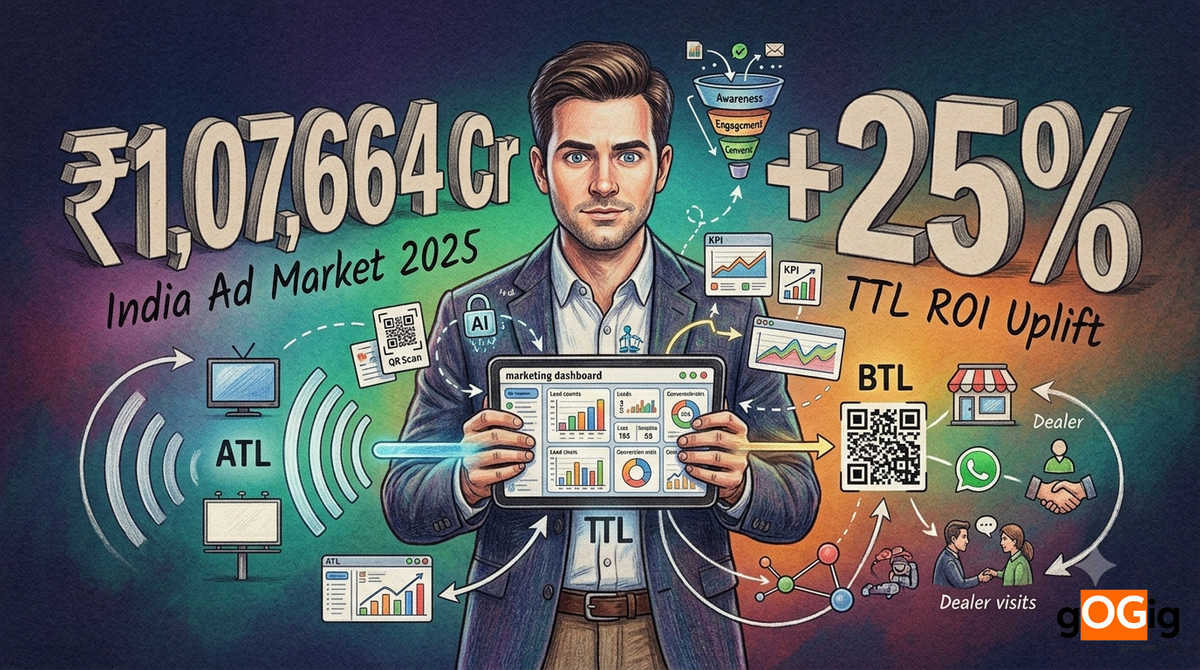
25%
Higher ROI for TTL (Through-the-Line) campaigns that integrate awareness, engagement, execution, and conversion compared to single-mode ATL or BTL campaigns in India. The TTL premium has nothing to do with channel mix. It comes from one capability: brands that can verify what actually happened on the ground and connect it to business outcomes outperform brands that cannot.
The marketing director of a national paint brand sits in a Monday morning planning meeting. Three slides discussed: a TV-IPL teaser for the new luxury range (ATL), 12,000 dealer-counter visit cycles with painter loyalty enrolment across 240 towns (BTL), and a connected campaign that ties them together with QR scans, WhatsApp leads, CRM nurture, and per-dealer attribution. The first two are classic categories. The third is the answer to "what is TTL in 2026". She does not have a budget problem. She has an accountability problem. The TV reach is measurable through BARC. The QR scans are measurable through MarTech. The 12,000 dealer counter visits are reported via WhatsApp photos and PPT closeouts, with no per-visit accountability. The gap between her ATL accountability and her BTL accountability is the gap she has to close before TTL works.
Above-the-line: Mass-reach untargeted advertising
Designed to build brand awareness at scale. Television, radio, print, large-format outdoor (highway hoardings, airports). High reach, low precision, measured via reach + frequency. India ATL spend: dominant share of FMCG, paint, cement, auto launch budgets. Examples: Cadbury "Kuch Khaas Hai" TVC, Asian Paints "Har Ghar Kuch Kehta Hai" film campaign, Bajaj Auto highway hoardings during festive season.
Below-the-line: Targeted on-ground, direct-engagement marketing
Designed to drive direct interaction and conversion. Retail branding, promoter activations, sampling, wall painting, auto-rickshaw branding, no-parking boards, dealer counter visits, contractor loyalty programs, mall activations, mobile vans, society events. High precision, lower reach, traditionally measured via event count and self-report. Examples: HUL sampling drives in society complexes, Birla Opus painter onboarding camps, Coca-Cola summer cooler placements.
Through-the-line: Integrated, omnichannel, customer-journey-led marketing
Designed to connect awareness, engagement, execution, and conversion into a single measurable system. ATL + BTL + digital + CRM + AI + execution verification. Each touchpoint feeds the next. Examples: Maruti Suzuki TV teaser → dealer test-drive roadshow → Instagram retargeting → CRM lead nurture → showroom visit → sale. Cadbury Celebrations: TV gifting emotion → retail merchandise → digital retargeting → e-commerce purchase.
| Dimension | BTL | TTL |
|---|---|---|
| Primary objective | Direct conversion, trial, engagement | End-to-end customer journey from awareness to purchase |
| Audience | Highly targeted, specific segment | Mass + targeted simultaneously |
| Channel mix | Activations, sampling, retail, on-ground | ATL + BTL + digital + CRM + AI verification |
| Reach | Local / hyperlocal | Mass scale + personalised |
| Measurement orientation | Per-event, per-outlet, per-promoter | Cross-channel attribution + per-customer journey |
| Typical campaign duration | 1-12 weeks | 3-12 months, with rolling waves |
| Verification challenge | Did the activation actually happen? | Did each touchpoint contribute to outcome? |
| Data systems | Excel + WhatsApp + PPT (legacy) | CRM + DSP + FEI + retail analytics + CDP |
| Vendor accountability | Activation agency, BTL contractor | Multi-vendor coordination across channels |
| India ROI characteristic | High when verified; low when self-reported | 25% higher than single-mode when stitched together |
| Operational complexity | Medium | High |
| Audit committee defensibility | Low (without verification) | Medium-High (with FEI underneath) |
| Activity | Goal |
|---|---|
| IPL TV spots | National brand recall during cricket season |
| YouTube pre-roll ads | Reach younger urban segment |
| Highway hoardings (top metros) | Visibility on commute routes |
| Print front-page jacket ads | Tier 1 + Tier 2 city awareness |
| Activity | Goal |
|---|---|
| Dealer counter branding | Recommendation visibility at point of sale |
| Contractor / painter loyalty enrolment | Influence the influencer at brand decision moment |
| Hardware retailer POSM rollout | Trade scheme adoption |
| Wall painting drives in tier 3 towns | Hyperlocal visibility |
| Society-level architects engagement | Premium segment conversion |
| Tinting machine deployment | Dealer infrastructure as marketing |
| Activity | Goal |
|---|---|
| QR code on paint cans | Trace + warranty registration |
| WhatsApp business automation | Lead capture from outdoor and retail |
| CRM nurture sequences | Painter / contractor segmentation |
| AI shade visualisation tools | Consumer-side decision aid |
| Per-dealer attribution dashboard | Closing the loop from spend to sale |
When all three layers are connected with measurement underneath, that is TTL in 2026.
Instagram Ad → consumer awareness → Consumer searches "best paint near me" → AI search result → Visits nearby retail outlet → Sees in-store branding and tinting demo (BTL touchpoint) → Asks painter / contractor for recommendation (influencer loyalty) → Scans QR code → brand WhatsApp engagement → Lead captured in CRM → nurture sequence → Purchase + warranty registration → retention loop begins
Maruti Suzuki · TV teaser → dealer roadshow → social retargeting → showroom test drive
National TVC builds curiosity. Dealer-level roadshows in 320+ cities deliver test drives. Instagram and YouTube retargeting nudge fence-sitters. CRM data closes the loop. ~25% higher ROI than TV-only campaigns.
Cadbury Celebrations · Festive TV emotion → retail merchandise → digital retargeting → e-commerce conversion
Emotional gifting TVC during Diwali / Rakhi. Simultaneous retail end-cap displays in 1.4 lakh outlets. Digital retargeting to add gifting context. E-commerce buy-button activates conversion. Sales spike of 18-32% over baseline season.
Birla Opus · Mass awareness → 45,000 tinting machines → 7.5 lakh painter onboarding → CRM
ATL builds brand recall in 24 months from launch. 45,000 tinting machines deployed across 6,600 towns. 7.5 lakh painters onboarded into loyalty CRM. QR codes on paint cans link consumer to brand. End-to-end TTL execution at infrastructure scale.
Asian Paints · Beautiful Homes ATL → SmartCare BTL retail focus → architect engagement → consumer app
Multi-decade ATL brand equity. Premium SmartCare waterproofing focus in trade. Architect and interior designer engagement programs. Consumer-side AI visualisation app. Combined journey ties end-consumer to specifier to dealer to brand.
Coca-Cola · "Share a Coke": Global TVC + billboard → personalised bottles in store → social shareability
National TV and billboards build campaign awareness (ATL). Personalised name-bottles in retail outlets become every point of sale a BTL touchpoint. Consumers post their personalised bottle on social media, creating earned-media TTL loop. Self-perpetuating engagement.
| Reason | What it means in practice |
|---|---|
| Channel fragmentation | Indian consumers spend across TV + YouTube + Instagram + WhatsApp + retail + outdoor; no single channel reaches all |
| Awareness without execution is wasted | Mass-reach campaigns underperform if dealer counter is empty or POSM missing |
| Execution without awareness has low conversion | Best-executed BTL underperforms if no consumer recognises the brand |
| First-party data takes over from third-party cookies | QR / WhatsApp / CRM become the connectors that stitch journeys |
| AI search is reshaping discovery | ChatGPT, Perplexity, Gemini, Google Local need both AI search and physical execution |
| BRSR Core ESG requirements | Listed brands must report end-to-end customer journey data; siloed channel reporting fails audit |
| Procurement consolidation | CFOs want one connected ROI number, not 4 channel-level numbers |
| Verification infrastructure is maturing | FEI platforms (gOGig and similar) make BTL measurable for the first time |
| Per-dealer attribution becomes possible | Sales lift can be measured at micro-market level when execution is verified |
| Higher ROI premium for stitched campaigns | 25% uplift over single-mode |
BTL 1.0 (pre-2024) — Activity-based, self-reported, low-accountability
Activations executed, photos sent via WhatsApp, Excel closeouts, PPT decks, invoice approval via supervisor judgement. Coverage % reported but VER unmeasured. Per-vendor scorecards manual. Per-outlet visibility absent. CFO defensibility weak. BRSR Core readiness manual.
BTL 2.0 (2026) — Verified, AI-scored, audit-grade
Geofenced execution. 100% AI-verified field submissions. Per-outlet scorecards. Per-vendor Tier A+ to D classification. Verified Execution Rate as headline KPI. Return on Verified Execution (RoVE) replacing self-reported ROAS. Proof-before-payment workflows. BRSR Core-ready evidence packs. Audit committee defensible.
Level 1. Channel silos
ATL and BTL run by different teams. Different agencies. Different KPIs. No connection between TV reach and dealer counter visits. Most common state in 2026.
Level 2. Coordinated campaign calendar
ATL, BTL, and digital aligned on campaign theme and timing. Creative is consistent. But measurement still siloed. Cross-channel ROI inferred, not measured.
Level 3. Connected data backbone
CRM + CDP + DSP + retail analytics + FEI platforms exchange data. Per-customer journey can be reconstructed across channels. Attribution model in place.
Level 4. Verified execution layer
BTL execution independently verified via FEI (gOGig). 100% AI accuracy on field submissions. Per-vendor accountability. Proof-before-payment in procurement. Per-dealer attribution to brand spend.
Level 5. AI-orchestrated TTL
AI predicts which BTL execution moves the consumer next based on TTL data. Real-time campaign optimisation across ATL, BTL, and digital. CFO sees one connected ROI number. BRSR Core audit-ready by default.
Move your BTL execution from reporting to verification
Free 30-Day Verification Challenge on one live BTL campaign. 9-layer mock-location detection, AI image verification, OTP-confirmed outlet visits, per-vendor scorecards, proof-before-payment workflows. Field force continues using WhatsApp. 100% verification accuracy. 100% fraud detection rate.
Request a TTL execution verification pilot →| India ad market indicator | Value |
|---|---|
| India ad market 2024 | ₹1,01,084 Cr (+6.3% YoY) |
| India ad market 2025 (forecast) | ₹1,07,664 Cr (+6.5%) |
| India ad market 2026 (forecast) | ~₹1,15,419 Cr (+7.2%) |
| Digital share 2026 | ~64-68% |
| TV share 2026 | ~25-28% |
| Print share 2026 | ~7-10% |
| OOH share 2026 | ~6-7% (₹8,000 Cr) |
| Estimated India BTL spend 2026 | ₹65,000-80,000 Cr (incl. trade marketing) |
| Tier 2/3 FMCG growth share 2025 | >40% of total growth |
| BTL execution leakage (unverified) | 14-32% |
| TTL ROI premium over single-mode | ~25% |
| What brands think | What is actually happening |
|---|---|
| "We are running TTL because we have ATL + BTL + digital" | The three are running in silos; data does not flow between them |
| "Our retail audit shows 96% coverage" | Coverage is reported. Verified Execution Rate is typically 14-26 pp lower. |
| "Our agency confirms BTL execution" | Confirmation is self-report. Independent verification absent. |
| "Our CRM has the customer data" | BTL touchpoints not captured in CRM; journey reconstruction broken at the dealer counter. |
| "Our attribution is in Google Analytics" | GA only sees digital; offline BTL not in the funnel. |
| "We invest more in ATL because BTL ROI is unclear" | BTL ROI is unclear because BTL is unverified; ATL ROI is just measured differently. |
| "Our TTL is integrated" | Without execution verification, "integrated" is a slide, not a system. |
| Question | Why it matters |
|---|---|
| Can we measure ATL reach + BTL execution + digital touchpoints on one dashboard? | Cross-channel attribution requires connected data |
| What is our Verified Execution Rate (VER) on BTL? | The headline accountability KPI |
| Can our agency prove every outlet activation actually happened? | Procurement defensibility |
| Can we link a TV viewer to a retail walk-in to a CRM lead to a sale? | True TTL journey reconstruction |
| What % of our BTL spend goes through proof-before-payment? | CFO accountability bar |
| Do we have per-dealer / per-outlet attribution to ATL brand lift? | Premium for verified execution at point of sale |
| Are we BRSR Core-ready for marketing spend disclosure? | Listed-company audit obligation FY 2025-26 → FY 2026-27 |
| Scenario | Best fit |
|---|---|
| New brand launch in India (national) | TTL with heavy ATL upfront, BTL at point of sale, digital for retargeting |
| Existing brand defending market share | TTL with stronger BTL (dealer engagement, painter/contractor loyalty) |
| Tier 2/3 hyperlocal expansion | BTL-led; wall painting, dealer counter visits, society activations |
| D2C / startup with limited budget | Digital BTL + retail BTL; minimal ATL until scale justifies |
| Premium / luxury segment | TTL with curated ATL (lifestyle publications), high-touch BTL (architects, designers) |
| Mass-market FMCG defending category | TTL with strong ATL (TV, IPL) + dense BTL (retail + trade) |
| B2B / enterprise | BTL-heavy (events, conferences, account-based marketing) + digital LinkedIn ATL |
| Regional brand expanding nationally | BTL-first (existing strength) + ATL layered on expansion markets |
| Crisis recovery / brand repair | BTL for trust rebuild + targeted ATL for reframing |
| Election or political campaign | BTL-dominant (wall painting, no-parking boards, rallies) + selective ATL |
| Sector | BTL % of marketing spend | TTL maturity |
|---|---|---|
| FMCG | 40-55% | Level 2-3 |
| Paint | 50-60% | Level 3-4 |
| Cement | 55-65% | Level 2-3 |
| Auto | 30-45% | Level 3-4 |
| BFSI | 35-50% | Level 2-3 |
| Pharma | 60-75% (MR field force) | Level 2 |
| QSR | 30-40% | Level 3 |
| Consumer durables | 35-45% | Level 2-3 |
| D2C / startup | 15-25% | Level 3-4 |
| E-commerce | 20-35% | Level 4-5 |
The biggest difference between BTL and TTL in 2026 is not media channels. It is measurement maturity. BTL is the execution layer. TTL is the customer-journey layer. And the brands that win in 2026 are not the ones that run prettier BTL or fancier TTL campaigns. They are the brands that can verify what actually happened on the ground and connect it to business outcomes.
gOGig's execution-verification layer turns every BTL format below into audit-grade, TTL-ready data that connects to CRM and brand attribution.
gOGig's verification layer is being adopted across these sectors as they move from self-reported BTL to AI-verified, TTL-ready execution.
Move your BTL execution from reporting to verification
Free 30-Day Verification Challenge on one live BTL campaign. 9-layer mock-location detection, AI image verification, OTP-confirmed outlet visits, per-vendor scorecards, proof-before-payment workflows. Field force continues using WhatsApp. 100% verification accuracy. 100% fraud detection rate.
100%
AI accuracy
100%
Detection rate
4-9x
Year-1 ROI
Written by
gOGig Editorial Team
The gOGig Editorial team publishes research, frameworks, and field intelligence drawn from gOGig Labs' dataset of 10,000+ verified field submissions across FMCG, OOH, BTL, pharma, and BFSI sectors.
Was this article helpful?
Your feedback helps us write better content.