Single-vendor vs multi-vendor BTL campaign management: 2026 decision framework
2 min read

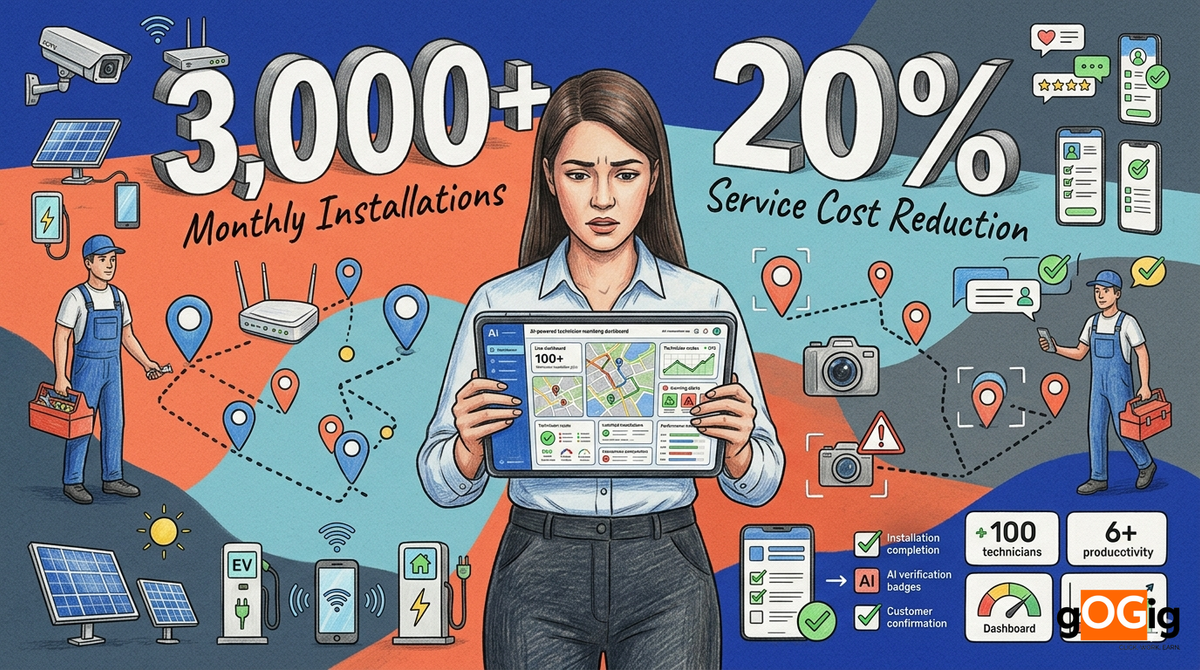
A practical 2026 buyer guide for telecom, broadband, solar, EV charger, CCTV, ATM, smart-home, BFSI, healthcare, and enterprise IT operations heads running 100+ technician installations daily across multiple cities. Built around what to require, how each FSM category solves a different problem, and the verification layer that sits underneath every modern field-service platform.
20%
Reduction in service costs delivered by leading FSM platforms in 2026 through AI-driven scheduling, offline mobile apps, and ERP/CRM integration. Teams also report 40% lower admin time and doubled technician productivity. But the bigger story sits below the productivity numbers: the platform that wins at 100+ daily installations is not the one with the most features. It is the one that can independently verify every installation actually happened.
A broadband ISP scales to 120 technicians across 8 Indian cities. 100+ daily installations across Whitefield, HSR, Andheri, Powai, Gurgaon, Indirapuram, Salt Lake, Banjara Hills. Friday evening review: weekly dashboard shows 92% Service Level Adherence. Customer satisfaction survey on Monday: 18% of customers say technician arrived late or not at all. 14% say wrong equipment installed. 9% report cash demands beyond invoice. The COO opens the FSM tool. Scheduling is flawless. Dispatch is optimised. Routes are mapped. But the gap between "job marked complete in FSM" and "customer experience" is the hidden 18-26% leakage. The platform is not failing. The verification model underneath it is. The right question for the next FY27 procurement RFP is not "which FSM platform should we use" but "which FSM platform + verification layer can independently prove every install actually happened?".
| Operational parameter | Reality at 100+ daily installs |
|---|---|
| Technicians deployed | 80-180 (3-4 jobs/tech/day) |
| Daily installations | 100-180 |
| Monthly installations | 3,000-5,400 |
| Cities covered | 3-22 |
| Photos per job | 4-10 |
| Monthly photo volume | 12,000-54,000 |
| Daily dispatch decisions | 100-180 |
| Daily route optimisations | 100-180 |
| Avg job duration | 30-180 min |
| Avg customer SLA window | 24-72 hours |
| Customer complaint volume | 15-32 per 100 installs |
| Supervisor capacity | 1 per 20-30 technicians |
| Manual photo audit feasibility | <5% of installs |
| Avg revenue per technician per day | ₹2,500-12,000 |
| Annual revenue dependent on scale | ₹15-80 Cr |
Enterprise FSM (IFS, Microsoft Dynamics 365 FS, Salesforce FS, SAP, Oracle FS) · Enterprise
Built for utilities, large telecom, manufacturing, healthcare-OEM operations at 500-10,000+ technician scale. Strong AI scheduling, predictive maintenance, ERP / CRM tight integration. 3-6 month implementation.
Pricing
Custom. Typically $100-200+/user/month
Implementation
$50,000-$500,000+
Best for
Large utilities, telecom (Airtel, Jio scale), industrial OEM
Verification layer
Limited; verification typically requires third-party add-on
Mid-market FSM (ServiceMax, ServiceTitan, ServiceFusion, Zoho FSM) · Mid-market
For mid-size operations at 50-500 technician scale. Strong scheduling, dispatch, mobile app, asset tracking. Mature in equipment-heavy industries (HVAC, elevator, medical devices).
Pricing
₹500-₹4,000/user/month (Zoho free tier; ServiceMax enterprise-custom)
Implementation
₹7,999 (Zoho) to ₹15-50 L (ServiceMax)
Best for
Manufacturing, telecom mid-tier, BFSI service, EdTech
Verification layer
Limited; supports geofencing, photo upload
SMB / startup FSM (Jobber, Housecall Pro, Connecteam, ReachOut) · SMB
For 5-50 technician operations. Simple scheduling, dispatch, invoicing, customer communication. Good entry-level platforms for emerging businesses.
Pricing
$30-100/user/month
Implementation
DIY / self-serve
Best for
Plumbers, electricians, small home-services, startup field teams
Verification layer
Basic; photo upload, GPS pin
India-built FSM (Zoho FSM, BlueOps, MYFO, Veraxis, Round Infinity) · India-built
Built for Indian market complexity: regional languages, Tally / Zoho Books integration, Indian labour law, GST, e-invoicing. Strong on Indian field-service workflow.
Pricing
₹1,000-3,500/user/month
Implementation
₹50,000-5,00,000
Best for
Indian broadband, solar, CCTV, EV chargers, retail fixtures
Verification layer
Photo + GPS standard; AI fraud detection in some
Industry-specific (FieldEdge for HVAC, ServiceMax for medical/industrial, ServicePower for OEM) · Vertical-specific
Purpose-built for one vertical's workflow. Strong domain features. Less flexible outside the vertical.
Pricing
$100-200/user/month
Implementation
3-6 months
Best for
HVAC, medical devices, elevators, OEM warranty service
Verification layer
Domain-specific compliance + photo + GPS
Verification-layer (Field Execution Intelligence) (gOGig) · FEI
Sits ON TOP of any FSM platform as the independent verification layer. Adds 9-layer mock-location detection, AI image verification, customer OTP, route reconstruction, per-technician scorecards. Does not replace FSM; augments it.
Pricing
₹15-30 per install (~₹3,000-6,000/tech/year)
Implementation
2-4 weeks (API integration with existing FSM)
Best for
100+ daily installs needing audit-grade verification
Verification layer
Core philosophy: 100% verification accuracy, 100% fraud detection
| Capability | Salesforce FS / ServiceMax | Zoho FSM | India FSM (BlueOps, MYFO) | + gOGig FEI layer |
|---|---|---|---|---|
| AI scheduling and dispatch | Strong | Strong | Moderate | Inherits FSM |
| Mobile offline mode | Yes | Yes | Yes | Yes (offline-first) |
| Live GPS tracking | Yes | Yes | Yes | Yes (with 9-layer auth) |
| Basic geofenced check-in | Yes | Yes | Yes | Yes (25-50m enforced) |
| Photo capture per job | Yes | Yes | Yes | Yes (live-capture only) |
| SHA-256 + perceptual hash | No | No | Limited | 100% (cross-job + cross-campaign) |
| Edit-signature detection | No | No | Limited | 100% |
| 9-layer mock-location detection | No | No | Limited | 100% |
| Technician face-match + Aadhaar | No | No | Limited | 100% |
| Equipment serial CV verification | No | No | Limited | 100% |
| Customer OTP confirmation gate | Limited | Limited | Limited | Mandatory |
| Customer digital signature | Yes | Yes | Yes | Yes |
| Customer selfie at high-value install | Limited | Limited | Limited | Optional/strong |
| Functional test capture (speed/voltage) | Limited | Limited | Limited | Strong |
| Route reconstruction + feasibility | Limited | Limited | Moderate | 100% |
| Cross-day pattern anomaly detection | No | No | Limited | 100% |
| Drive-by / phantom-install detection | No | No | Limited | 100% |
| Per-technician Tier A+ to D scorecard | Limited | Limited | Limited | Real-time |
| 3-way matching (PO + invoice + verified) | Limited | Limited | Limited | Native |
| Proof-Before-Payment workflow | Manual | Manual | Manual | Native |
| 7-year audit-grade retention | Yes | Yes | Yes | Yes (structured) |
| BRSR Core / IS 17017 / IoTSCS export | Manual | Manual | Manual | API-ready |
| What FSM solves well | What FSM does not solve |
|---|---|
| Scheduling 100+ jobs across 80-180 technicians | Whether the technician physically reached the customer |
| Dispatch optimization based on proximity | Whether the right technician (not a substitute) did the job |
| Route mapping | Whether GPS coordinates are real or spoofed |
| Mobile app for technician workflow | Whether the photo evidence is genuine or recycled |
| Customer communication and ETA updates | Whether the customer actually confirmed completion |
| Asset and inventory tracking | Whether the right equipment was actually installed |
| SLA and service contract management | Whether the work was completed to standard |
| Invoicing and payment integration | Whether invoices match verified delivery |
| Customer feedback collection | Whether feedback correlates with actual installation quality |
| Reports and dashboards | Whether the underlying data is independently verifiable |
Geofenced arrival verification
25-50 meter geofence around customer location. Job clock cannot start until technician physically inside. 9-layer mock-location detection runs in parallel.
Technician face-match + Aadhaar identity
Aadhaar-validated photo verified at job start. Catches substitute technician fraud. Critical at 100+ daily installs where outsourced technicians rotate.
Live-capture photo evidence
Gallery uploads disabled. Before + during + after photos captured live with server-side timestamp. SHA-256 + perceptual hash + edit-signature detection on every image.
Equipment serial CV verification
Computer vision matches installed equipment serial number to pre-locked SKU. Catches wrong-equipment install (cheaper router billed as premium).
Functional test capture
Speed test (broadband), voltage test (solar / EV), camera test (CCTV), commissioning test (ATM) captured live during install. Result locked to job record.
Customer OTP + digital signature gate
Job cannot be marked complete without customer OTP to registered mobile + customer signature on technician device. Eliminates "vendor said it was done" gap.
Route reconstruction and feasibility
Continuous GPS trail across the day. Travel-time feasibility benchmarked. Technicians claiming 12 jobs across multiple zones in 8 hours auto-flagged.
AI anomaly detection (cross-day, cross-technician patterns)
Network-wide AI catches patterns invisible to single-job review: speed-running, photo recycling, mock-location use, batch upload, identical job durations, cross-vendor asset re-use.
Add verification on top of your existing FSM platform
Free 30-Day Verification Challenge on one city of your operation. Geofenced arrival + 9-layer mock-location + live photo capture + customer OTP + technician face-match + route reconstruction + AI anomaly detection. Works on top of Zoho FSM, Salesforce FS, ServiceMax, BlueOps, MYFO, or any FSM. Field force continues using existing app. 100% verification accuracy. 100% fraud detection rate.
Request a verification layer pilot →Operations metrics — Daily throughput and pipeline
Jobs assigned vs completed vs pending · Average completion time per job type · First-time fix rate · SLA compliance (24/48/72 hour windows) · Backlog and reschedule rate
Verification metrics — Authenticity of installation
GPS-verified arrival rate · Customer OTP confirmation rate · Equipment serial match rate · Functional test pass rate · Photo authenticity rate (SHA-256 + perceptual hash) · Mock-location detection rate · Verified Execution Rate (VER) per technician
Risk metrics — Where fraud is concentrating
Route deviations and unexpected stops · Missed appointments + reschedule patterns · GPS / location anomalies · Suspicious photo submissions · Customer dispute rate per technician · Cross-vendor substitution detection · Cash-on-the-side fraud signals
Executive metrics — Business-level performance
City-level productivity and SLA performance · Technician efficiency (jobs/day vs verified) · First-time completion rate per zone · Revenue per technician per day · Net Promoter Score correlated to verified install quality · Cost per verified install vs cost per claimed install · Return on Verified Execution (RoVE) by region
| Vertical | Typical install type | Critical verification |
|---|---|---|
| Broadband (ACT, JioFiber, Airtel) | FTTH + ONT setup | Tech arrival + speed test + customer OTP |
| Solar (rooftop residential) | 1-10 kW + inverter | Panel serial CV + grid sync test + 30-day generation check |
| EV charger (AC + DC) | 3.3 kW to 30 kW | IS 17017 compliance + CMS commissioning + load test |
| CCTV (residential + enterprise) | 2-32 cameras + DVR/NVR | IoTSCS compliance + camera-by-camera test + cloud sync |
| ATM (BFSI) | ATM kiosk + cash logistics | RBI compliance + multi-stakeholder sign-off + currency-recycler test |
| Smart home / IoT | Hub + sensors + door locks | Device pairing + customer OTP + Wi-Fi network test |
| Air conditioner / appliance | Split AC + outdoor unit | Refrigerant test + remote-control test + customer demo |
| Set-top box / DTH | STB + mounting | Activation test + signal strength + customer OTP |
| Telecom 5G CPE / Wi-Fi 6 mesh | Indoor router + extenders | Speed test capture + coverage map + customer OTP |
| Enterprise hardware (laptops, printers, servers) | Asset tagging + onboarding | Asset serial + employee OTP + IT department confirmation |
| Healthcare devices (ECG, BP, oxygen concentrator) | Hospital / home use | Calibration test + healthcare professional sign-off |
| Retail fixtures (FMCG / brands) | Shelf-edge, branding, refrigerators | Per-outlet creative match + retailer OTP + planogram compliance |
| Live dashboard metric | Live value |
|---|---|
| Active technicians (today) | 118 of 120 |
| Jobs scheduled (today) | 432 |
| Jobs in progress | 146 |
| Jobs completed (reported) | 228 |
| Jobs verified (AI + customer OTP) | 211 |
| Jobs flagged for review | 17 |
| Customer OTP completion rate | 96.1% |
| Equipment serial match rate | 98.4% |
| Functional test pass rate | 93.8% |
| Mock-location flags | 2 technicians |
| Photo duplicate flags | 5 jobs |
| Route feasibility flags | 3 technicians |
| Avg job duration (zone-weighted) | 62 min |
| Verified Execution Rate (VER) | 92.5% |
| SLA compliance (24-hour window) | 96.8% |
| First-time fix rate | 87% |
| Per-technician Tier A+ count | 78 of 120 |
| Per-technician Tier C-D count | 4 of 120 (intervention) |
| Cost dimension | Annual impact at 100 daily installs (₹2,000 avg job value) |
|---|---|
| False completion claims | ₹14-26 L |
| Substitute technician quality issues | ₹3-9 L |
| Wrong-equipment install | ₹4-12 L |
| Cash-on-the-side customer dissatisfaction | ₹3-9 L |
| Customer dispute resolution overhead | ₹6-14 L |
| Customer churn from bad installs | ₹22-48 L (3-year LTV impact) |
| NPS impact + reputational damage | Difficult to quantify directly |
| Skipped functional tests creating re-work | ₹4-10 L |
| Manual reconciliation labour | ₹2-6 L |
| Total annual leakage at 100 daily installs | ₹58 L - 1.34 Cr |
| Daily installation volume | Verification cost (gOGig annual) | Avg leakage prevented | Net ROI |
|---|---|---|---|
| 30 installs/day | ₹8-15 L | ₹35-65 L | 4-8x |
| 60 installs/day | ₹14-26 L | ₹65-1.2 Cr | 5-9x |
| 100 installs/day | ₹22-40 L | ₹1-2 Cr | 5-10x |
| 200 installs/day | ₹40-70 L | ₹2-4 Cr | 5-12x |
| 500 installs/day | ₹95-1.6 Cr | ₹5-12 Cr | 5-14x |
| 1,000+ installs/day | ₹1.8-3 Cr | ₹12-24 Cr | 6-14x |
| Dimension | FSM-only (Zoho / Salesforce / ServiceMax / similar) | FSM + gOGig verification layer |
|---|---|---|
| Scheduling and dispatch | Strong | Inherited (no change) |
| Mobile app for technician | Native | Inherited (no change) |
| Basic GPS check-in | Yes | Enhanced with 9-layer authenticity |
| Coverage of installs verified | 5-15% (audit sample) | 100% |
| Phantom install detection | ~12% | 100% (geofence + customer OTP) |
| Drive-by completion detection | ~6% | 100% (duration + indoor GPS) |
| Photo recycling detection | 4-8% | 100% (SHA-256 + perceptual hash) |
| Substitute technician detection | ~0% | 100% (face-match CNN) |
| Mock-location detection | ~0% | 100% (9-layer) |
| Wrong-equipment detection | ~10% | 100% (serial-match CV) |
| Customer OTP enforcement | Variable | Mandatory gate |
| Time per job verified | 3-8 min manual | ~3 seconds AI |
| Customer dispute resolution time | 5-14 days | 1-2 days |
| Per-technician scorecard refresh | Monthly | Real-time |
| BRSR Core / IS 17017 / IoTSCS audit-ready | Manual exercise | API-ready, on-demand |
| Year-1 ROI | 20% cost saving (admin) | 5-14x on verification spend |
The best platform to monitor 100+ technician installations daily in 2026 is not a single product. It is a combination: a strong FSM for scheduling, dispatch, and workflow plus a verification layer for proof-of-execution. The two solve different problems. The brands that win are the ones that stop treating "platform" as one purchase and start treating it as a stack.
| Operation size | Recommended FSM | Verification layer |
|---|---|---|
| 10-30 daily installs | Zoho FSM, Jobber, Housecall Pro | Optional; manual sampling feasible |
| 30-80 daily installs | Zoho FSM, BlueOps, MYFO, ServiceFusion | Recommended; ROI typically 4-7x |
| 80-200 daily installs | Zoho FSM, MYFO, ServiceMax, Salesforce FS | Mandatory; ROI typically 5-12x |
| 200-500 daily installs | Salesforce FS, ServiceMax, Microsoft Dynamics 365 FS | Mandatory; ROI typically 6-14x |
| 500+ daily installs (enterprise) | IFS, SAP, Oracle FS, Microsoft Dynamics 365 FS | Mandatory; CFO-defensibility critical |
| Industry-specific (medical / HVAC / OEM) | ServiceMax, ServicePower, FieldEdge | Mandatory; compliance and warranty audit |
| Multi-country operations | IFS, Salesforce FS, Microsoft Dynamics 365 FS | Mandatory; cross-geography variance tracking |
AI scheduling and dispatch reducing service costs by 15-20%
Mobile app with genuine offline mode (not just "limited offline")
Live GPS tracking with 9-layer mock-location detection
Geofenced job verification at 25-50m enforcement
Live-capture photo only (gallery uploads disabled)
Technician face-match + Aadhaar identity at job start
Equipment serial CV verification
Functional test capture (speed, voltage, connectivity)
Customer OTP confirmation required to mark complete
Customer digital signature on tech device
Customer selfie for high-value installs
Route reconstruction + travel-time feasibility
SHA-256 + perceptual hash on every image
Per-technician Tier A+ to D scorecard refreshed real-time
Customer post-install satisfaction survey auto-triggered T+24 hrs
Proof-before-payment workflow for technician payout
7-year audit-grade retention + IS 17017 / IoTSCS / BRSR Core export
Verified by gOGig certification or equivalent independent verification standard
gOGig's verification layer works on top of any FSM platform across every high-volume technician-installation vertical.
gOGig's FSM-agnostic verification layer is deployed across India's metros and tier-1/tier-2 cities for high-volume technician-installation operations.
Add verification on top of your existing FSM platform
Free 30-Day Verification Challenge on one city of your operation. Geofenced arrival + 9-layer mock-location + live photo capture + customer OTP + technician face-match + route reconstruction + AI anomaly detection. Works on top of Zoho FSM, Salesforce FS, ServiceMax, BlueOps, MYFO, or any FSM. Field force continues using existing app. 100% verification accuracy. 100% fraud detection rate.
100%
AI accuracy
100%
Detection rate
5-14x
Year-1 ROI
Written by
gOGig Editorial Team
The gOGig Editorial team publishes research, frameworks, and field intelligence drawn from gOGig Labs' dataset of 10,000+ verified field submissions across FMCG, OOH, BTL, pharma, security, telecom, and BFSI sectors.
Was this article helpful?
Your feedback helps us write better content.