Single-vendor vs multi-vendor BTL campaign management: 2026 decision framework
2 min read

The complete operational walkthrough. Every layer, every data field, every check that happens in those 3 seconds. Built for brand managers and operations heads ready to understand exactly what they're buying.
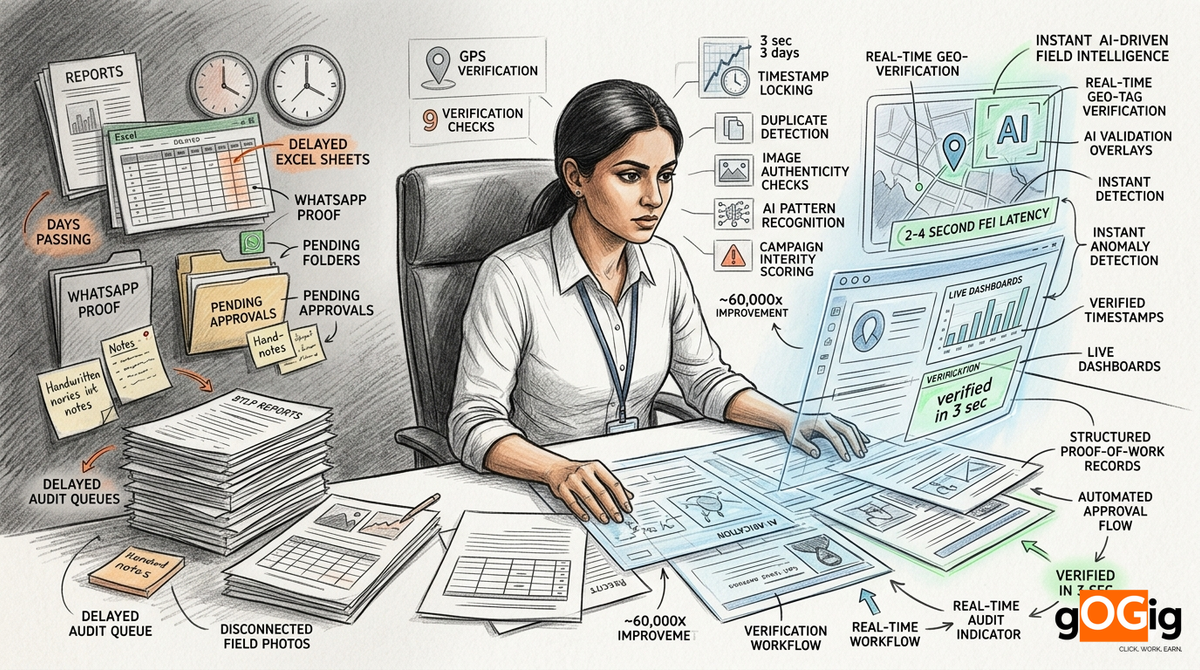
3 sec vs 3 days
Time from field submission to verified ground-truth record. The latency collapse that defines BTL accountability in 2026.
A brand manager at a top FMCG company opens her phone at 11:43 AM. She sees that 2,847 retail visibility audits were completed across 18 cities in the last 4 hours. 314 anomalies flagged. 18 awaiting her review. Three years ago, she would have received a PDF deck at 7 PM on Friday summarising last week's campaigns. This is what changed.
| Stage | Owner | Time taken |
|---|---|---|
| Field worker captures photo | Vendor / promoter | 0–30 minutes |
| Photo sent on WhatsApp group | Vendor | Few minutes (delayed) |
| Photo manually sorted by agency PM | Agency | 4–12 hours |
| Photos compiled into PDF / Excel | Agency | 1–2 days |
| Report shared with brand | Agency | 1 day |
| Brand reviews and queries | Brand Manager | 2–5 days |
| Resolution and final approval | Brand + Agency | 3–15 days |
| Total cycle | -- | 3–21 days |
| Lost capability | Cost impact |
|---|---|
| Mid-campaign course correction | Re-execution costs 30–60% of original spend |
| Real-time anomaly detection | Fraud passes through undetected |
| Forensic metadata (GPS, EXIF) | Verification impossible after the fact |
| Pattern recognition at scale | Each campaign treated as isolated event |
| Vendor performance baseline | No comparable data across vendors |
| Procurement 3-way matching | Cannot enforce Proof Before Payment |
| Phase | What happens | Time (ms) |
|---|---|---|
| 0–300 ms | WhatsApp message arrives at platform server | 300 |
| 300–500 ms | Image extracted, metadata parsed | 200 |
| 500–900 ms | GPS, EXIF, timestamp validated against contract | 400 |
| 900–1500 ms | Mock-location detection + accelerometer cross-check | 600 |
| 1500–2100 ms | Image hash + duplicate detection across dataset | 600 |
| 2100–2600 ms | AI image classification (brand asset, scene type) | 500 |
| 2600–2900 ms | Geo-fence + clustering check against campaign scope | 300 |
| 2900–3000 ms | Submission scored, anomaly flags posted to dashboard | 100 |
| Total | From upload to verified record | ~3 seconds |
| Parallel process | Output |
|---|---|
| EXIF parsing | Capture timestamp, GPS, device ID |
| Server timestamping | Upload time, immutable record |
| Mock-location flag check | True / false |
| Image hash computation | SHA-256 fingerprint |
| Cross-campaign duplicate search | Match against existing dataset |
| AI brand element detection | Logo, planogram, product placement scores |
| Accelerometer reading check | Device motion at capture |
| Geo-fence validation | Inside or outside contracted zone |
| Clustering anomaly detection | Suspicious co-location with other submissions |
Book a 20-minute demo
See the 3-second verification on one of your live campaigns. We'll walk you through each layer, show you the dashboard your team will use, and answer technical questions in plain language.
Book a 20-minute demo →| Field | Source | Required |
|---|---|---|
| Photo / video | Device camera | Yes |
| GPS coordinates | Device GPS hardware | Yes |
| Capture timestamp | Device clock | Yes |
| EXIF metadata | Camera firmware | Yes |
| Device identifier | Device fingerprint | Yes |
| Accelerometer reading | Device motion sensor | Yes |
| User / vendor identity | WhatsApp number or app login | Yes |
| Campaign / PO reference | Pre-tagged in workflow | Yes |
| Outlet / site identifier | Pre-tagged or selected at capture | Yes |
| Activity type | Pre-defined dropdown | Yes |
| Free-text notes | Field worker input | Optional |
| Voice note | Field worker recording | Optional |
| Check | Pass criteria | What failure indicates |
|---|---|---|
| GPS-EXIF coordinate match | Difference < 50 meters | Photo not taken where claimed |
| Server timestamp validity | Capture < 24 hours before upload | Pre-dated or recycled submission |
| Mock-location flag | Flag = false | Mock-location app active on device |
| Geo-fence inclusion | Coordinates within contracted zone | Site visit fabricated or skipped |
| EXIF integrity | Metadata block intact and unmodified | Image manipulation or sharing via WhatsApp standard mode |
| Accelerometer cross-check | Motion consistent with claimed activity | Static device claiming travel, or vice versa |
| Device identifier match | Device registered to authorised vendor | Submission from unauthorised device |
| Campaign window check | Capture within campaign start-end | Late submission or fabricated |
| Model | What it checks | Output |
|---|---|---|
| Image hash fingerprinting | Same image submitted multiple times across campaigns | Match / no-match against dataset |
| Image quality scoring | Blur, dark, glare, framing | Quality score 0–100 |
| Brand asset detection | Logo, packaging, planogram elements present | Confidence score per asset |
| Scene classification | Retail, outdoor, indoor, mall, society, road | Scene label + confidence |
| Object counting | Promoters present, packs displayed, hoarding count | Numeric count |
| Planogram compliance | Facings, share-of-shelf, OOS detection | Compliance % score |
| OCR (text extraction) | Pricing, batch codes, retailer board names | Extracted text |
| Face detection (counting only) | Promoter / customer presence | Count + no PII storage |
| Anomaly classifier | Composite score across all model outputs | Risk score 0–100 |
| Dashboard element | Real-time data shown |
|---|---|
| Live activity map | Submissions plotted on India map with anomaly flags |
| Campaign progress meter | % executed vs contracted, live |
| Verified execution rate | % of submissions passing all 9 checks |
| Anomaly inbox | Flagged submissions for review |
| Vendor leaderboard | Verified execution rate per vendor |
| City performance | Anomaly rate per city, ranked |
| Format performance | Anomaly rate per medium |
| Variance report | Contract milestones vs verified execution |
| Audit trail viewer | Per-submission verification record |
| Export center | Procurement-ready reports for 3-way matching |
| Layer | Function | Latency | Technology |
|---|---|---|---|
| Capture | Submission via WhatsApp / app | 0–300 ms | WhatsApp Business API, native apps |
| Validation | GPS, EXIF, timestamp, geo-fence checks | 300–1500 ms | Server-side validation engine |
| AI Verification | 9 AI models analyse content | 1500–2900 ms | Cloud-edge hybrid inference |
| Dashboard | Real-time view + alerts | 2900–3000 ms | Web dashboard + mobile views |
| Storage | Audit-grade evidence retention | Continuous | Encrypted cloud storage, 7-year retention |
| Integration | Procurement, ERP, ESG systems | Configurable | API + webhooks |
| Operational moment | Legacy time | FEI time | Improvement |
|---|---|---|---|
| Submission to upload | 30 min–12 hrs | 0–5 minutes | ~10–150x |
| Upload to validation | 1–2 days (manual review) | 1–2 seconds | ~80,000–170,000x |
| Validation to anomaly detection | Often never | Sub-second | Newly possible |
| Anomaly to brand visibility | 3–7 days | Real-time | ~300,000x |
| Brand visibility to vendor notification | 5–15 days | Same day or sooner | ~150x |
| Resolution to payment release | 30–90 days | 3–7 days | 10–30x |
| Full cycle | 3–21 days | 2–4 seconds | ~60,000x |
| Anomaly type | Auto-action | Human action |
|---|---|---|
| GPS-EXIF mismatch | Flag in dashboard, hold from verified count | Brand reviews, decides accept / reject |
| Mock-location detected | Submission rejected automatically | Vendor escalation triggered |
| Image hash duplicate | Submission rejected automatically | Pattern review across vendor history |
| Timestamp pre-dated | Submission rejected automatically | Vendor notified, evidence requested |
| Geo-fence violation | Flag for review, hold from verified count | Brand reviews context |
| Image quality below threshold | Vendor asked to re-submit | If re-submission fails, brand reviews |
| Brand element absent | Flag for review | Brand reviews, sets corrective action |
| Quantity mismatch | Flag for review | Brand reviews, may trigger audit |
| Clustering anomaly | Flag for review, surface to investigation queue | Brand reviews potential systematic fraud |
| Verified rate range | Auto-trigger | Outcome |
|---|---|---|
| >=95% | Payment release approved | Full invoice processed |
| 90–94% | Variance window opened (15 business days) | Vendor submits additional evidence |
| 85–89% | Hold + investigation required | Brand + procurement review jointly |
| 80–84% | Pro-rata payment + vendor improvement plan | Quarterly performance review triggered |
| <80% | Payment held pending escalation | Vendor classification reviewed (Clause 7 risk) |
| Metric on the control tower | Refresh rate | What it shows |
|---|---|---|
| Live submissions counter | Real-time | Submissions arriving across all campaigns |
| Active campaigns | Real-time | Number of running campaigns + status |
| Anomaly inbox | Real-time | Flagged submissions awaiting review |
| City-level activity heatmap | Hourly | Where execution is happening across India |
| Verified execution rate by campaign | Real-time | Campaign-level scorecard |
| Verified execution rate by vendor | Real-time | Vendor leaderboard |
| Verified execution rate by medium | Real-time | Format-level performance |
| Variance window open list | Real-time | Disputes in 15-day window |
| Procurement-ready exports | On-demand | 3-way matching reports for AP |
| Audit-grade trail viewer | On-demand | Per-submission forensic record |
| Alert type | Channel | Latency from event |
|---|---|---|
| Anomaly flagged on submission | Dashboard + email | 3–5 seconds |
| Vendor execution rate <90% | Email to brand manager | End of day |
| Variance window expiry approaching | Email to procurement | 3 days before expiry |
| Campaign milestone reached | Dashboard + mobile push | Real-time |
| Mock-location detected | Email to brand + agency | Real-time |
| Cross-campaign duplicate detected | Investigation queue | Within minutes |
| Vendor consistently failing | Quarterly summary | Quarterly |
| BRSR-required audit evidence ready | Internal audit email | Monthly |
9:12:34 AM: Field worker takes photo
Promoter at mall activation in Pune captures photo of setup. Camera writes GPS, timestamp, EXIF, device info to file.
9:13:08 AM: Photo uploaded via WhatsApp
Field worker shares photo to the gOGig-monitored WhatsApp number. WhatsApp Business API delivers to platform in 200 ms.
9:13:08 AM: Capture layer ingestion
Image extracted, metadata parsed, vendor ID matched, campaign / PO ID looked up. 300 ms.
9:13:08 AM: Validation checks fire
GPS within geofence (yes), EXIF matches GPS within 30m (yes), timestamp = capture time (yes), mock-location flag = false (yes), device authorised (yes). All checks pass.
9:13:09 AM: AI verification runs
Image hash = unique. Brand logo detected (confidence 94%). Scene = mall interior. Promoter count = 3. Planogram compliance = 87%. Anomaly score = 12 (low risk).
9:13:11 AM: Dashboard updates
Submission appears in brand manager's live activity feed. Campaign progress meter moves from 47% to 48%. Audit trail record created.
9:13:11 AM: Verified record archived
Submission stored in encrypted vault with 7-year retention. Available for BRSR Core assurance, internal audit, procurement 3-way matching.
9:13:12 AM: Brand manager sees update on phone
Real-time push notification (optional). Brand manager continues with her morning. The work has already been verified.
| Integrity check | Source signal | Detection accuracy |
|---|---|---|
| Authentic device | Device fingerprint + vendor mapping | 99%+ |
| Authentic time | Server-side timestamp at upload | 100% |
| Authentic location | GPS + EXIF + accelerometer | 92–96% |
| Authentic image | EXIF integrity + hash uniqueness | 95–98% |
| Authentic activity | AI scene + object classification | 92–96% |
| Authentic vendor | Submission via authorised WhatsApp / app | 99%+ |
| Authentic campaign | PO / SOW reference match | 99%+ |
| Authentic geo-scope | Geo-fence inclusion check | 98%+ |
| System type | Integration method | Typical use case |
|---|---|---|
| SAP Ariba | API (PO + invoice + verified report) | 3-way matching for AP |
| Coupa | API + invoice gating | Procurement approval workflow |
| Oracle Procurement Cloud | REST API | Vendor verification at PO stage |
| SAP S/4HANA | Native 3-way match extension | End-to-end procurement |
| Microsoft Dynamics 365 F&O | Power Platform connectors | Invoice gating |
| Salesforce | API for vendor performance data | CRM + execution scorecards |
| Zoho Books / Tally | Webhook-based reconciliation | Small enterprise AP |
| BRSR reporting platforms | API for assurance evidence | Value chain disclosure |
| Internal audit tools (TeamMate, MetricStream) | API + dashboard embed | Audit trail review |
| Slack / Teams / Email | Native integration | Alerts & notifications |
| Format | What gets verified | Anomaly types caught |
|---|---|---|
| OOH hoardings & pole boards | Geo-locked install photo + dimensions + brand logo | Recycled photos, wrong site, dimension mismatch |
| Wall painting | Pre / mid / post photos + geo | Coverage inflation, recycled proofs |
| Mobile van & roadshow | Route GPS trail + activity photos | Route deviation, location skipping |
| Bus & cab branding | Vehicle ID + weekly geo-tagged photo | Vehicle swap, zone substitution |
| Shop name boards | Before / after geo-tagged photos | Photo recycling, fake installs |
| Visual merchandising | Outlet photo + planogram compliance score | Skipped outlets, compliance inflation |
| Sampling drives | Stock movement + outlet check-ins | Stock diversion, duplicate proofs |
| Promoter activations | Geo-fenced check-in + selfie + activity photos | Fake attendance, duration manipulation |
| Field sales visits | Geo-tagged check-in + retailer signature | GPS spoofing, route deviation |
| Lead generation | Promoter activity + OTP-verified leads | Lead fabrication, recycled lead lists |
| RWA / society activation | Society entry + activity photos | Skipped societies, duplicate submissions |
| Technician verification | Geo-tagged install + customer signature | Location fraud, time inflation |
| Franchise audit | Outlet check + compliance checklist | Skipped audits, fabricated scores |
| Security patrol | NFC tag scans + geo + photos | Skipped rounds, time manipulation |
| Stage | Duration | Outcome |
|---|---|---|
| Day 0: Kick-off + scope alignment | 1 day | Use cases defined, formats selected |
| Days 1–3: Platform setup + vendor onboarding | 3 days | Vendors briefed, WhatsApp number live |
| Days 4–7: Pilot campaign launch | 4 days | First verified submissions flowing |
| Days 8–14: Pilot mid-review | 1 week | Mid-pilot verified execution rate measured |
| Days 15–21: Pilot completion + lessons | 1 week | Full pilot report shared |
| Days 22–30: Scale-up to additional formats | 1 week | Additional campaigns under PBP |
| Day 30: First full month live | -- | First monthly board report |
| Outcome | Baseline (pre-FEI) | After 30 days |
|---|---|---|
| Time to verify a submission | 3–7 days | 3 seconds |
| Anomalies detected per campaign | Near zero | 15–25% of submissions |
| Brand manager hours on reconciliation | 10–20 hours / week | 2–4 hours / week |
| Payment cycle to vendor | 30–60 days | 10–15 days |
| Dispute resolution time | 4–8 weeks | 3–5 days |
| Verified execution rate visibility | Unknown | Per campaign, per vendor, per city |
| Audit-grade evidence coverage | None | 100% of new submissions |
| Time | Activity | Tool used |
|---|---|---|
| 9:30 AM | Opens dashboard on phone | gOGig mobile dashboard |
| 9:31 AM | Sees 2,847 submissions from overnight + early morning campaigns | Live activity feed |
| 9:32 AM | Sees 314 flagged for anomaly | Anomaly inbox |
| 9:33 AM | Reviews top 18 highest-severity flags | Anomaly drill-down |
| 9:40 AM | Approves 12, escalates 4, rejects 2 | One-tap decision interface |
| 9:42 AM | Checks city heatmap to spot patterns | City performance map |
| 9:44 AM | Notices Patna campaign anomaly rate spiking - investigates | City + campaign filter |
| 9:50 AM | Messages agency partner about Patna pattern | WhatsApp + dashboard link |
| 9:55 AM | Closes app. Total time: 25 minutes for what used to take 3 hours of WhatsApp scrolling. | -- |
Batch processing (legacy)
Data flows on a delayed cadence. Brand managers see summaries at week-end or month-end. Errors compound while invisible. Course correction limited to post-campaign analysis. Manual reconciliation absorbs 30–50% of operations time.
Real-time processing (FEI)
Data flows continuously. Brand managers see issues as they arise. Errors surface within seconds. Mid-campaign correction routine. Manual reconciliation reduced to 5–10% of operations time. Investigation time replaces data collection time.
| Security parameter | Standard applied |
|---|---|
| Data residency | India-hosted, compliant with DPDP Act 2023 |
| Encryption at rest | AES-256 |
| Encryption in transit | TLS 1.3 |
| Access control | Role-based (RBAC) + multi-factor authentication |
| Audit logs | Tamper-proof, full chain of custody |
| SOC 2 / ISO 27001 | Compliance roadmap underway |
| Data retention | 7 years (BRSR Core aligned) |
| Right to deletion | DPDP-compliant subject access rights |
| Vendor data isolation | Multi-tenant with logical separation |
| Disaster recovery | Multi-region backup, RPO < 1 hour |
| Monthly submission volume | Per-submission cost | Equivalent annual cost |
|---|---|---|
| < 5,000 / month | ₹12–18 | ₹7–11 lakh |
| 5,000–25,000 / month | ₹8–12 | ₹10–36 lakh |
| 25,000–100,000 / month | ₹5–8 | ₹18–96 lakh |
| 100,000–500,000 / month | ₹3–5 | ₹36 lakh–3 Cr |
| 500,000+ / month | ₹2–4 | ₹1.2–4.8+ Cr |
The 3-second verification cycle is not a feature. It is the architectural decision that makes every other operational gain possible: mid-campaign correction, real-time procurement integration, BRSR Core assurance, and the cultural reset that follows.
Book a 20-minute demo
See the 3-second verification on one of your live campaigns. We'll walk you through each layer, show you the dashboard your team will use, and answer technical questions in plain language.
3–7 days
Legacy verification cycle
3 seconds
FEI verification cycle
~60,000x
Improvement
Written by
Platform & Technology Team
The gOGig Editorial team publishes original research, platform explainers, and operational guides on field execution intelligence, BTL technology, and campaign verification for India's physical economy.
Was this article helpful?
Your feedback helps us write better content.