Single-vendor vs multi-vendor BTL campaign management: 2026 decision framework
2 min read

A practical 2026 framework for OOH heads, election campaign managers, real estate launch marketers, FMCG brand teams, and BTL agency operations leads who need to know not just whether the installation happened, but whether every single board in a 1,000+ overnight deployment can be independently verified before invoice approval.
8.3 hrs
Time a brand team would need to manually photo-review 1,000 boards at 30 seconds each. And even after 8.3 hours, the brand still cannot confirm whether the board remained installed, whether the location was correct, whether the photo was authentic, or whether the board existed after the installer left. Manual review at this scale is structurally broken.
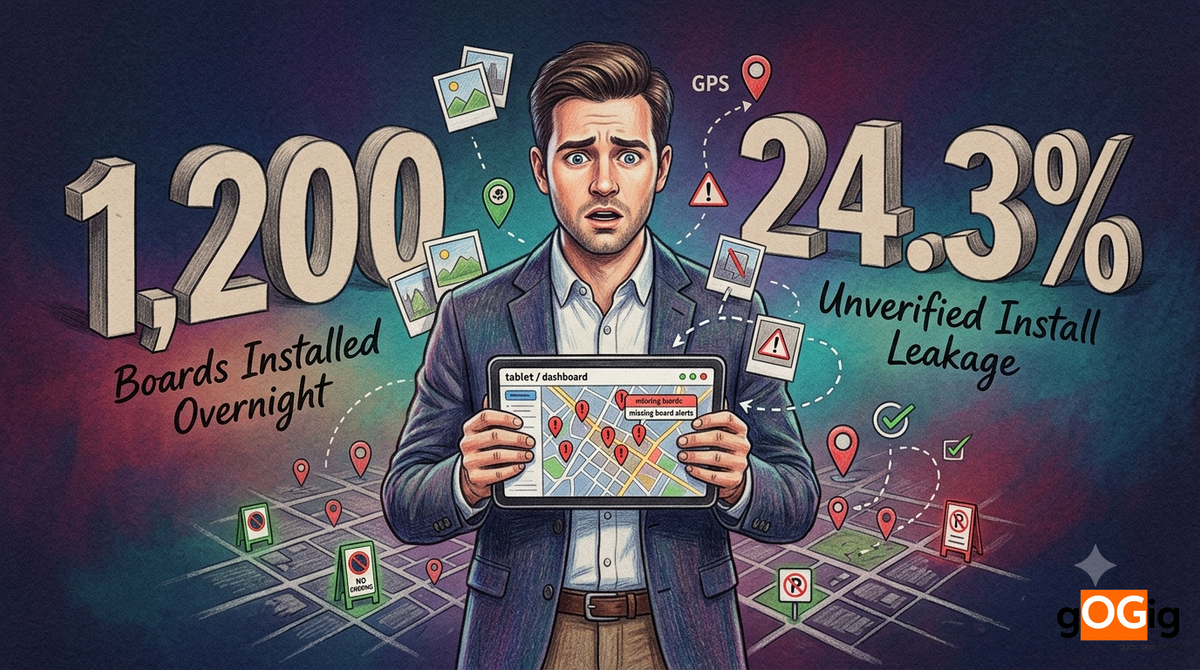
A real estate developer in Bangalore launches a new tower at 9 PM Friday. By 6 AM Saturday, 1,200 no-parking boards must be installed across 14 micro-markets in HSR Layout, Sarjapur Road, Whitefield, Marathahalli, and the Outer Ring Road belt. 22 installation teams. 38 supervisors. ₹6.2 L invoice committed. Saturday morning, a WhatsApp group fills with 1,400 photos, geo-tags, and PPT closeout slides. The developer's marketing head opens the dashboard. Coverage shown: 100%. Reality on Sunday's drive-by audit: 187 boards missing, 64 boards installed at wrong addresses, 41 boards already removed by societies. Verified installations: 908 out of 1,200. The leakage is 24.3%, which means ₹1.5 L of the invoice rests on activity that cannot be substantiated. Without a structured per-board tracking system, every 1,000-board overnight campaign hides a similar reality.
| Campaign attribute | Typical overnight scale |
|---|---|
| Boards per campaign | 500 to 2,500 |
| Installation window | 6-10 hours (typically 9 PM to 6 AM) |
| Installation teams in parallel | 15-40 |
| Supervisors | 4-12 |
| Geographic spread | 6-22 micro-markets |
| Average boards per team | 30-80 |
| Time pressure | Must complete before sunrise/peak traffic |
| Mobility | Each team covers 4-12 km in the night |
| Visibility window | Boards often visible for 3-14 days only |
| Removal risk | Society watchmen / RWAs remove within 24-72 hours |
| Vendor coordination calls | 200-600 per night |
| Post-install verification window | Saturday morning (4-6 hours) |
| Problem | Operational impact |
|---|---|
| 1,000 photos arrive overnight in one group | No human can review at this pace |
| Multiple teams upload simultaneously | Chat history scrolls past faster than reviewable |
| EXIF/GPS stripped on WhatsApp standard | ~89% of submissions lose location metadata |
| Photo recycling between teams | Cannot be detected manually |
| Same board photographed from multiple angles | Inflates apparent coverage |
| Upload time ≠ install time | Cannot distinguish install completion from photo upload |
| No per-board unique ID linking | 1,400 photos but no way to know which board is which |
| No coverage map in real time | Cannot spot missed clusters before 6 AM deadline |
| No post-install retention check | Cannot verify board still exists 24 hrs later |
| No audit-grade retention | Chat archives lost or unstructured |
Pre-mapped locations and unique board IDs
Every target location gets a unique ID. Every board becomes a trackable asset. Before installation begins, the full asset master is locked. Each target location receives a permanent identifier. GPS coordinates are pre-mapped. Installation route is assigned. Expected creative variant is recorded. Vendor team is assigned per cluster. Sample asset IDs: NP-001, NP-002, NP-003 … NP-1000
Geofenced installation proof capture
Installation teams cannot upload proof unless they are physically within the assigned coordinate geofence. A 25-50 meter geofence is set around every pre-mapped location. Proof capture must happen at the geofence. Mock-location detection runs in parallel. Live-capture validation ensures the photo is taken at the moment of installation, not pre-recorded. This eliminates remote uploads, wrong-location installations, and fake completion reports automatically.
AI image verification at the moment of upload
Instead of supervisors reviewing 1,000 images manually, AI performs the first audit automatically. Every uploaded image is analysed at the moment of submission for duplicate photos, perceptual near-matches, reused board angles, wrong creative variant, poor visibility, incorrect placement height, image tampering, and edit signatures. Verification time per submission compresses from minutes to ~3 seconds.
Live dashboard with per-board status
The moment installation occurs, the dashboard updates. Brand teams monitor progress in real time instead of waiting for a PPT.
Campaign
RE_LAUNCH_TOWER_X
Planned Boards
1,200
Installed
1,036
Pending
164
Verified (AI + GPS)
991
Flagged for review
45
Coverage %
86.3%
Verified Execution Rate
82.6%
Time remaining
02h 14m
Random audit sampling and 48-hour retention check
Even with AI verification, 5-10% independent audits and re-verification at 24-48 hours catch downstream removals. For a 1,000-board campaign, 50-100 random locations are surprise-audited within 48 hours. This catches boards that were installed correctly but removed by RWAs, watchmen, or competing brands. Installation teams know any location may be checked, creating behavioural accountability.
| Per-board data field | Value |
|---|---|
| Board ID | NP-XXXX (unique per location) |
| Assigned cluster / micro-market | Pre-mapped |
| Target GPS coordinates | Pre-mapped |
| Assigned team and supervisor | Pre-locked |
| Pre-install baseline image | Optional but recommended |
| Installation timestamp (server-side) | Live |
| Installation GPS (validated) | Live + mock-location check |
| Live-capture install image | 3-5 photos per board |
| Creative-match score | AI-verified |
| Mounting height check | ~4-5 ft eye-level requirement |
| Surrounding context check | Wall vs gate vs pole |
| Anomaly flags | 0 / 1 / 2+ |
| OTP confirmation (where applicable) | Optional society/RWA confirmation |
| 48-hour retention check | Audit team flyby |
| Final verified status | VERIFIED / FLAGGED / MISSING / REMOVED |
| Leakage scenario | Missing boards | Hidden invoice value (₹5 L total) |
|---|---|---|
| 2% leakage | 20 boards | ₹10,000 |
| 5% leakage | 50 boards | ₹25,000 |
| 8% leakage | 80 boards | ₹40,000 |
| 14% leakage | 140 boards | ₹70,000 |
| 22% leakage | 220 boards | ₹1,10,000 |
| 26% leakage | 260 boards | ₹1,30,000 |
| Verification approach | Time per board | Total time for 1,000 boards |
|---|---|---|
| Manual photo review (one supervisor) | 30 seconds | 8.3 hours |
| Manual review with quality check | 60-90 seconds | 16.7-25 hours |
| Manual + spreadsheet logging | 2-3 minutes | 33-50 hours |
| Parallel team review (4 supervisors) | 30 seconds per board | 2.1 hours (still after sunrise) |
| gOGig AI verification | ~3 seconds | ~50 minutes (parallel, before installation completes) |
| gOGig AI + per-board scorecard live | Real-time as upload happens | 0 (no batch verification needed) |
Get every board independently verified before the invoice arrives
Free 14-day Field Execution Intelligence pilot for OOH agencies and brand teams running overnight no-parking board, hoarding installation, wall-painting, or POSM rollout campaigns. Pre-mapped asset master, geofenced live capture, AI image verification, per-board scorecard, real-time dashboard, 48-hour retention audit. 100% verification accuracy. 100% fraud detection rate.
Request a no-parking board verification pilot →Red flag 1. Photos arrive in batches at the end of the night rather than streaming through the installation window. Indicates batch shooting at one or two locations.
Red flag 2. Multiple boards show identical background framing. Indicates a single board photographed multiple times or stock-photo re-use.
Red flag 3. Coverage reaches 100% within the first 4 hours of a 9-hour install window. Statistically improbable.
Red flag 4. Teams report covering 80+ boards in 6 hours. Above realistic install pace of 10-14 boards per team per hour.
Red flag 5. All photos missing EXIF/GPS metadata. Indicates WhatsApp standard upload, not verified capture.
Red flag 6. Vendor refuses pre-mapped GPS targets. Wants flexibility to "install wherever space available."
Red flag 7. Vendor objects to 48-hour retention audit. Suggests awareness that boards may be removed quickly.
Red flag 8. Pre-install baseline images are refused. Removes ability to confirm before/after change.
Red flag 9. Vendor reports zero "society removal" or "RWA pushback" incidents. Operationally implausible in residential micro-markets.
Red flag 10. Invoice arrives within 12 hours of completion. Indicates pre-prepared, not closing on verified data.
| Time | Activity | System state |
|---|---|---|
| T-7 days | Campaign brief + cluster definition | Asset master created |
| T-5 days | Pre-mapping of 1,000 GPS coordinates | NP-001 to NP-1000 locked |
| T-3 days | Team assignment + route optimisation | Per-team workload locked |
| T-1 day | Creative variant locked per cluster | AI creative-match training |
| T-0 (8 PM) | Pre-install baseline capture begins | Baseline images recorded |
| 9 PM | Installation begins, all teams | Geofenced capture live |
| 10 PM-2 AM | Peak installation hours | AI verification running 100% submissions |
| 2 AM-5 AM | Completion phase | Coverage dashboard real-time |
| 5 AM-6 AM | Final installations + missing-location alerts | Brand team intervenes on gaps |
| 6 AM | Installation window closes | VER reported to brand team |
| +24 hrs | Random audit team flyby (50-100 boards) | Retention check live |
| +48 hrs | Final per-board scorecard locked | Invoice 3-way matching enabled |
| +72 hrs | Payment approval (PBP) | BRSR Core-grade audit pack ready |
| Use case | Typical scale | Verification stakes |
|---|---|---|
| Real estate tower launch | 800-2,500 boards | ₹3-12 L; brand pressure on launch weekend |
| Election campaign (candidate-level) | 1,500-5,000 boards | ECI compliance; expenditure ceiling reporting |
| FMCG product launch (city-level) | 500-1,200 boards | ₹2-6 L; SOV vs competitors |
| BFSI branch launch / NFO | 400-1,000 boards | ₹1.5-4 L; RBI Digital KYC parallel |
| EdTech enrolment campaign | 1,000-3,000 boards | ₹4-10 L; pre-admission cycle |
| Healthcare clinic chain | 500-1,500 boards | ₹2-5 L; clinic catchment marketing |
| Local services / hyperlocal | 300-800 boards | ₹1-3 L; neighbourhood penetration |
| Society/RWA-targeted campaign | 200-600 boards | ₹0.7-2 L; gated community penetration |
| Festival / event campaign | 1,500-3,500 boards | ₹5-12 L; time-bound visibility |
| Automotive dealer launch | 600-1,200 boards | ₹2-5 L; test drive footfall |
| Campaign scale | Verification cost (gOGig) | Avg leakage prevented | Net ROI |
|---|---|---|---|
| 500 boards | ₹6,000-12,000 | ₹35,000-65,000 | 4-8x |
| 1,000 boards | ₹12,000-24,000 | ₹70,000-1,30,000 | 5-9x |
| 2,000 boards | ₹24,000-48,000 | ₹1,40,000-2,60,000 | 5-10x |
| 5,000 boards | ₹60,000-1,20,000 | ₹3,50,000-6,50,000 | 5-11x |
| 10,000 boards (election) | ₹1,20,000-2,40,000 | ₹7,00,000-13,00,000 | 5-11x |
Board-level GPS verification for every NP-XXXX entry
Geofenced proof capture at 25-50 meter radius per board
Server-side timestamp validation on every install
AI image analysis with SHA-256 + perceptual hash duplicate detection
Live dashboard visibility through installation window
Pre-install baseline image for every campaign asset
48-hour retention audit on random 5-10% of boards
Audit trail for every installation with 7-year retention
Per-board scorecard with VERIFIED / FLAGGED / MISSING / REMOVED status
Proof-before-payment workflow for invoice 3-way matching
Verified Execution Rate (VER) as a contractual KPI
Verified by gOGig certification or equivalent independent verification standard
| Dimension | Manual review | gOGig AI pipeline |
|---|---|---|
| Coverage of submissions audited | 5-15% sampling | 100% |
| Time to verify all boards | 8.3 hours minimum | ~50 minutes parallel |
| Fraud detection rate | 6-22% | 100% |
| Per-board unique ID linking | Manual spreadsheet | Automatic |
| GPS authenticity check | None | 9-layer mock-location detection |
| Duplicate detection | 4-8% | 100% (SHA-256 + perceptual hash) |
| Creative-match verification | Subjective | AI verified (100% accuracy) |
| Coverage % visible during install | Lagging by 1-3 days | Real-time during install window |
| 48-hour retention check | Manual flyby | Audit team + AI cross-check |
| Audit-grade retention | Manual collation | 7-year structured retention |
| BRSR Core readiness | Manual exercise | API-ready, on-demand |
| Year-1 ROI | Baseline | 5-11x |
A 1,000-board overnight install is not an advertising campaign. It is a distributed field operation with 30+ moving teams and 1,000 independent assets, each of which is alive or dead within hours of installation. The only honest answer to "did this happen" is per-board verification, not 1,000 photos.
gOGig's per-asset verification model works across all distributed BTL and OOH installation formats, not just no-parking boards.
gOGig's geofenced installation proof and AI verification pipeline is live across all major Indian metros and Tier-2 cities.
Get every board independently verified before the invoice arrives
Free 14-day Field Execution Intelligence pilot for OOH agencies and brand teams running overnight no-parking board, hoarding installation, wall-painting, or POSM rollout campaigns. Pre-mapped asset master, geofenced live capture, AI image verification, per-board scorecard, real-time dashboard, 48-hour retention audit. 100% verification accuracy. 100% fraud detection rate.
100%
AI accuracy
100%
Detection rate
5-11x
Year-1 ROI
Written by
gOGig Editorial Team
The gOGig Editorial team publishes research, frameworks, and field intelligence drawn from gOGig Labs' dataset of 10,000+ verified field submissions across FMCG, OOH, BTL, pharma, and BFSI sectors.
Was this article helpful?
Your feedback helps us write better content.