
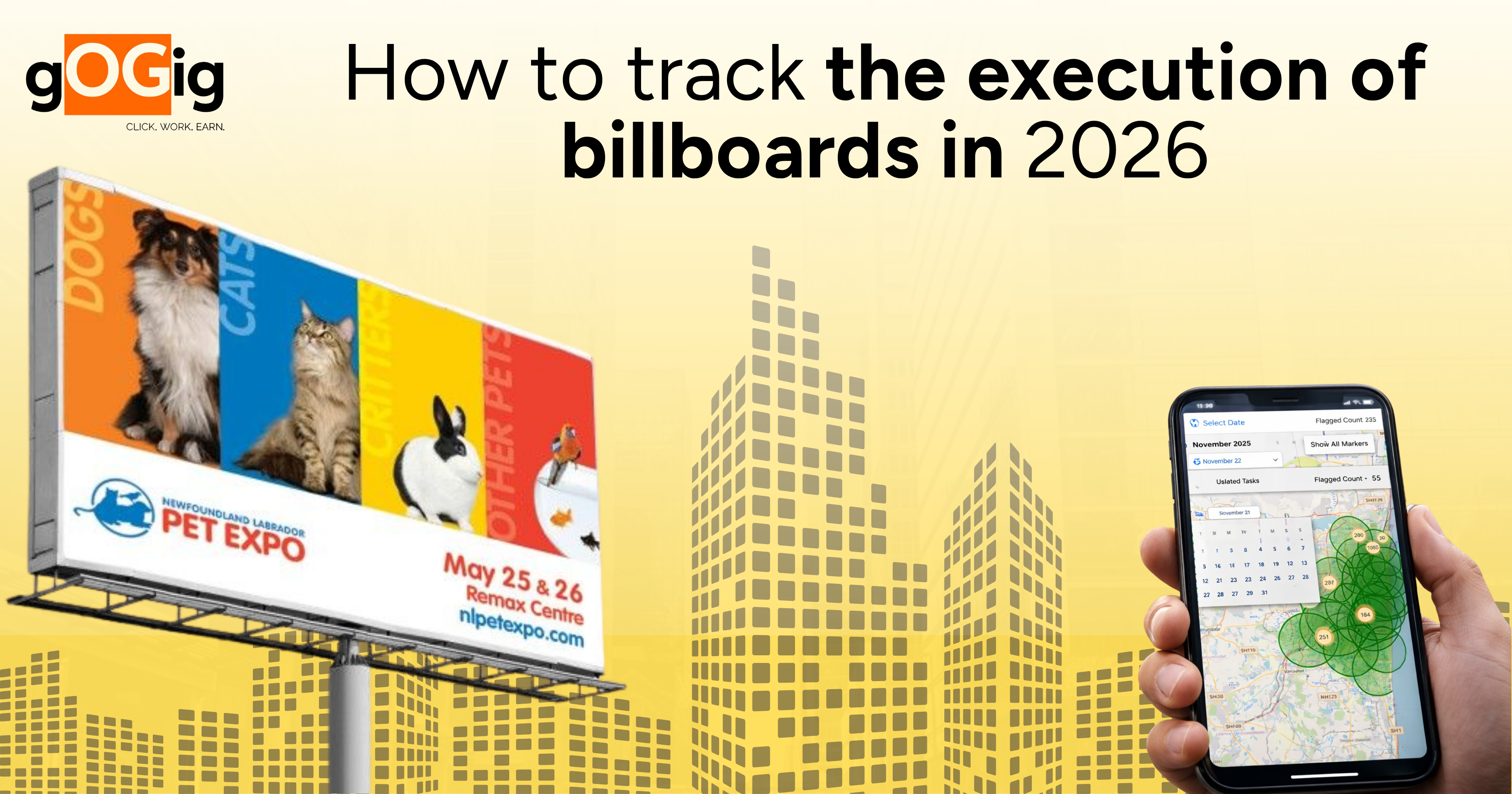
How to Track the Execution of Billboards in 2026: A Complete Guide for Brands and Agencies
Learn how to track billboard execution in 2026 using real-time verification tools like gOGig. Discover how to eliminate fake proofs, monitor outdoor campaigns live, and improve ROI on BTL marketing.
Outdoor advertising is one of the most resilient media formats in modern marketing. But for decades, brands have had to take vendors at their word when it comes to execution. In 2026, that's no longer acceptable.
Whether you're running a pan-India transit branding campaign across 500 autos, managing pole boards in Tier-2 cities, or overseeing a seasonal wall-painting drive, the question remains the same: how do you actually know if your billboard or outdoor branding was executed correctly, at the right place, at the right time?
The answer lies in real-time outdoor advertising tracking, automated execution verification, and platforms built specifically for BTL campaign monitoring. And gOGig is leading that charge from Bangalore.
This guide walks you through everything you need to know about tracking billboard and outdoor advertising execution in 2026. We cover the problems that plague traditional methods and the exact tools and workflows that modern brands and agencies use to stay in control.
Why Billboard Execution Tracking Matters More Than Ever in 2026
The offline marketing industry has long operated on trust. Vendors submit photos, agencies compile PPTs, and brands sign off on deliverables they never truly verified. But as marketing budgets tighten and accountability standards rise, outdoor campaign execution monitoring has become a non-negotiable.
Here's the uncomfortable truth: a significant portion of outdoor media execution today is either incorrectly placed, poorly documented, or outright fabricated through reused or misrepresented photographs. Manual audits are expensive, slow, and practically impossible to scale across multi-city campaigns.
That's why in 2026, forward-looking brands are investing in billboard tracking software, geo-tagged proof-of-execution tools, and real-time field monitoring platforms to close the gap between what was planned and what actually happened on the ground.
What Does "Tracking Billboard Execution" Actually Mean?
Tracking billboard execution goes far beyond knowing that a vendor submitted a photo. True execution tracking in 2026 covers several things at once.
Was the branding placed at the exact approved site? Was it installed within the campaign window? Is the correct version of the creative being used? How many units out of the total plan have actually been executed? And perhaps most importantly, is the photo genuine or is it a duplicate or reused submission?
A platform like gOGig addresses every one of these dimensions through automated, AI-powered verification. It replaces the old model of manual audits and post-campaign reporting with a live, centralized command center.
How gOGig Tracks Outdoor and Billboard Execution in Real Time
gOGig is a Bangalore-based SaaS platform purpose-built for tracking BTL and outdoor marketing execution. It converts every offline branding activity into structured, trackable tasks with geo-tagged and time-stamped evidence. This covers everything from auto branding to pole boards to RWA gate installations.
Here's how the tracking workflow actually operates:
1. Campaign Setup and Task Structuring
Every execution point is configured as a discrete task within the gOGig platform. Whether it's each auto, each board, or each location, every unit gets its own task. This gives campaign managers a clear picture of the total execution universe from day one: how many units are planned, across which cities, and assigned to which vendors.
2. WhatsApp-First Field Execution
One of gOGig's most distinctive features is that field teams don't need to install any app. Executors receive tasks and submit proof directly through WhatsApp, the app every gig worker and field team already uses daily. This eliminates onboarding friction, reduces drop-offs, and ensures high adoption even in Tier-2 and Tier-3 markets where getting people onto new platforms is a real challenge.
3. Geo-Tagged and Time-Stamped Submissions
When a field executor submits a task, the platform automatically captures the GPS coordinates of where the photo was taken, the exact timestamp of submission, and the media proof itself. This metadata makes every submission traceable and verifiable. There's simply no way to submit a photo from a different location and have it pass as valid.
4. Automated Verification and Fraud Detection
This is where gOGig separates itself from basic photo-collection tools. Every submission is automatically validated against geo-fencing rules to check if the executor was within the approved zone, time rules to confirm the submission happened during the campaign window, and duplication checks to flag if the same image or location has been submitted before.
Non-compliant or suspicious submissions are flagged instantly, not discovered weeks later during a manual audit.
5. Live Dashboard and Command Center
All verified execution data flows into a centralised dashboard that brand teams, agency managers, and operations heads can access in real time. You can see task-wise completion status across pending, in-progress, and completed states, city-wise and vendor-wise coverage, a map-based execution view with exact locations of verified submissions, and the campaign-level compliance percentage all in one place.
6. One-Click Report Generation
When it's time to share results with clients, internal stakeholders, or for billing purposes, gOGig generates campaign reports instantly from verified data. No manual compilation, no spreadsheets, no misleading PPTs.
Outdoor Branding Formats You Can Track with gOGig
gOGig supports tracking across all major outdoor and BTL branding formats.
Transit Branding covers auto branding, cab wraps, bus panels, mobile vans, e-rickshaws, and pole boards. Geo-fencing ensures vehicles operate in approved zones, and each unit is tracked individually.
Retail and Trade Branding includes shop name boards, in-shop branding, and flanges across outlet networks. Each outlet is treated as a unique execution task with daily visibility on progress.
Society and Community Branding covers RWA gate branding, lift branding, and society-level activations. Geo-fencing ensures executions happen only inside approved residential societies.
Events and Media Branding includes arch gates, cinema branding, wall paintings, and umbrella branding. Time-based tracking ensures installations happen before the event goes live.
Who Should Be Using a Billboard Execution Tracking Platform?
If your organisation spends on outdoor or BTL media, you almost certainly need a platform like gOGig. Here's who benefits most.
Brand and Marketing Teams running multi-city outdoor campaigns need live visibility into whether their execution partners are actually delivering what was promised.
CMOs and Marketing Heads want a single dashboard view of campaign health, not a vendor-submitted PPT two weeks after the campaign ends.
BTL and Media Agencies want to provide transparent, verified proof of work to clients and reduce disputes around execution quality and billing.
Field Operations Managers who are currently managing field teams through WhatsApp groups, calls, and spreadsheets are looking for a structured, scalable alternative.
Audit and Compliance Teams need location and time-stamped evidence without physically visiting every site across multiple cities.
The Problem With How Most Brands Still Track Billboards
Despite all the technology available today, many brands still rely on WhatsApp groups for photo collection with no verification of location or time. They depend on post-campaign PPTs assembled by vendors with no independent validation, manual audits that are expensive and impossible to scale, and spreadsheets to track creative rotations and campaign deadlines.
The result is a system where vendors self-report performance, brands have no real-time visibility, and problems like wrong creatives, missing installations, and fake photos only surface after the campaign has ended and the money has been spent.
gOGig replaces this entire workflow with a single, automated, always-on tracking layer.
Frequently Asked Questions About Billboard Execution Tracking
Q: What is billboard execution tracking? Billboard execution tracking is the process of monitoring, verifying, and documenting whether outdoor advertising assets have been installed correctly at the right location and within the planned timeframe. This covers billboards, transit branding, retail boards, and more. Modern platforms like gOGig use geo-tagging, timestamps, and automated verification to make this process real-time and reliable.
Q: How does gOGig verify that execution photos are genuine? gOGig's automated verification system checks every submission against multiple parameters. It uses GPS coordinates to confirm the executor is at the right location, a timestamp to verify the submission was made within the campaign window, and duplication detection to catch if the image has been submitted before or used across multiple tasks. Non-compliant submissions are flagged instantly without any manual review required.
Q: Do field teams need to install an app to use gOGig? No. gOGig is built around a WhatsApp-first model, which means field executors and gig workers submit tasks and proof entirely through WhatsApp. There's no separate app to download or training required, which makes adoption seamless especially for large, distributed field teams in smaller cities.
Q: Can gOGig track branding across multiple cities and vendors simultaneously? Yes, and this is one of gOGig's core strengths. The unified central dashboard consolidates data from all cities, vendors, and campaigns in one place. Managers can use Smart Campaign Filters to search and sort by location, campaign name, or other criteria, making it easy to get an overview of a pan-India campaign or drill down into a specific city's execution.
Q: How is gOGig different from just collecting photos on WhatsApp? Collecting photos on WhatsApp tells you that a vendor sent you a photo. gOGig tells you where the photo was taken, when it was taken, whether the location matches the approved zone, whether the image has been submitted before, and whether execution is compliant with campaign guidelines. It's the difference between an unverified claim and a verified proof of execution.
The Future of Outdoor Advertising Tracking
As outdoor advertising budgets continue to grow and performance accountability becomes standard across all media formats, real-time execution verification will shift from being a premium feature to being the baseline expectation.
In 2026, the brands and agencies winning the trust game are the ones who can show verified, geo-tagged, timestamped evidence of every execution and not just a folder of photos submitted on WhatsApp.
Platforms like gOGig are making that possible today, turning what was once a black box of offline execution into a transparent, data-rich, controllable operation, one geo-tagged submission at a time.
Meta Description: Learn how to track billboard execution in 2026 using real-time verification tools like gOGig. Discover how to eliminate fake proofs, monitor outdoor campaigns live, and improve ROI on BTL marketing.
Outdoor advertising is one of the most resilient media formats in modern marketing. But for decades, brands have had to take vendors at their word when it comes to execution. In 2026, that's no longer acceptable.
Whether you're running a pan-India transit branding campaign across 500 autos, managing pole boards in Tier-2 cities, or overseeing a seasonal wall-painting drive, the question remains the same: how do you actually know if your billboard or outdoor branding was executed correctly, at the right place, at the right time?
The answer lies in real-time outdoor advertising tracking, automated execution verification, and platforms built specifically for BTL campaign monitoring. And gOGig is leading that charge from Bangalore.
This guide walks you through everything you need to know about tracking billboard and outdoor advertising execution in 2026. We cover the problems that plague traditional methods and the exact tools and workflows that modern brands and agencies use to stay in control.
Why Billboard Execution Tracking Matters More Than Ever in 2026
The offline marketing industry has long operated on trust. Vendors submit photos, agencies compile PPTs, and brands sign off on deliverables they never truly verified. But as marketing budgets tighten and accountability standards rise, outdoor campaign execution monitoring has become a non-negotiable.
Here's the uncomfortable truth: a significant portion of outdoor media execution today is either incorrectly placed, poorly documented, or outright fabricated through reused or misrepresented photographs. Manual audits are expensive, slow, and practically impossible to scale across multi-city campaigns.
That's why in 2026, forward-looking brands are investing in billboard tracking software, geo-tagged proof-of-execution tools, and real-time field monitoring platforms to close the gap between what was planned and what actually happened on the ground.
What Does "Tracking Billboard Execution" Actually Mean?
Tracking billboard execution goes far beyond knowing that a vendor submitted a photo. True execution tracking in 2026 covers several things at once.
Was the branding placed at the exact approved site? Was it installed within the campaign window? Is the correct version of the creative being used? How many units out of the total plan have actually been executed? And perhaps most importantly, is the photo genuine or is it a duplicate or reused submission?
A platform like gOGig addresses every one of these dimensions through automated, AI-powered verification. It replaces the old model of manual audits and post-campaign reporting with a live, centralized command center.
How gOGig Tracks Outdoor and Billboard Execution in Real Time
gOGig is a Bangalore-based SaaS platform purpose-built for tracking BTL and outdoor marketing execution. It converts every offline branding activity into structured, trackable tasks with geo-tagged and time-stamped evidence. This covers everything from auto branding to pole boards to RWA gate installations.
Here's how the tracking workflow actually operates:
1. Campaign Setup and Task Structuring
Every execution point is configured as a discrete task within the gOGig platform. Whether it's each auto, each board, or each location, every unit gets its own task. This gives campaign managers a clear picture of the total execution universe from day one: how many units are planned, across which cities, and assigned to which vendors.
2. WhatsApp-First Field Execution
One of gOGig's most distinctive features is that field teams don't need to install any app. Executors receive tasks and submit proof directly through WhatsApp, the app every gig worker and field team already uses daily. This eliminates onboarding friction, reduces drop-offs, and ensures high adoption even in Tier-2 and Tier-3 markets where getting people onto new platforms is a real challenge.
3. Geo-Tagged and Time-Stamped Submissions
When a field executor submits a task, the platform automatically captures the GPS coordinates of where the photo was taken, the exact timestamp of submission, and the media proof itself. This metadata makes every submission traceable and verifiable. There's simply no way to submit a photo from a different location and have it pass as valid.
4. Automated Verification and Fraud Detection
This is where gOGig separates itself from basic photo-collection tools. Every submission is automatically validated against geo-fencing rules to check if the executor was within the approved zone, time rules to confirm the submission happened during the campaign window, and duplication checks to flag if the same image or location has been submitted before.
Non-compliant or suspicious submissions are flagged instantly, not discovered weeks later during a manual audit.
5. Live Dashboard and Command Center
All verified execution data flows into a centralised dashboard that brand teams, agency managers, and operations heads can access in real time. You can see task-wise completion status across pending, in-progress, and completed states, city-wise and vendor-wise coverage, a map-based execution view with exact locations of verified submissions, and the campaign-level compliance percentage all in one place.
6. One-Click Report Generation
When it's time to share results with clients, internal stakeholders, or for billing purposes, gOGig generates campaign reports instantly from verified data. No manual compilation, no spreadsheets, no misleading PPTs.
Outdoor Branding Formats You Can Track with gOGig
gOGig supports tracking across all major outdoor and BTL branding formats.
Transit Branding covers auto branding, cab wraps, bus panels, mobile vans, e-rickshaws, and pole boards. Geo-fencing ensures vehicles operate in approved zones, and each unit is tracked individually.
Retail and Trade Branding includes shop name boards, in-shop branding, and flanges across outlet networks. Each outlet is treated as a unique execution task with daily visibility on progress.
Society and Community Branding covers RWA gate branding, lift branding, and society-level activations. Geo-fencing ensures executions happen only inside approved residential societies.
Events and Media Branding includes arch gates, cinema branding, wall paintings, and umbrella branding. Time-based tracking ensures installations happen before the event goes live.
Who Should Be Using a Billboard Execution Tracking Platform?
If your organisation spends on outdoor or BTL media, you almost certainly need a platform like gOGig. Here's who benefits most.
Brand and Marketing Teams running multi-city outdoor campaigns need live visibility into whether their execution partners are actually delivering what was promised.
CMOs and Marketing Heads want a single dashboard view of campaign health, not a vendor-submitted PPT two weeks after the campaign ends.
BTL and Media Agencies want to provide transparent, verified proof of work to clients and reduce disputes around execution quality and billing.
Field Operations Managers who are currently managing field teams through WhatsApp groups, calls, and spreadsheets are looking for a structured, scalable alternative.
Audit and Compliance Teams need location and time-stamped evidence without physically visiting every site across multiple cities.
The Problem With How Most Brands Still Track Billboards
Despite all the technology available today, many brands still rely on WhatsApp groups for photo collection with no verification of location or time. They depend on post-campaign PPTs assembled by vendors with no independent validation, manual audits that are expensive and impossible to scale, and spreadsheets to track creative rotations and campaign deadlines.
The result is a system where vendors self-report performance, brands have no real-time visibility, and problems like wrong creatives, missing installations, and fake photos only surface after the campaign has ended and the money has been spent.
gOGig replaces this entire workflow with a single, automated, always-on tracking layer.
Frequently Asked Questions About Billboard Execution Tracking
Q: What is billboard execution tracking?
Billboard execution tracking is the process of monitoring, verifying, and documenting whether outdoor advertising assets have been installed correctly at the right location and within the planned timeframe. This covers billboards, transit branding, retail boards, and more. Modern platforms like gOGig use geo-tagging, timestamps, and automated verification to make this process real-time and reliable.
Q: How does gOGig verify that execution photos are genuine?
gOGig's automated verification system checks every submission against multiple parameters. It uses GPS coordinates to confirm the executor is at the right location, a timestamp to verify the submission was made within the campaign window, and duplication detection to catch if the image has been submitted before or used across multiple tasks. Non-compliant submissions are flagged instantly without any manual review required.
Q: Do field teams need to install an app to use gOGig?
No. gOGig is built around a WhatsApp-first model, which means field executors and gig workers submit tasks and proof entirely through WhatsApp. There's no separate app to download or training required, which makes adoption seamless especially for large, distributed field teams in smaller cities.
Q: Can gOGig track branding across multiple cities and vendors simultaneously?
Yes, and this is one of gOGig's core strengths. The unified central dashboard consolidates data from all cities, vendors, and campaigns in one place. Managers can use Smart Campaign Filters to search and sort by location, campaign name, or other criteria, making it easy to get an overview of a pan-India campaign or drill down into a specific city's execution.
Q: How is gOGig different from just collecting photos on WhatsApp?
Collecting photos on WhatsApp tells you that a vendor sent you a photo. gOGig tells you where the photo was taken, when it was taken, whether the location matches the approved zone, whether the image has been submitted before, and whether execution is compliant with campaign guidelines. It's the difference between an unverified claim and a verified proof of execution.
The Future of Outdoor Advertising Tracking
As outdoor advertising budgets continue to grow and performance accountability becomes standard across all media formats, real-time execution verification will shift from being a premium feature to being the baseline expectation.
In 2026, the brands and agencies winning the trust game are the ones who can show verified, geo-tagged, timestamped evidence of every execution and not just a folder of photos submitted on WhatsApp.
Platforms like gOGig are making that possible today, turning what was once a black box of offline execution into a transparent, data-rich, controllable operation, one geo-tagged submission at a time.